
Close Menu

    Subscribe to Updates

    Get the latest creative news from FooBar about art, design and business.

    What's Hot

    Recognizing Early Expression in Multilingual Young Children

    April 20, 2026

    How Breaking Words Changed the Way My Students Approach Language

    April 20, 2026

    Designing for Depth: When High Achievement Isn’t the Whole Story 

    April 19, 2026
    Facebook X (Twitter) Instagram
    My Blog
    • Home
    • Freelancer
    • Employment
    • Retirement
    • Career
    • Job Interview
    • Work From Home
    Facebook X (Twitter) Instagram
    My Blog
    Home»Uncategorized»What Is Bloom’s Revised Taxonomy?
    Uncategorized

    What Is Bloom’s Revised Taxonomy?

    sanjayBy sanjayDecember 9, 2025No Comments2 Mins Read
    Facebook Twitter Pinterest LinkedIn Tumblr Email
    Share
    Facebook Twitter LinkedIn Pinterest Email


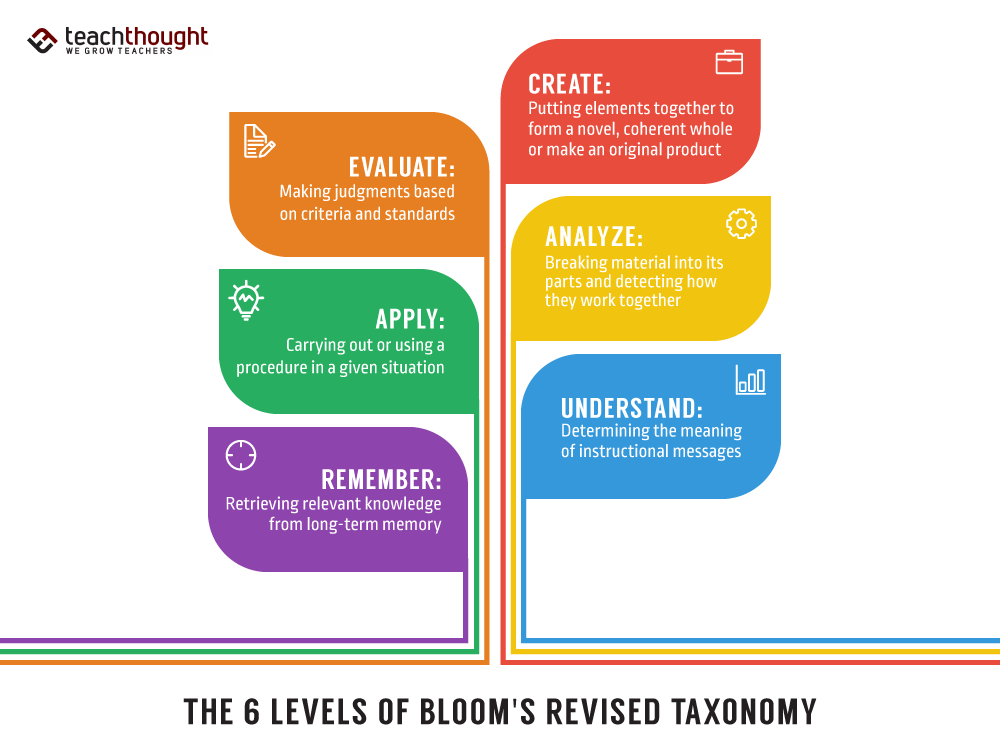
    Bloom's Revised Taxonomy chart: Remember, Understand, Apply, Analyze, Evaluate, CreateBloom's Revised Taxonomy chart: Remember, Understand, Apply, Analyze, Evaluate, Create
    Bloom’s Revised Taxonomy: cognitive process dimension

    Bloom’s Revised Taxonomy changed the original 1956 framework by updating the level names to verbs, reordering the top levels, and adding a second dimension for types of knowledge. The revision clarifies what students do cognitively and how those actions interact with factual, conceptual, procedural, and metacognitive knowledge.

    How Bloom’s Taxonomy Changed

    • Nouns to verbs: levels reframed as cognitive actions: Remember, Understand, Apply, Analyze, Evaluate, Create.
    • Top-level reorder: Create placed above Evaluate to reflect generative thinking.
    • Two dimensions: pair the Cognitive Process with the Knowledge Dimension (Factual, Conceptual, Procedural, Metacognitive).
    • Clearer alignment: objectives, instruction, and assessment mapped with the Taxonomy Table.
    • Modernized language: Comprehension becomes Understand; Knowledge becomes Remember.
    • Planning impact: encourages task verbs and evidence of learning rather than category labels.

    Original vs Revised Level Names

    Original (1956) Revised (2001)
    Knowledge Remember
    Comprehension Understand
    Application Apply
    Analysis Analyze
    Synthesis Create
    Evaluation Evaluate

    What Changed Beyond the Words

    The revision introduced the Taxonomy Table: a grid that crosses six cognitive processes with four knowledge types. This helps teachers specify outcomes and assessments more precisely, for example, Analyze x using conceptual knowledge or Apply y using procedural knowledge.

    • Knowledge Dimension: Factual, Conceptual, Procedural, Metacognitive.
    • Process–knowledge pairing: clarifies task design and evidence quality.
    • Assessment implications: verb choice signals expected thinking and scoring focus.

    Why It Was Revised

    From 1995 to 2000, a team led by Lorin Anderson and David Krathwohl updated Bloom’s Taxonomy to reflect contemporary cognitive science and classroom assessment practice. The goal was to honor the original while making it more actionable for planning, instruction, and evaluation.

    Reference: David R. Krathwohl (2002). A Revision of Bloom’s Taxonomy: An Overview. Theory Into Practice, 41(4), 212–218.

    Related Reading


    Source link

    Share. Facebook Twitter Pinterest LinkedIn Tumblr Email
    sanjay
    • Website

    Related Posts

    Recognizing Early Expression in Multilingual Young Children

    April 20, 2026

    How Breaking Words Changed the Way My Students Approach Language

    April 20, 2026

    Designing for Depth: When High Achievement Isn’t the Whole Story 

    April 19, 2026
    Leave A Reply Cancel Reply

    Don't Miss
    Uncategorized

    Recognizing Early Expression in Multilingual Young Children

    By sanjayApril 20, 20260

    contributed by Iryna Liusik, Early Childhood Educator — Linguistics & Emotional Development Series note: This…

    How Breaking Words Changed the Way My Students Approach Language

    April 20, 2026

    Designing for Depth: When High Achievement Isn’t the Whole Story 

    April 19, 2026

    50+ Most Requested Teacher Gifts in Every Price Range

    April 17, 2026
    Stay In Touch
    • Facebook
    • Twitter
    • Pinterest
    • Instagram
    • YouTube
    • Vimeo
    Our Picks

    Recognizing Early Expression in Multilingual Young Children

    April 20, 2026

    How Breaking Words Changed the Way My Students Approach Language

    April 20, 2026

    Designing for Depth: When High Achievement Isn’t the Whole Story 

    April 19, 2026

    50+ Most Requested Teacher Gifts in Every Price Range

    April 17, 2026
    Demo
    About Us
    About Us

    learn-growth is your jobs, career, and work related blog website. We provide you with the latest and exciting jobs and related info. Do visit us daily to keep yourself updated.

    We're accepting new partnerships right now.

    Email Us: [email protected]

    Our Picks

    The Essential Back-to-Work Style Guide for Women

    January 14, 2020

    How to Find the Best Pet Insurance for Your Dog

    January 14, 2020

    11 Japandi Style Home Decor Finds From Amazon

    January 14, 2020

    Subscribe to Updates

    Get the latest creative news from Learn-growth about tips and tricks for boosting your business success.

    Facebook X (Twitter) Instagram Pinterest
    • Get In Touch
    • Cookie Policy
    • Do-not-sell
    • Terms and Conditions
    • Privacy Policy
    • About Us
    © 2026 - learn-growth.com. All rights reserved.

    Type above and press Enter to search. Press Esc to cancel.

    Powered by
    ...
    ►
    Necessary cookies enable essential site features like secure log-ins and consent preference adjustments. They do not store personal data.
    None
    ►
    Functional cookies support features like content sharing on social media, collecting feedback, and enabling third-party tools.
    None
    ►
    Analytical cookies track visitor interactions, providing insights on metrics like visitor count, bounce rate, and traffic sources.
    None
    ►
    Advertisement cookies deliver personalized ads based on your previous visits and analyze the effectiveness of ad campaigns.
    None
    ►
    Unclassified cookies are cookies that we are in the process of classifying, together with the providers of individual cookies.
    None
    Powered by