

Summer break is one of the best times of the year for many kids, and teachers too. It’s a chance to rest and recharge before diving back in to another year of learning. But while nearly all U.S. schools have extended summer breaks, they vary quite a bit from state to state. So, how long is summer break, and why do schools even have them? Read on to find out!

How long is summer break on average?
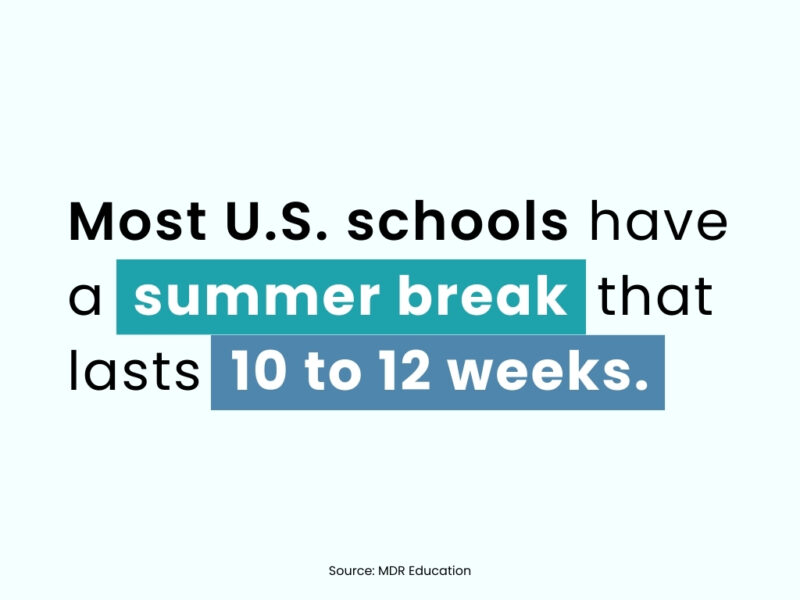
In the United States, most schools have a summer break of 10 to 12 weeks, or around 2.5 to 3 months. The start and end dates of summer break vary considerably across the country, though, with various schools on break anywhere from the end of May to early September.
On a world scale, U.S. school summer breaks fall on the long side. Other countries with average summer breaks around the same length include Italy, Greece, and Russia. Many European and East Asian schools have much shorter summer breaks of around six weeks. These countries often balance things out with longer breaks (two or three weeks) during the fall, winter, and spring.

When does summer break start?
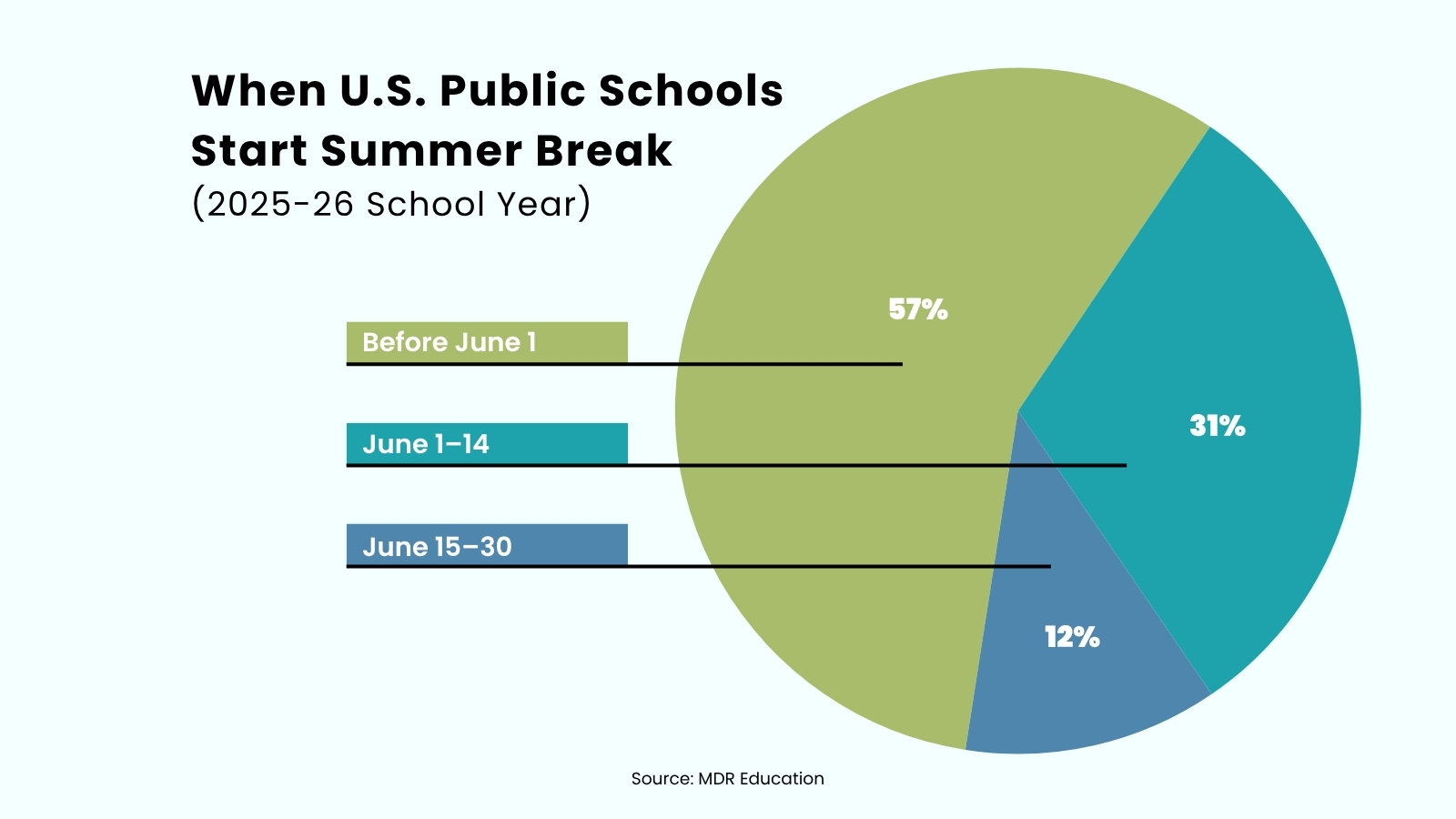
In the United States, K-12 summer break can start anywhere from the end of May through late June. Many schools time their calendar to start summer break after Memorial Day, which is the last Monday in May. According to data collected by MDR Education for the 2025-26 school year, more than half of U.S. public schools (57%) start summer break before June 1.
Around one-third of schools (31%) begin their break during the first two weeks in June, while the remainder (12%) end their year sometime in the last two weeks of the month.
Which states’ summer breaks start the earliest and latest?
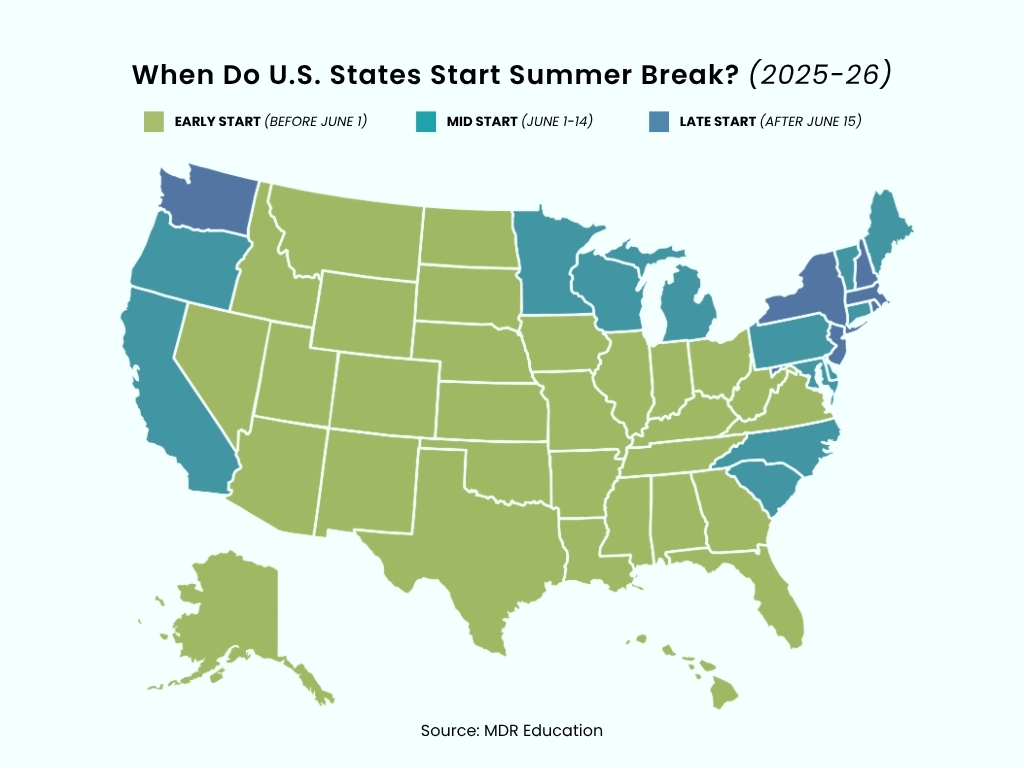
In most states, districts and schools have the ability to set their own start and end dates, as long as students receive the mandated number of school days each year (usually 175 to 180 days). But most schools in each state tend to follow the same pattern of earlier or later breaks.
In 2025-26, states where the majority of schools start summer break before June 1 include:
- Alabama
- Alaska
- Arizona
- Arkansas
- Colorado
- Florida
- Georgia
- Hawaii
- Idaho
- Illinois
- Indiana
- Iowa
- Kansas
- Kentucky
- Louisiana
- Mississippi
- Missouri
- Montana
- Nebraska
- Nevada
- New Mexico
- North Dakota
- Ohio
- Oklahoma
- South Dakota
- Tennessee
- Texas
- Utah
- Virginia
- West Virginia
- Wyoming
These states start their summer break the latest on average, with the majority of schools closing after June 15:
- Massachusetts
- New Hampshire
- New Jersey
- New York
- Rhode Island
- Washington
- Washington, D.C.
When does summer break end?
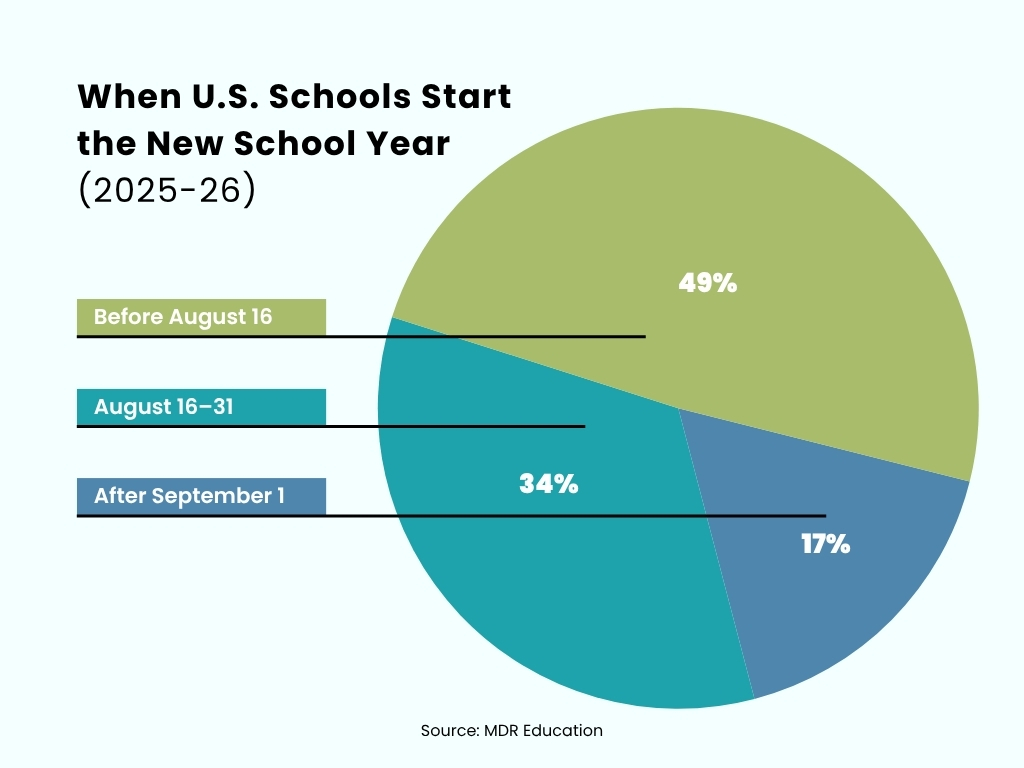
Because summer break lengths vary, the percentages of average ending dates don’t quite match up with the average start dates. In the United States, just under half of schools (49%) end their breaks and start the new school year before August 16. A little more than a third (34%) end summer break during the last two weeks of August.
Traditionally, many U.S. schools used to begin classes after Labor Day (the first Monday in September). Some schools still keep to that tradition, with 17% of schools ending summer break and kicking off the new school year September 1 or later.
Which states’ summer breaks end the earliest and latest?
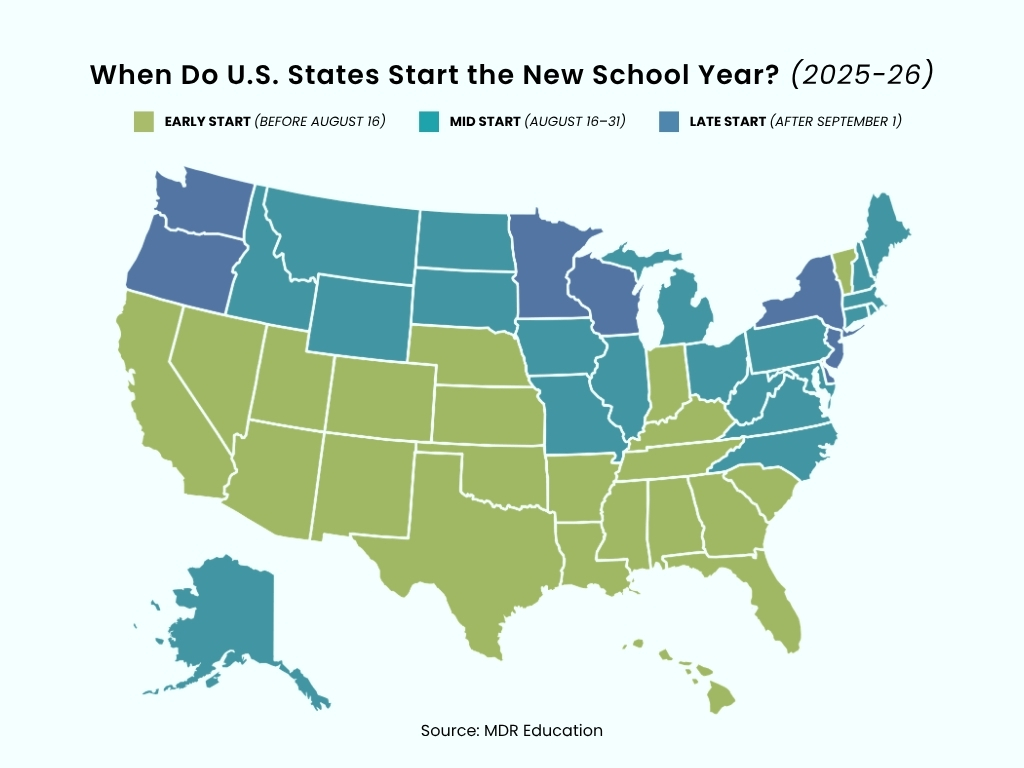
While schools that start summer break early often end it early as well, that’s not always the case. The overall length of break can vary, meaning some schools start breaks late and end them early, or vice versa.
In 2025-26, the majority of schools in these states end summer break early and begin the new school year before August 16:
- Alabama
- Arizona
- Arkansas
- California
- Colorado
- Florida
- Georgia
- Hawaii
- Indiana
- Kansas
- Kentucky
- Louisiana
- Mississippi
- Nebraska
- Nevada
- New Mexico
- Oklahoma
- South Carolina
- Tennessee
- Texas
- Utah
In these states, the majority of schools end summer break and start the school year late, after September 1:
- Delaware
- Minnesota
- New Hampshire
- New Jersey
- New York
- Oregon
- Washington
- Wisconsin
For a complete breakdown of school start and end dates by state, visit MDR Education.
Why do schools have long summer breaks?
It’s a commonly held belief that summer breaks historically allowed children to be home in summer to work on family farms. As it turns out, though, that’s not quite the case. In fact, in farming communities, schools were often in session during the winter and summer months. Spring planting and fall harvest were the busiest times on a farm, when students were needed at home. During the summer, a lull in intensive farm activity gave kids the chance to attend school for a few months.
Ultimately, the United States owes its tradition of long summer breaks to urban schools. In the early years of the 19th century, many city schools were open more or less year-round, and children attended when they could. In most cities, summer months were extremely unpleasant in the days before air-conditioning and sanitation improvements. Families who could afford to fled the cities to spend the summer days in the country or at the beach, taking their kids out of school.
By the late 19th century, school reformers pushed for a standardized school calendar. They urged a lengthy summer break to give students time to rest. (Teachers were supposed to spend those months in training or further education.) This also meant that schools were closed during the hot sticky months before air-conditioning was available or common.
Today, summer break has become a cherished tradition in the United States. Families use it for longer vacations or to send kids to summer camp. In some areas, older school buildings still lack air-conditioning, so a long summer break is practical too.
Do year-round schools have summer vacation?
Contrary to popular belief, year-round schools do indeed have summer vacations. They’re just shorter, averaging about six weeks. This extended break is still enough time for kids and teachers to relax, and to draw a distinct line between one school year and the next. About 2% of schools in the United States run on year-round schedules.
Learn more about year-round schools here.
Are college summer vacations as long as K-12 summer breaks?
Although it varies by institution, U.S. college summer vacations are actually usually even a little longer than those of K-12 schools. Many colleges end the school year in early May and start back up again in late August. These extended breaks allow college students the chance to gain full-time work experience or participate in summer session classes.
Do long summer breaks cause learning loss?
The concept of “summer slide” is a concern for many teachers and families. But is it real? It depends on who you ask. One study found that students in grades 1 through 8 lose 17% to 34% of the prior year’s learning over the summer. Early learners and students from low-income families seem to experience the most summer learning loss.
Learn more about summer slide and how to fight it here.
What do teachers do during summer vacation?
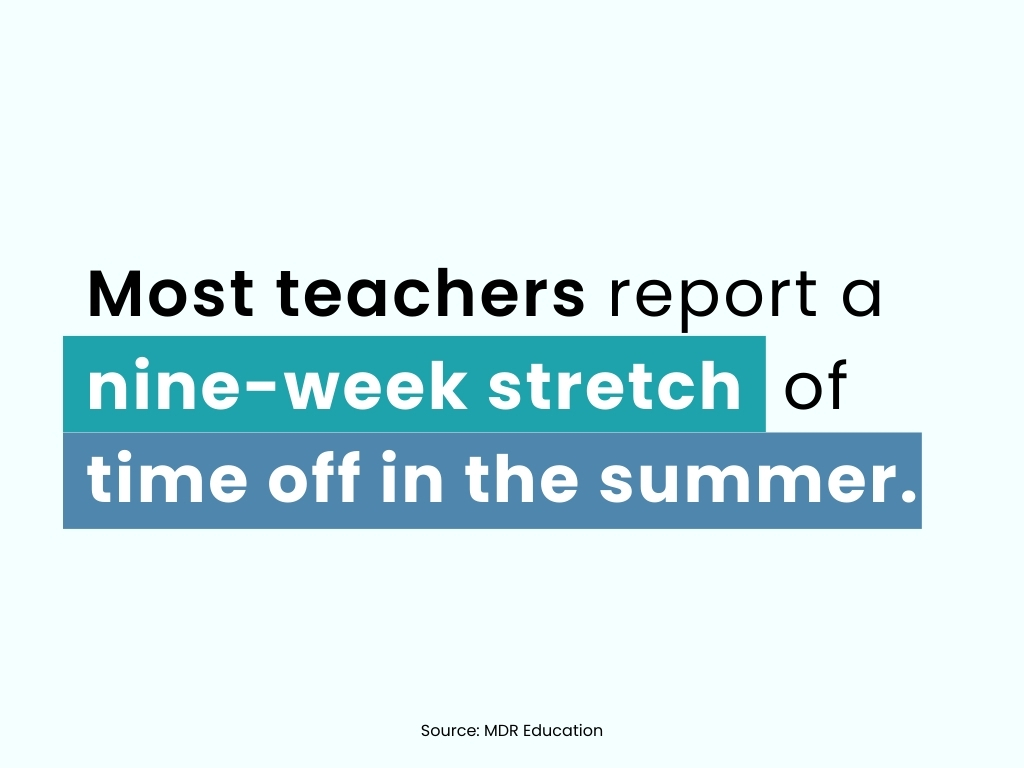
The general public often seems to think that teachers have it easy, with three months of paid vacation each summer. Teachers know the truth, though. To begin with, teachers don’t get as much time off as students do. They usually spend a week or more wrapping things up after students leave in summer, and they prepare their classrooms and curriculum before students return in the fall. In a We Are Teachers survey, most teachers reported a nine-week stretch of time off in the summer.
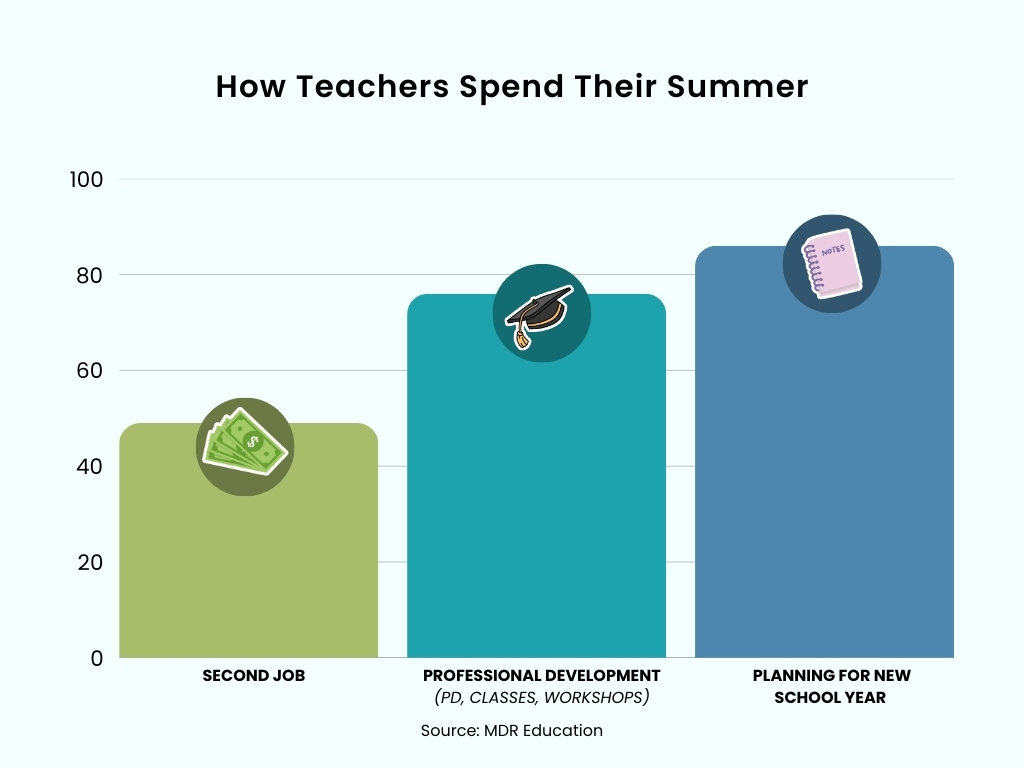
But don’t think that all teachers just lay around sipping drinks by the pool during the summer. According to our survey, nearly half (49%) of teachers work a second job in the summer. And 76% of teachers use summer for required professional development, taking classes or attending workshops to keep their skills sharp. Plus, most teachers (86%) spend at least part of their summer planning for the new school year ahead.
Oh, and not all teachers continue getting paychecks over summer break. Up to a fifth of them don’t have the option to receive their salary evenly throughout the year, making summer budgeting a real challenge for some.
Should parents encourage learning over summer vacation?
A little structured learning time each day during summer break isn’t a bad idea for any child. This can be as simple (and fun!) as encouraging summer reading, playing online learning games, trying outdoor science experiments, or getting in some active math practice. Aim for about 15 to 20 minutes a day, but be sure to provide plenty of time for kids to relax and play too.
Summer is a great time to help students who are falling behind their peers. They may attend summer school or participate in one-on-one tutoring. But even these students should get the benefit of a lighter schedule in the summer, with more time spent outdoors or playing with friends. Summer was always intended as a time for kids to take a break, so don’t be afraid to let them do just that!
Don’t forget to grab your free summer reading list for kids and teens!

Find books for every age, preschool through high school, including fiction, nonfiction, graphic novels, poetry, and much more. Just click the button below and fill out the form to get your summer reading list for kids and teens.
