

[ad_1]
Google Slides is a favorite teaching tool for many educators, both in person and online. With a huge selection of free features and options, this powerhouse allows teachers to create dynamic, interactive presentations. But many slide decks fall flat, boring students or, even worse, overwhelming and distracting them. Learn how to design clean, interactive Google Slides that support learning on a deeper level with these simple tips.
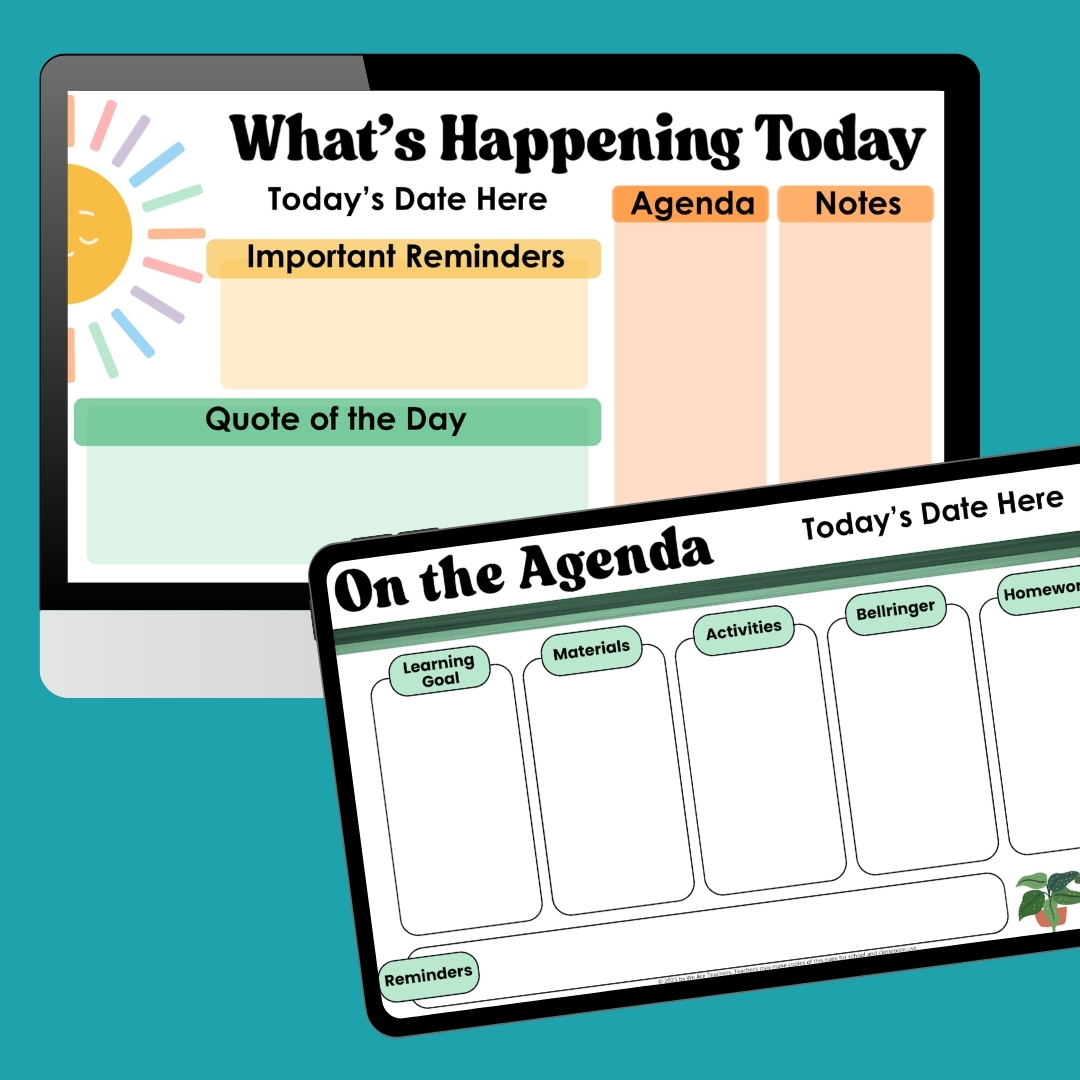
1. Cut the clutter to focus student thinking
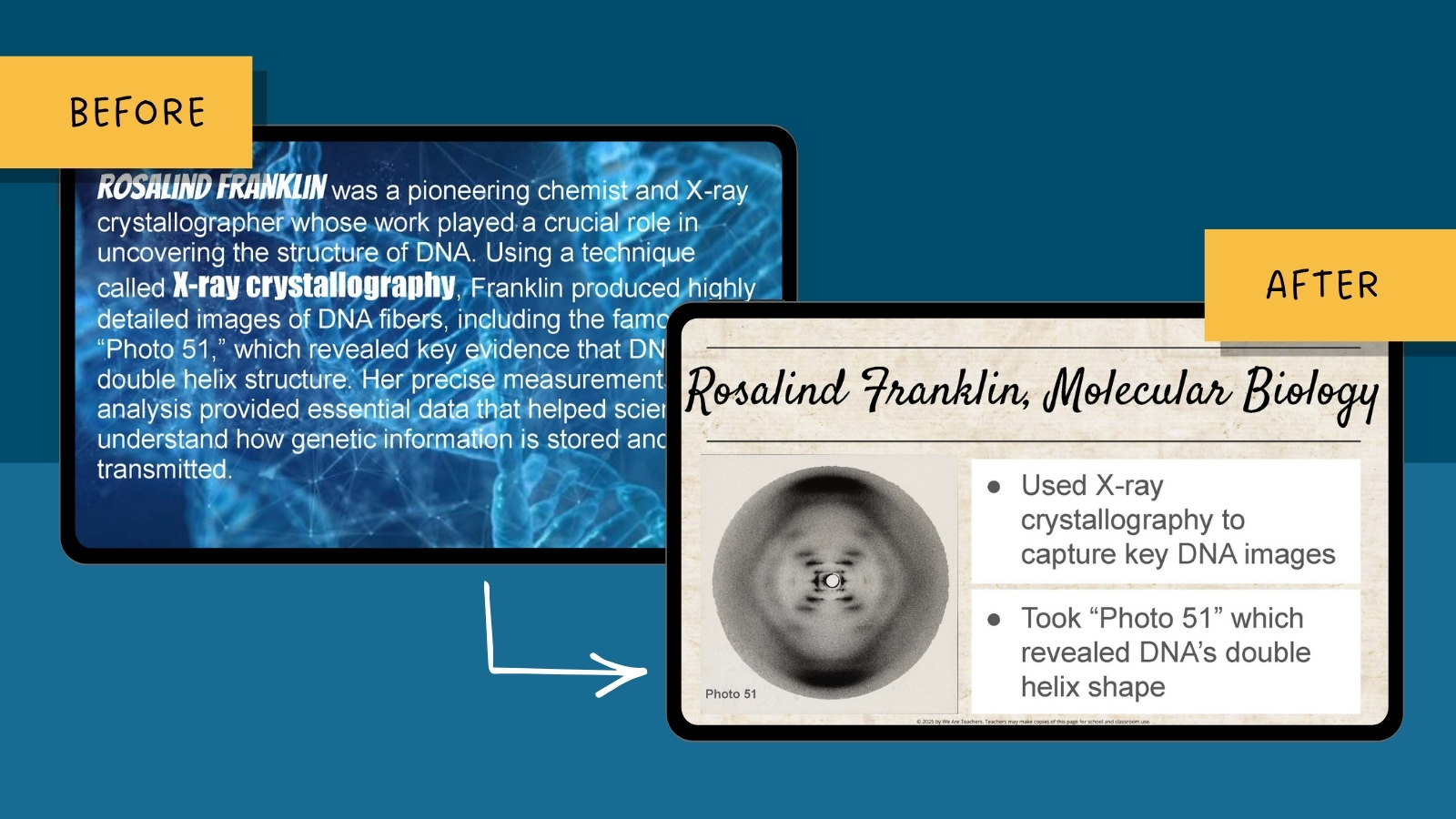
The Problem: Slides often try to do too much—they’re text-heavy and overloaded with competing design elements like fonts, colors, and clip art. Slides aren’t meant to give students every bit of information they need, especially when you’re using them to support a lecture or presentation.
The Upgrade: Think of a slide deck more like an outline, highlighting key information. A clean design means your students spend less time reading and more time listening and thinking about the material.
- Stick to one main idea or question per slide.
- Replace paragraphs and complete sentences with key words or phrases.
- Use visuals that support learning instead of adding decoration.
- Remove elements that don’t support your learning goals.
- Use a consistent font/color scheme throughout your deck.
Try this:
- Take an existing text-heavy slide and cut at least half the text. Turn what’s left into a bulleted list of key words or phrases.
- Replace a block of text with a supporting visual like an image, diagram, chart, or video.
- Use one of our Free Google Slides themes or templates for a more cohesive look.
2. Turn slides into active learning moments
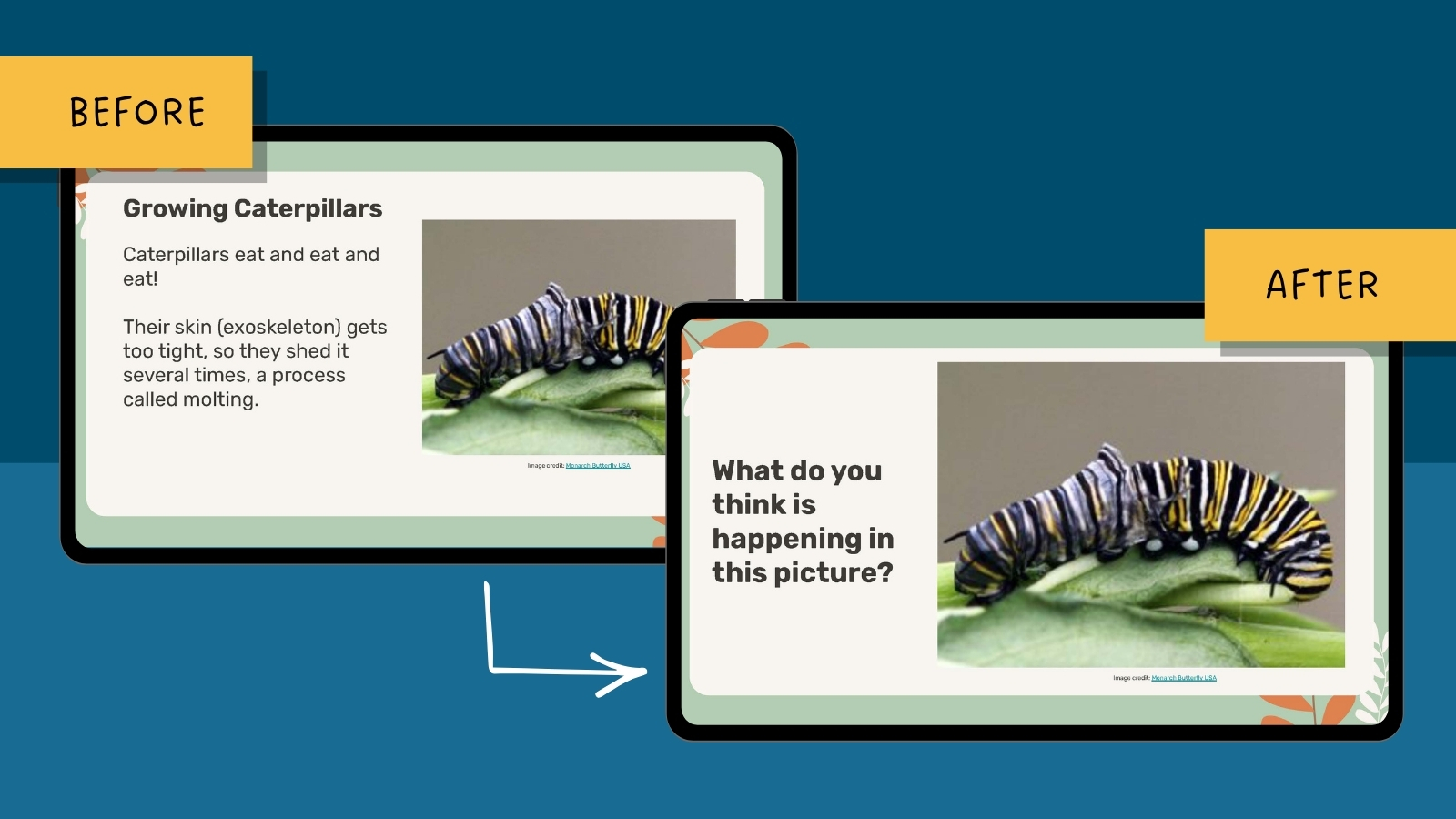
The Problem: Many slide decks promote passive viewing—kids just sit, listen, and watch instead of getting actively involved in the learning. One-way presentations on even the most interesting content tend to be boring, making students more likely to tune out.
The Upgrade: Add slides that encourage active engagement from students—get them thinking, writing, talking, evaluating, and predicting.
- Include prompts for reflection and discussion.
- Add questions that require students to respond in writing or out loud.
- Create slides that ask students to predict what comes next.
- Build in formative assessment checks throughout.
Try this:
- Replace one explanation slide with a question or prompt that invites students to predict information instead of waiting to hear it passively.
- Add a slide that checks for understanding after every major theme or idea (Get 25 unique formative assessment ideas here).
- Include a discussion question or written response prompt after a block of information.
3. Shift the work from you to your students
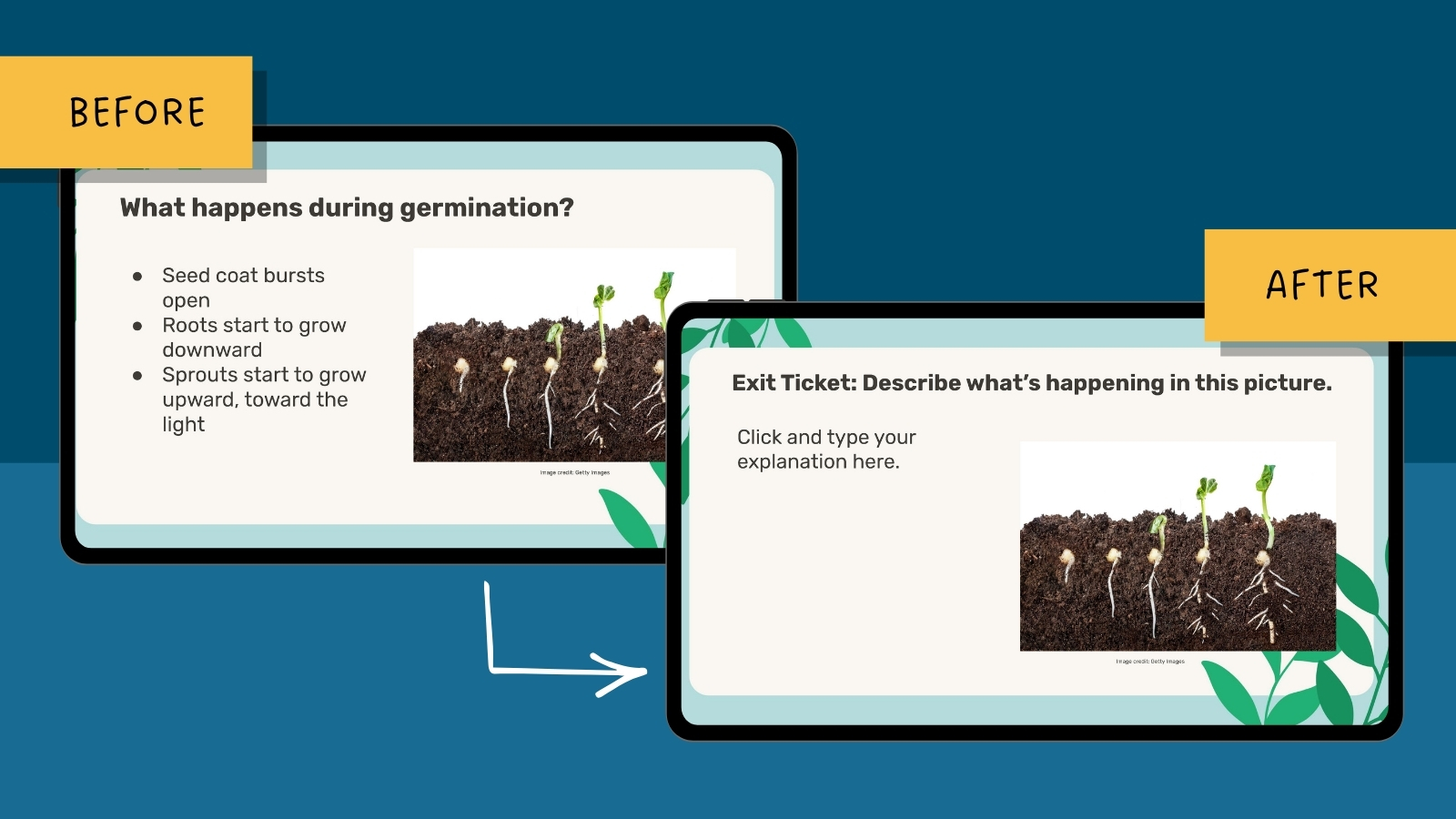
The Problem: When Google Slides is a teacher-provided tool, they miss out on the opportunity to engage students and give them ownership of the learning. Viewing slides is a passive activity that may not promote deeper thinking and understanding.
The Upgrade: Instead of providing completed presentations, turn slides into a workspace where students actively demonstrate learning.
- Invite students to contribute slides to build a class deck.
- Ask students to create collaborative slide decks to teach others what they’ve learned.
- Use slides as response spaces, not just a presentation tool.
Try this:
- Give each student a specific section of text to read and summarize in a Google Slide. Put the slides together to make an informative deck for the whole class.
- Use slides as exit tickets: At the end of a lesson, ask each student to make a slide showing something they know now that they didn’t know before. Use those slides as a review before picking up the next day. (Get more exit ticket ideas here.)
- Have students create visuals that help them better understand or explain a topic or concept, and add these to your existing slide deck.
4. Design slides students can use without you
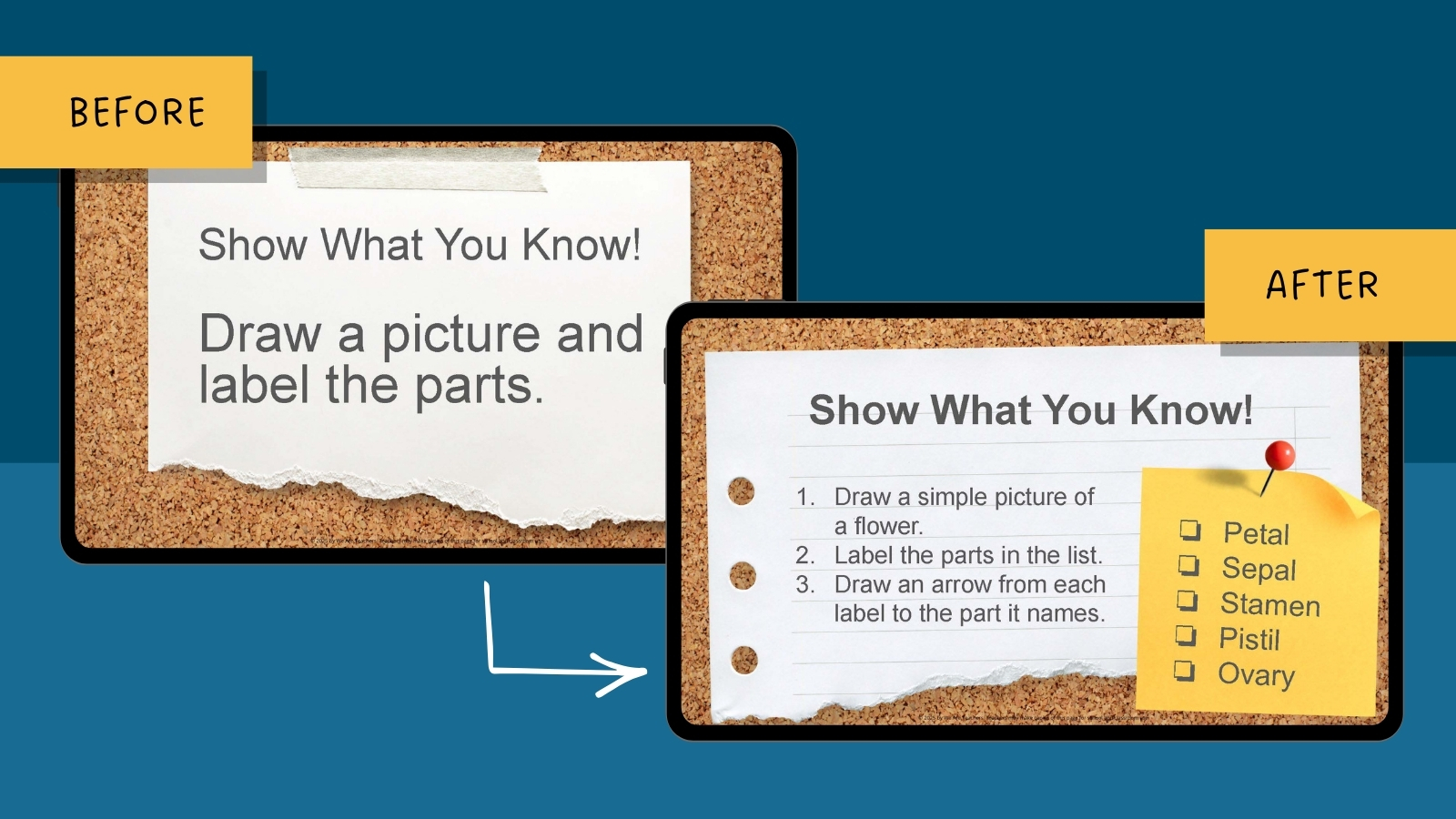
The Problem: Many slide decks depend on a teacher to explain them, which means they’re not useful outside of the classroom. They leave out important resources, detailed instructions, or examples. Students who view these decks independently (for makeup work, review, etc.) don’t get the full picture.
The Upgrade: Include more instructional clarity on your slides. This may seem like it conflicts with the recommendation of “less content” overall, but the two aren’t mutually exclusive. Less content doesn’t mean less clarity. More text is OK when it’s helpful—just be sure to keep it as clear and simple as possible.
- Use a consistent structure so students know where to look for important information.
- Write clear, simple activity directions on your slides rather than only explaining verbally.
- Break complex tasks into smaller steps or use a scaffolded approach over multiple slides.
- Include models, examples, and other visuals that clarify or expand on a concept.
- Anticipate confusion or questions and answer them in the slide deck.
Try this:
- Take one slide that gives instructions, and remove yourself from the equation. Would students know what to do if you weren’t there to explain it?
- Identify a slide or set of slides that often leave students with more questions. Add information or visuals to help address those questions if you’re not present to answer them.
- Embed a video that explains a complex concept in more detail (this could even just be a video of yourself sharing the information as you would in class).
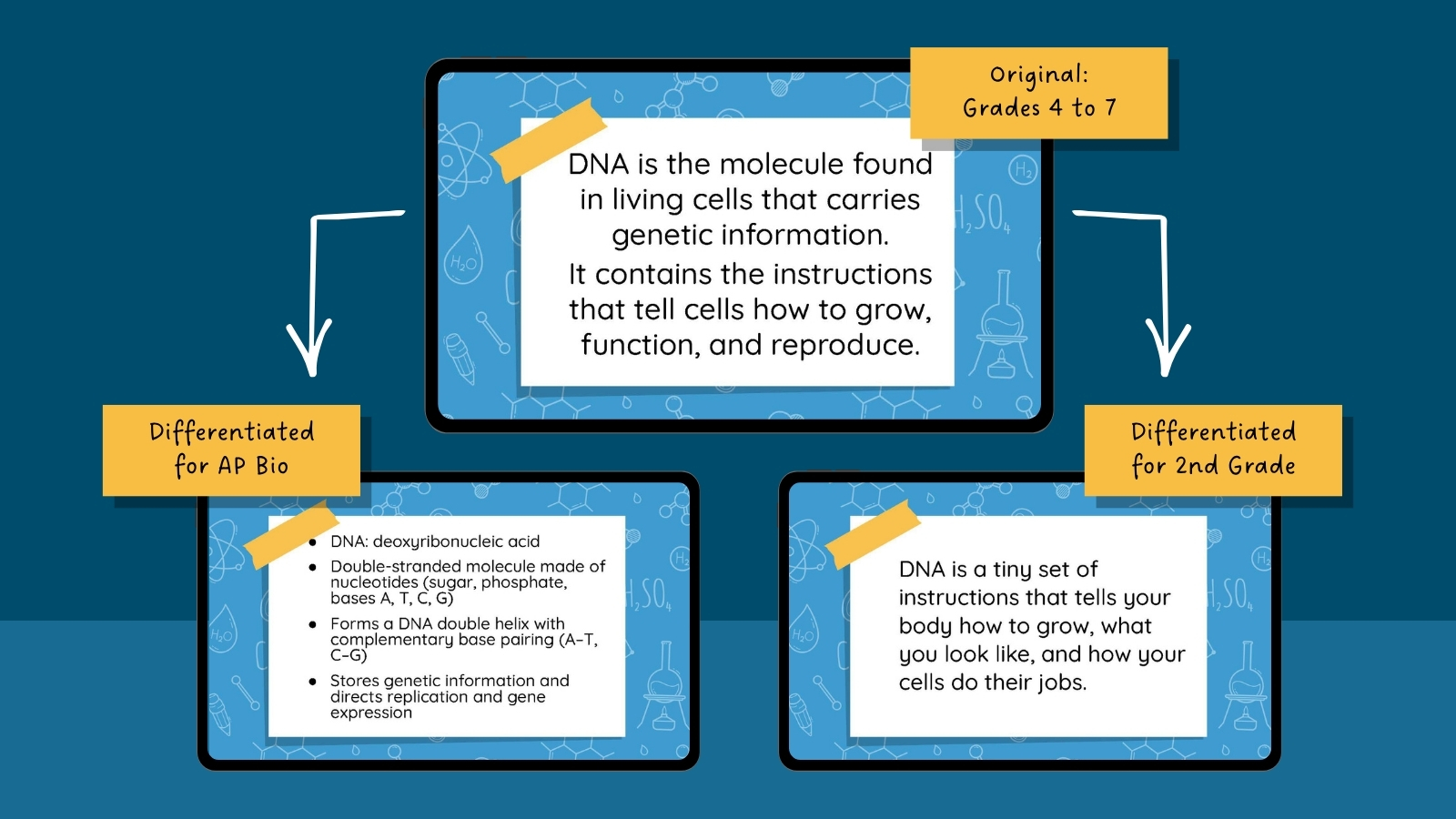
The Problem: It takes a lot of time and effort to create effective slide decks. Simplifying text, writing directions, finding good visuals, building in differentiation or interaction … these take up valuable time that busy teachers just don’t always have.
The Upgrade: Use pre-built decks and AI tools to save time and effort. Find or buy an editable slide deck on your topic or subject that you can modify or customize as needed. When starting from scratch, use a template or theme so you can speed through the general design process.
AI tools can also be very helpful when you’re building Google Slides. Use them to:
- Generate first drafts of slides you can refine into finished content.
- Break your text or lesson notes into slide outlines.
- Differentiate text quickly and easily.
- Generate questions to check for understanding.
- Find images or videos to embed in your slides (always give credit where needed).
- Ask for suggestions or ideas to improve an existing slide deck.
Try this:
- Have an AI tool review one of your lesson plans and turn it into a basic slide deck outline that you can build and expand on.
- Take a text-heavy slide and use an AI tool to simplify it down into key highlights.
- Ask an AI tool for suggestions to turn a passive slide deck into an interactive one that encourages deeper thinking.
Bonus Tip: Make Google Slides Interactive
Don’t limit yourself to presentations! With drag-and-drop elements or editable text blocks, you can turn Google Slide decks into interactive activities for students to use independently or as a group. Try some of these ideas for making interactive Google Slides:
- Sorting or matching: Students move words, images, or examples into categories (e.g., living vs. nonliving, fact vs. opinion, main idea vs. detail).
- Build the answer: Students arrange words or images.
- Labeling: Students drag labels onto images, maps, or charts to show understanding.
- This or that: Students select between options and justify their thinking on the same slide.
- Click and reveal: Students answer or predict first, then advance to reveal answers or explanations.
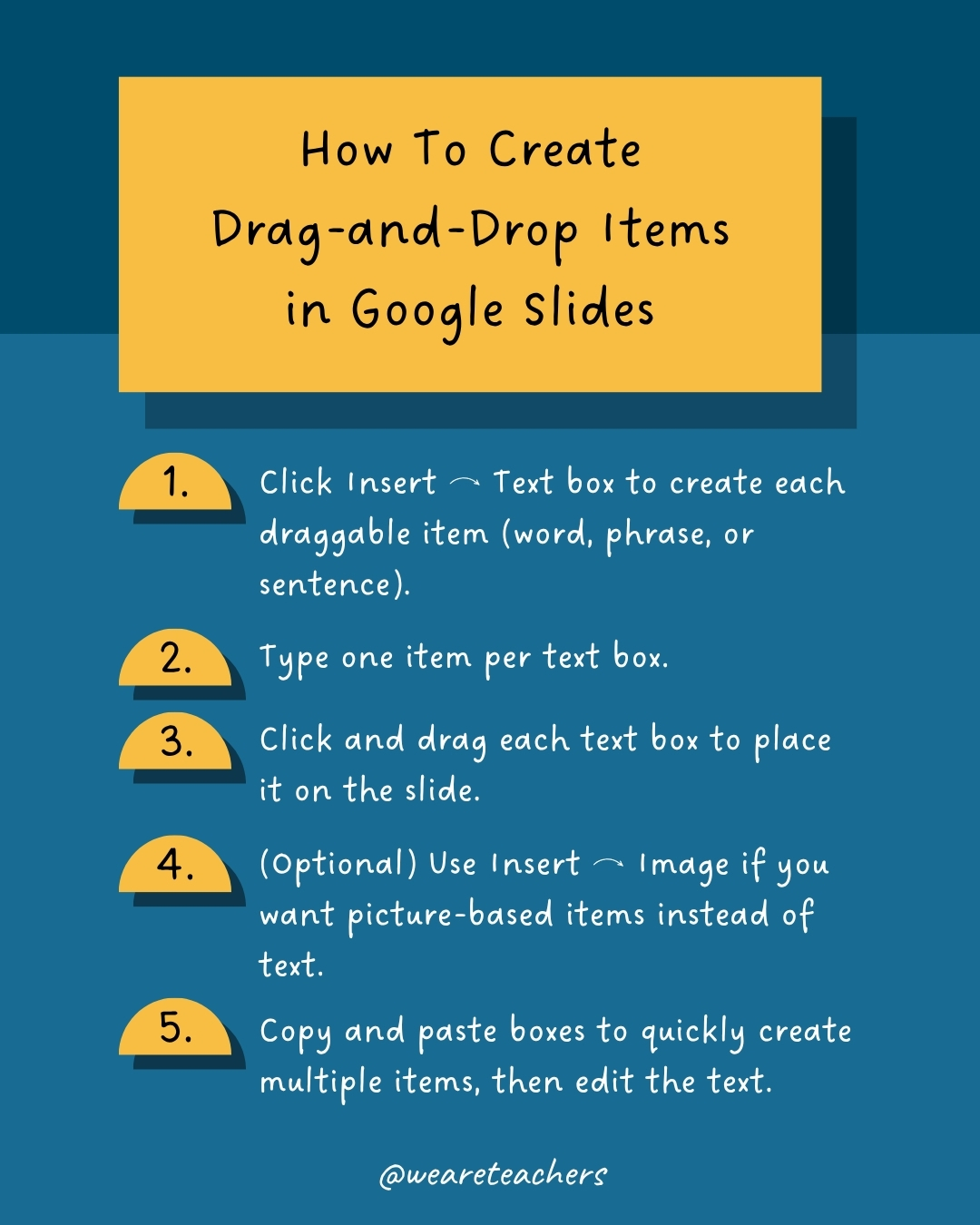
Be sure to download your free set of Google Slides templates and themes!
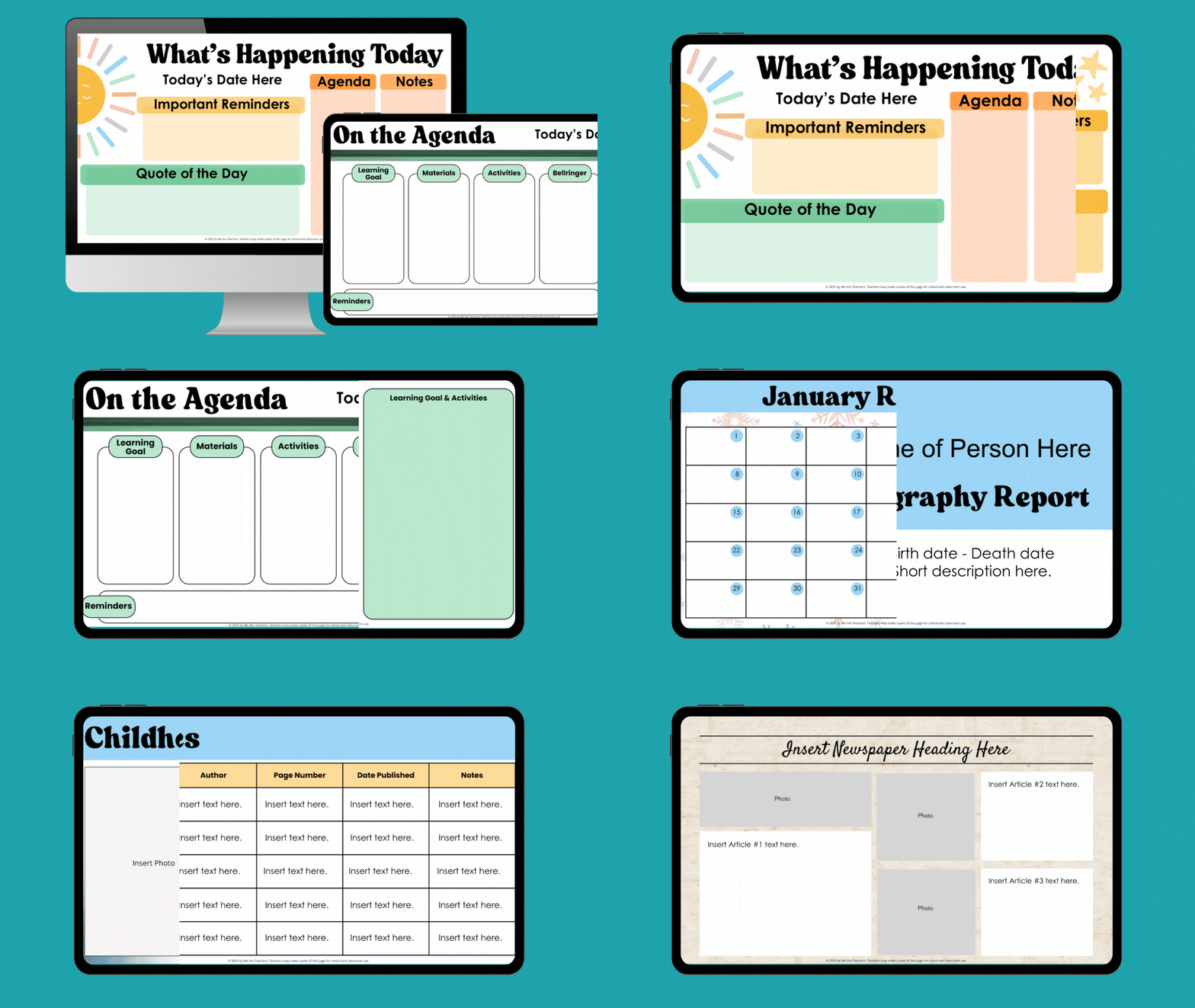
Our huge set includes presentation themes, student activities, interactive slides, and so much more. Download them all for free! Just click the link below and fill out the form to get yours.
Plus, get Free Google Classroom Banners for Every Subject and Theme.
And don’t miss all our Google Classroom resources here!
[ad_2]
Source link