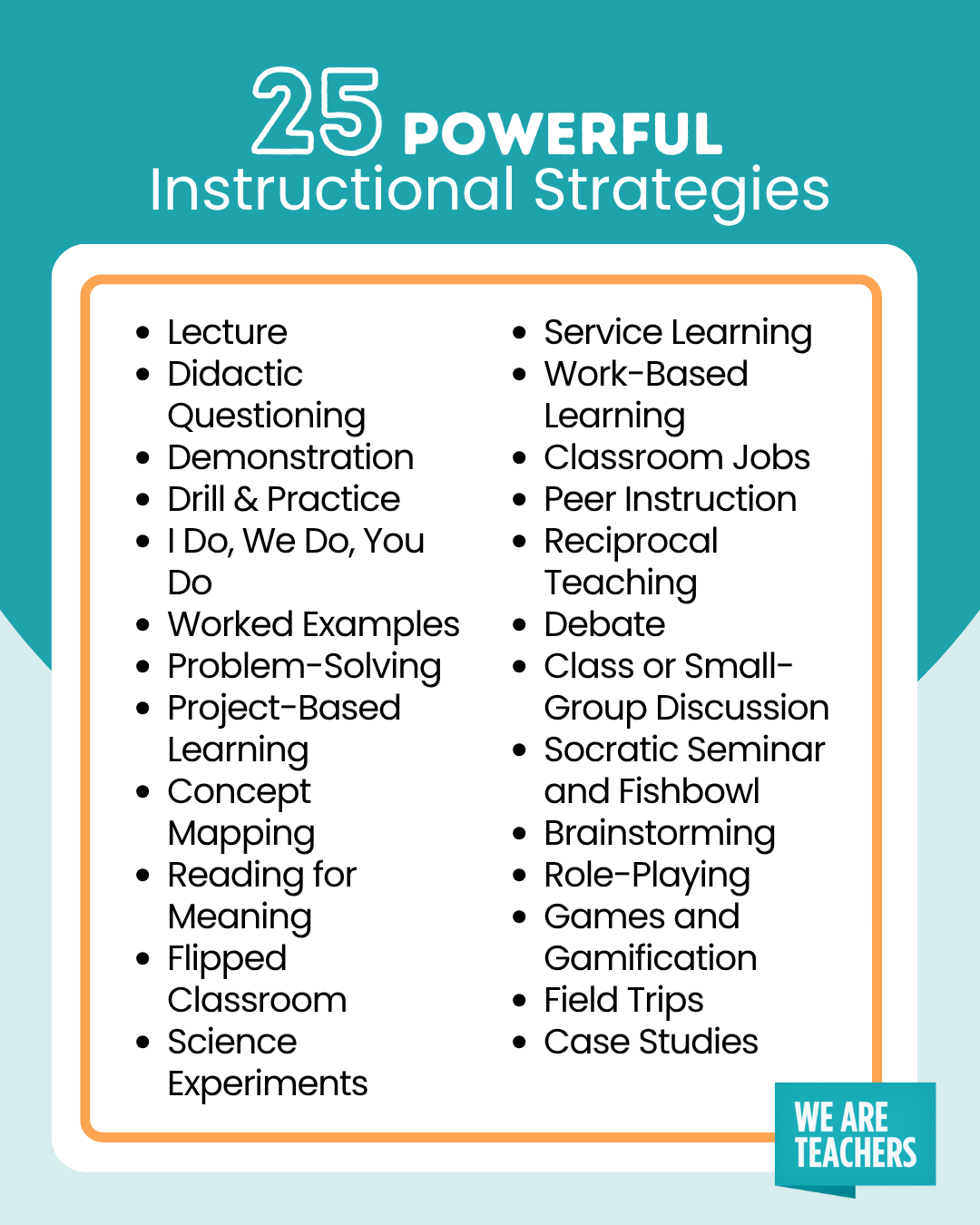

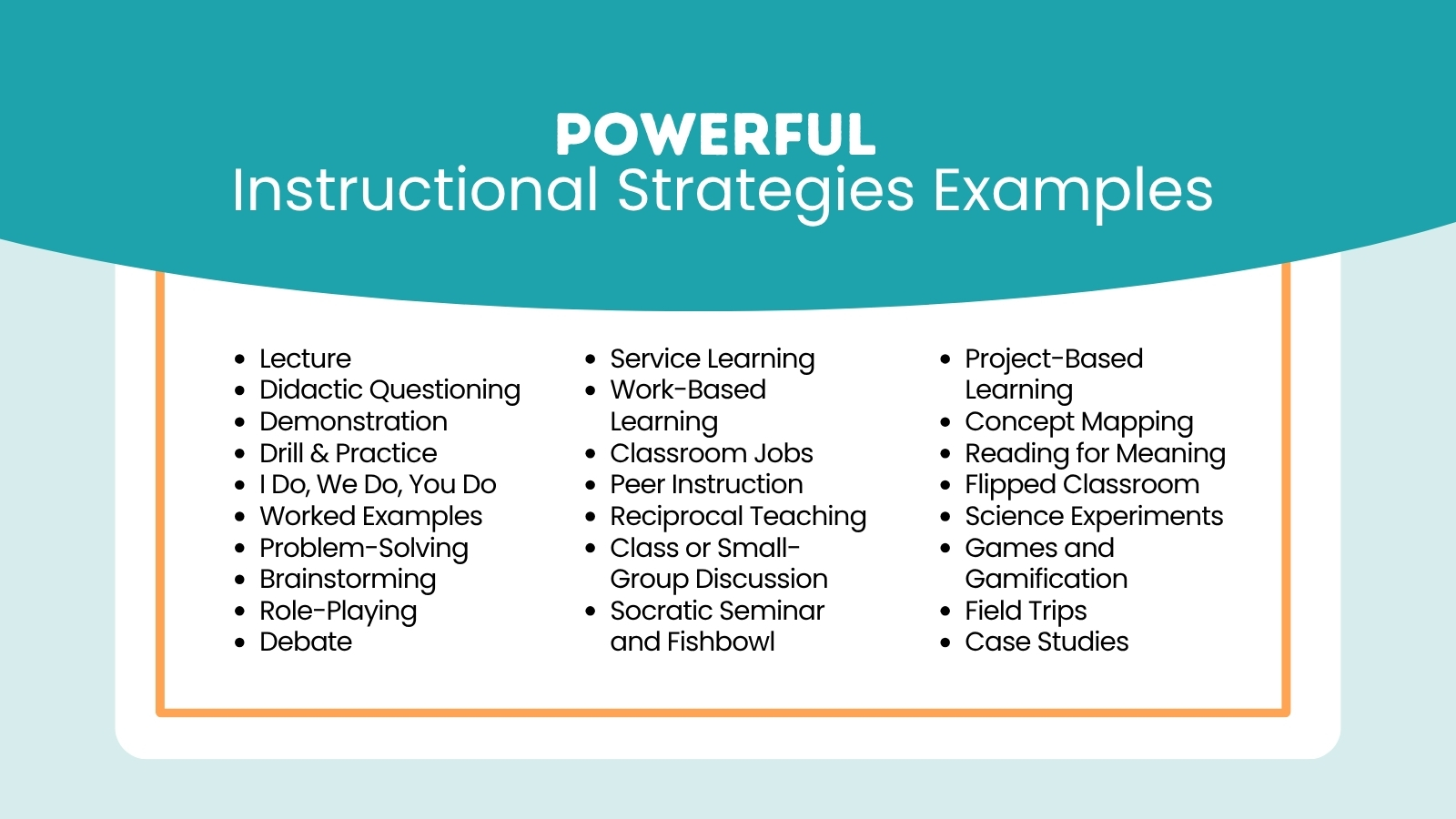
Looking for some new ways to teach and learn in your classroom? This roundup of instructional strategies examples includes methods that will appeal to all learners and work for any teacher. You’ll find sample instructional strategies in a variety of styles, so you can pick and choose those that work best for every situation.
We’ve also partnered with instructional coach Chrissy Beltran from Buzzing With Ms. B, and Jo Lein, leadership coach and author of the upcoming book Burn the Script: How Great Coaches Disrupt Thinking and Transform Practice, to bring you expert tips on upping your instructional strategies game. Follow them both on Instagram at @buzzingwithmsb and @educoachbyjo for more teaching and leadership tips.
Jump to:
Instructional Strategies FAQs
What are instructional strategies?
In the simplest of terms, instructional strategies are the methods teachers use to achieve learning objectives. In other words, pretty much every learning activity you can think of is an example of an instructional strategy. They’re also known as teaching strategies and learning strategies.
Great instructional strategies make thinking visible. When students read, discuss, explain, and respond to one another, teachers can see what students actually understand. That visibility allows teachers to adjust instruction in real time, which is one of the most powerful drivers of student learning.
—Jo Lein, @educoachbyjo
You’ll learn a lot about instructional strategies during your teacher preparation program, which is why it’s important to be selective and thoughtful about which program you choose. In Moreland University’s online TEACH-NOW Teacher Preparation Certificate Program, for example, you’ll learn in a global cohort with educators from around the world. This gives you a diverse perspective on instructional strategies and styles in different communities and schools.
Why is it important to know and use a wide array of instructional strategies?
The more instructional strategies a teacher has in their tool kit, the more they’re able to reach all of their students. Different types of learners respond better to various strategies, and some topics are best taught with one strategy over another. Usually, teachers use a wide array of strategies across a single lesson. This gives all students a chance to play to their strengths and ensures they have a deeper connection to the material.
“No single strategy works for every learner, subject, or moment in a lesson,” explains Jo Lein. “When teachers build a strong repertoire of strategies, they gain flexibility and can adjust instruction in real time based on students’ needs.”
Students don’t learn through one exposure to new content; they build understanding over time through multiple exposures and opportunities to retrieve and practice information and thought processes in different ways. Using a strategy until students get good at it and are able to actually learn with it is great. Using a strategy until students groan out of dread and boredom when you give directions disengages kids and the strategy loses its potency.
—Chrissy Beltran, (@buzzingwithmsb)
How do multiple instructional strategies support a diverse student population?
Every classroom is different, and so is every student. Each has their own strengths, challenges, background knowledge, family situation, culture, and learning style. Supporting such a diverse collection of learners means being creative and flexible in how you instruct, lead, and support your students. “Different students may respond to different strategies,” Chrissy notes. “If we don’t use a variety of tools throughout the year, we are missing opportunities for kids to make valuable connections.”
Different strategies also create different access points to learning. Some students need time to think individually while others need discussion, modeling, or collaborative problem-solving. A wide range of strategies helps teachers design classrooms where more students can actively participate and build confidence as learners.
—Jo Lein, @educoachbyjo
How can teachers feel more comfortable trying new instructional strategies?
Remember that your goal is to help every student in your classroom succeed. When you stay student-focused, you’ll find it easier to push past your own discomfort.
Growing as a teacher means we often feel discomfort until we figure something out. The first time you used any single strategy, it probably felt a little awkward. That is completely normal. Something new doesn’t feel comfortable yet, but that doesn’t mean it’s wrong.
—Chrissy Beltran, (@buzzingwithmsb)
“Start small and treat your classroom like a laboratory,” Lein advises. “The goal is to continuously learn what works for your students. Try one strategy during one part of a lesson and simply observe what happens. Did more students participate? Did it help them understand the content? See the cause-and-effect relationships.”
“It helps if you really understand that the first time, you’re learning how to instruct the strategy, and kids are learning how to use it,” adds Beltran. “It’s OK that it’s not perfect. You may find something you absolutely love, but you won’t know until you try it out. If it doesn’t work out after a couple of tries, try something different!”
Another tip from Jo Lein: “Name it explicitly. Students are usually very receptive when teachers are transparent. Saying, ‘We’re trying something new today because I want to help everyone participate more,’ builds trust and often increases buy-in.”
Beltran also advises, “If you’re unsure about trying a new strategy, try with a buddy! Find a teacher partner or an instructional coach who would love to work with you to implement something new. It’s always easier when you have a partner, and they can serve as a listening and reflective support.”
How do I choose the right instructional strategies for my classroom?
When it comes to choosing instructional strategies, consider your learning objectives, assessments, learning styles, and learning environment.
- Learning objectives: What will students be able to do as a result of this lesson or activity? If you are teaching specific skills or detailed information, a direct approach may be best. When you want students to develop their own methods of understanding, consider experiential learning. To encourage critical thinking skills, try indirect or interactive instruction.
- Assessments: How will you be measuring whether students have met the learning objectives? The strategies you use should prepare them to succeed. For instance, if you’re teaching spelling, direct instruction is often the best method, since drill-and-practice simulates the experience of taking a spelling test.
- Learning styles: What types of learners do you need to accommodate? Most classrooms (and most students) respond best to a mix of instructional strategies. Those who have difficulty speaking in class might not benefit as much from interactive learning, and students who have trouble staying on task might struggle with independent learning.
- Learning environment: Every classroom looks different, and the environment can vary day by day. Perhaps it’s testing week for other grades in your school, so you need to keep things quieter in your classroom. This probably isn’t the time for experiments or lots of loud discussions. Some activities simply aren’t practical indoors, and the weather might not allow you to take learning outside.
What are some of the best instructional strategy examples?
There are no “best” instructional strategy examples for every teacher and classroom. The important thing is to keep adding to your teacher tool kit, looking for new ways to engage and support every learner. Our big list of examples provides plenty of new options to try!
Types of Instructional Strategies
There are a lot of different ways of looking at instructional strategies. One of the most common breaks them into five basic types. It’s important to remember that many learning activities fall into more than one of these categories, and teachers rarely use one type of strategy alone. The key is to know when a strategy can be most effective, for the learners or for the learning objective. Here’s a closer look at the basic types, with sample instructional strategies for each.
Samples of Direct Instruction Instructional Strategies
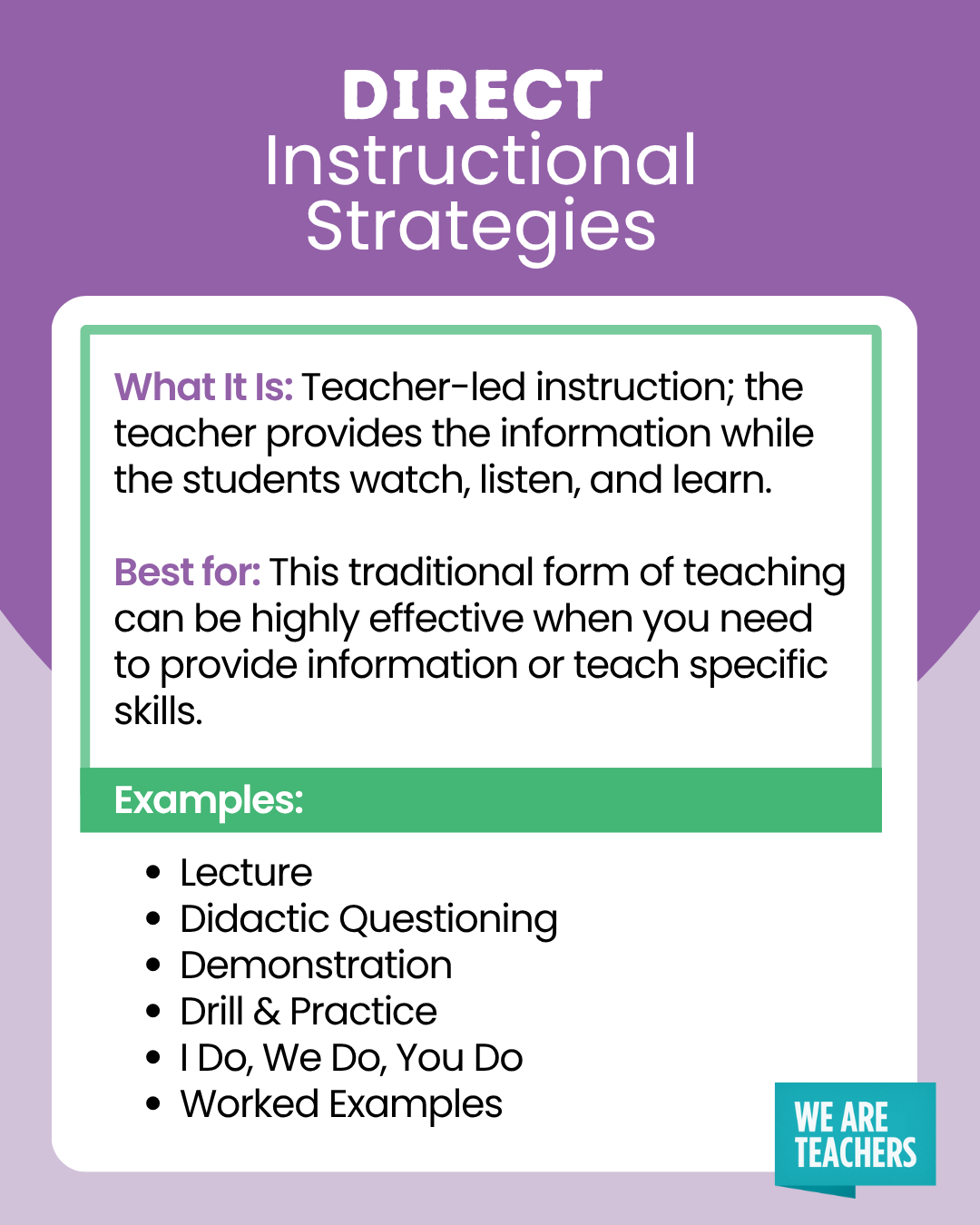
Direct instruction can also be called “teacher-led instruction,” and it’s exactly what it sounds like. The teacher provides the information, while the students watch, listen, and learn. Students may participate by answering questions asked by the teacher or practicing a skill under their supervision. This is a very traditional form of teaching, and one that can be highly effective when you need to provide information or teach specific skills.
Lecture
This method gets a lot of flack these days for being “boring” or “old-fashioned.” It’s true that you don’t want it to be your only instructional strategy, but short lectures are still very effective learning tools. This type of direct instruction is perfect for imparting specific detailed information or teaching a step-by-step process. And lectures don’t have to be boring—just look at the success of TED Talks.
Didactic Questioning
These are often paired with other direct instruction methods like lecturing. The teacher asks questions to determine student understanding of the material. They’re often questions that start with “who,” “what,” “where,” and “when.”
Demonstration
In this direct instruction method, students watch as a teacher demonstrates an action or skill. This might be seeing a teacher solving a math problem step-by-step, or watching them demonstrate proper handwriting on the whiteboard. Usually, this is followed by having students do hands-on practice or activities in a similar manner.
Drill & Practice
If you’ve ever used flash cards to help kids practice math facts or had your whole class chant the spelling of a word out loud, you’ve used drill & practice. It’s another one of those traditional instructional strategies examples. When kids need to memorize specific information or master a step-by-step skill, drill & practice really works.
I Do, We Do, You Do
In this instructional strategies example, the teacher first demonstrates the skill or task. Then, the teacher and students do the skill or task together, and finally students complete the work independently to demonstrate mastery. It’s a great way to build confidence along with academics.
Worked Examples
This is similar to I Do, We Do, You Do, but focuses on the step-by-step process to complete a task. The teacher and then the students must be able to explain their thinking and reasoning every step of the way, rather than just finding the correct answer. This one is especially useful in science and math situations.
Indirect Instruction Instructional Strategies Examples
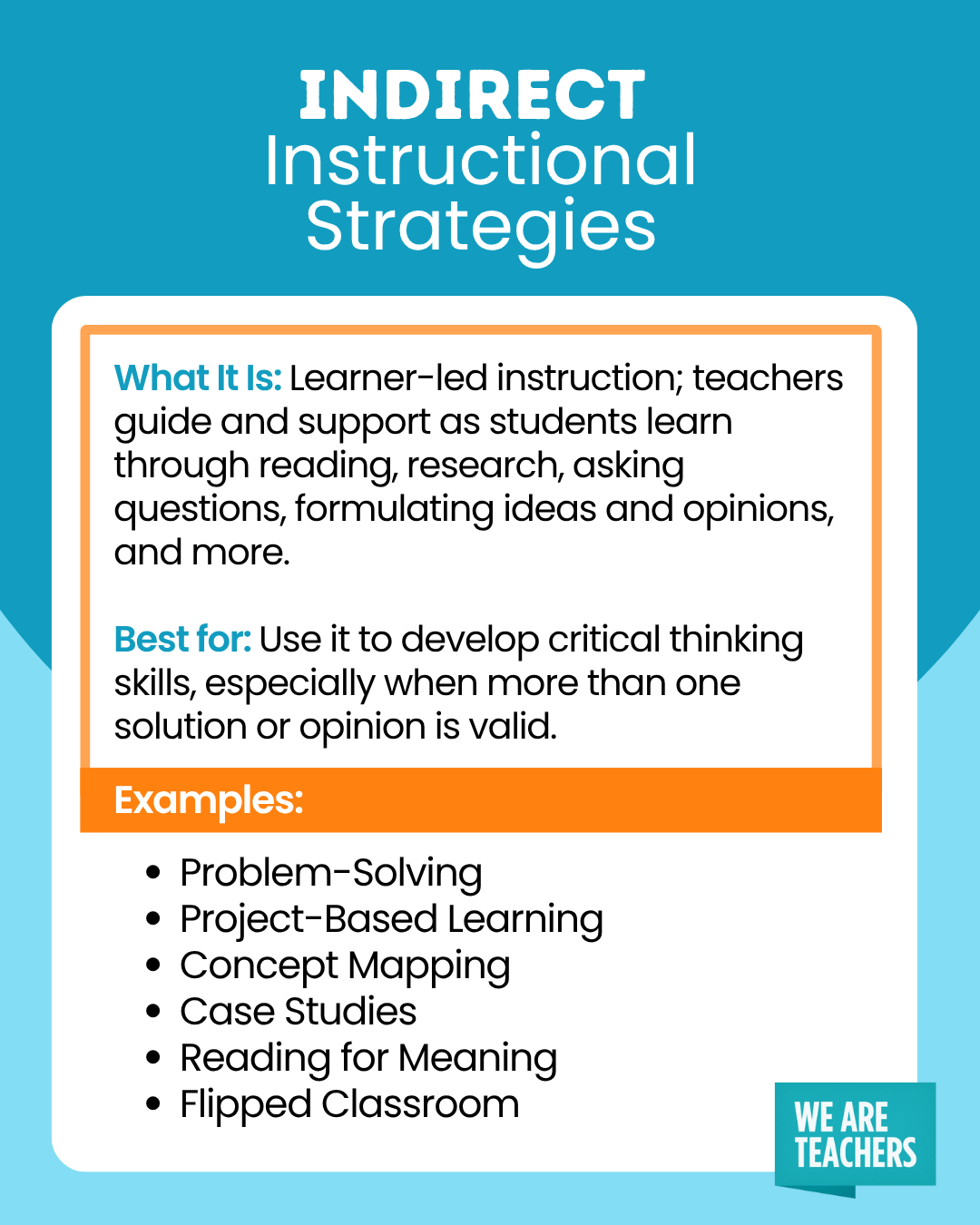
This form of instruction is learner-led and helps develop higher-order thinking skills. Teachers guide and support, but students drive the learning through reading, research, asking questions, formulating ideas and opinions, and more. This method isn’t ideal when you need to teach detailed information or a step-by-step process. Instead, use it to develop critical thinking skills, especially when more than one solution or opinion is valid.
Problem-Solving
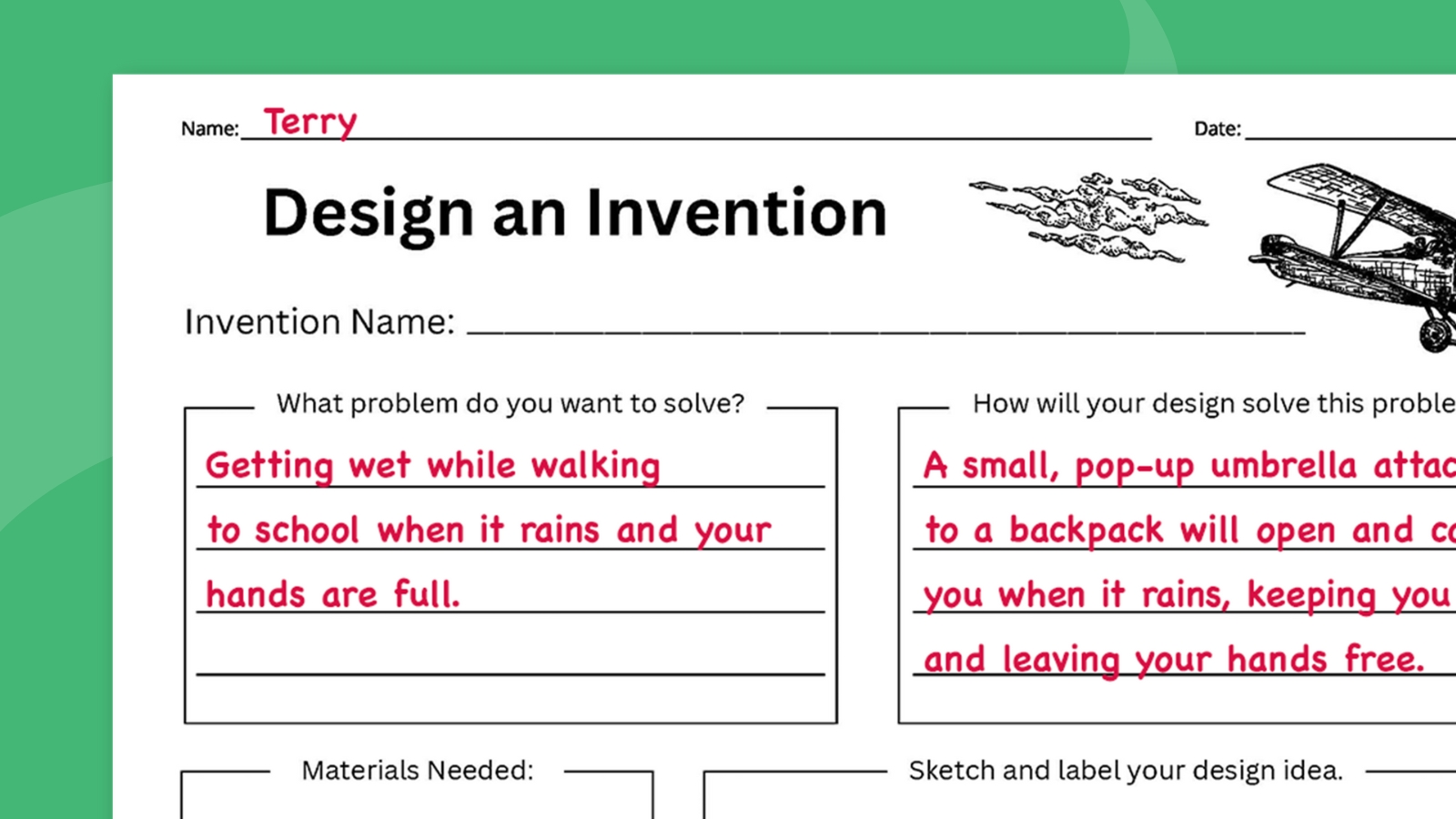
In this indirect learning method, students work their way through a problem to find a solution. Along the way, they must develop the knowledge to understand the problem and use creative thinking to solve it. STEM challenges are terrific examples of problem-solving instructional strategies.
Project-Based Learning
When kids participate in true project-based learning, they’re learning through indirect and experiential strategies. As they work to find solutions to a real-world problem, they develop critical thinking skills and learn by research, trial and error, collaboration, and other experiences.
Learn more: What Is Project-Based Learning?
Concept Mapping
Students use concept maps to break down a subject into its main points and draw connections between these points. They brainstorm the big-picture ideas, then draw lines to connect terms, details, and more to help them visualize the topic.
Case Studies
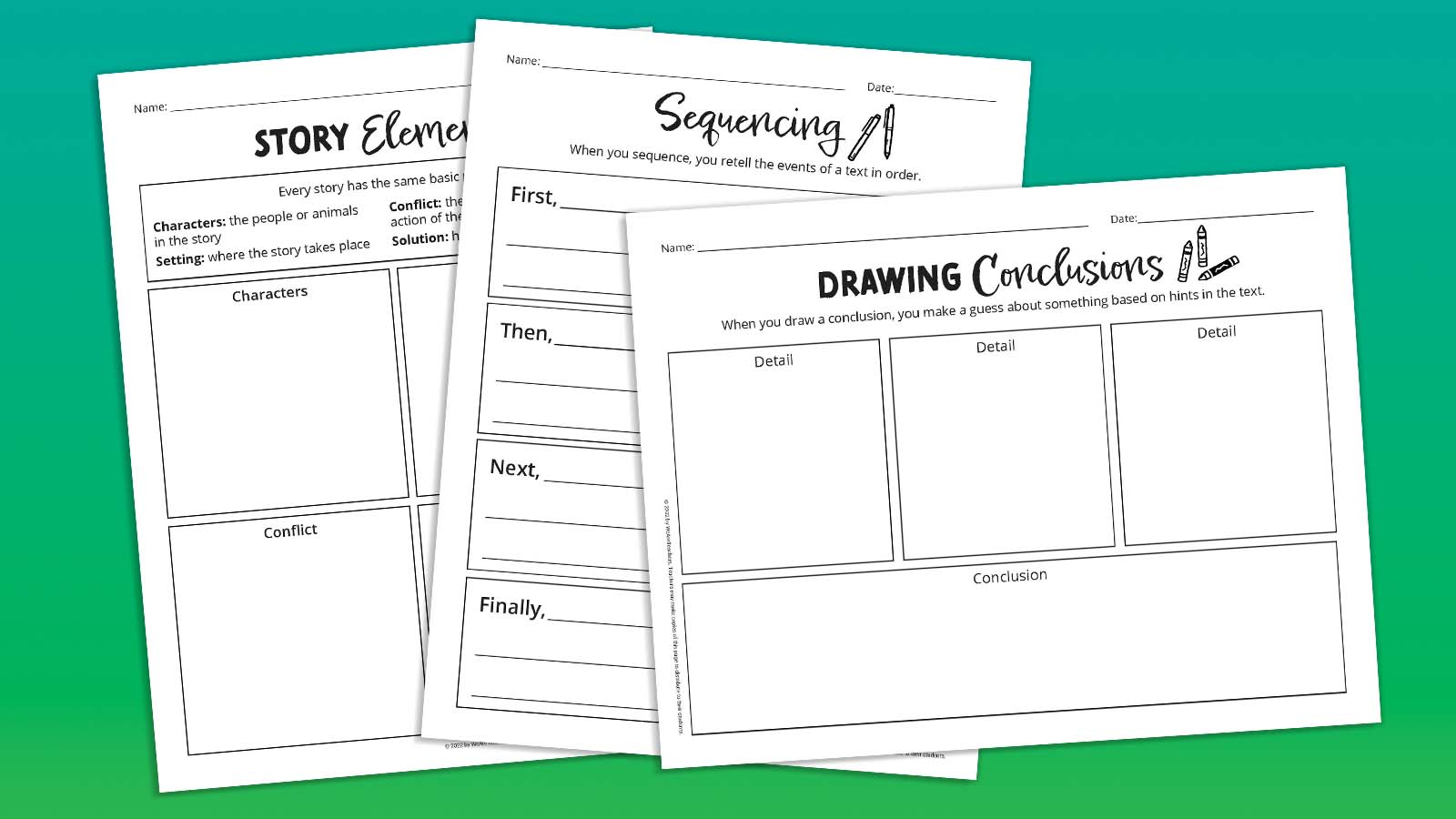
When you think of case studies, law school is probably the first thing that jumps to mind. But this method works at any age and for a variety of topics. This indirect learning method teaches students to use material to draw conclusions, make connections, and advance their existing knowledge.
Reading for Meaning
This is different than learning to read. Instead, it’s when students use texts (print or digital) to learn about a topic. This traditional strategy works best when students already have strong reading comprehension skills.
Flipped Classroom
In a flipped classroom, students read texts or watch prerecorded lectures at home. Classroom time is used for deeper learning activities, like discussions, labs, and one-on-one time for teachers and students.
Learn more: What Is a Flipped Classroom?
Samples of Experiential Learning Instructional Strategies
In experiential learning, students learn by doing. Rather than following a set of instructions or listening to a lecture, they dive right into an activity or experience. Once again, the teacher is a guide, there to answer questions and gently keep learning on track if necessary. At the end, and often throughout, the learners reflect on their experience, drawing conclusions about the skills and knowledge they’ve gained. Experiential learning values the process over the product.
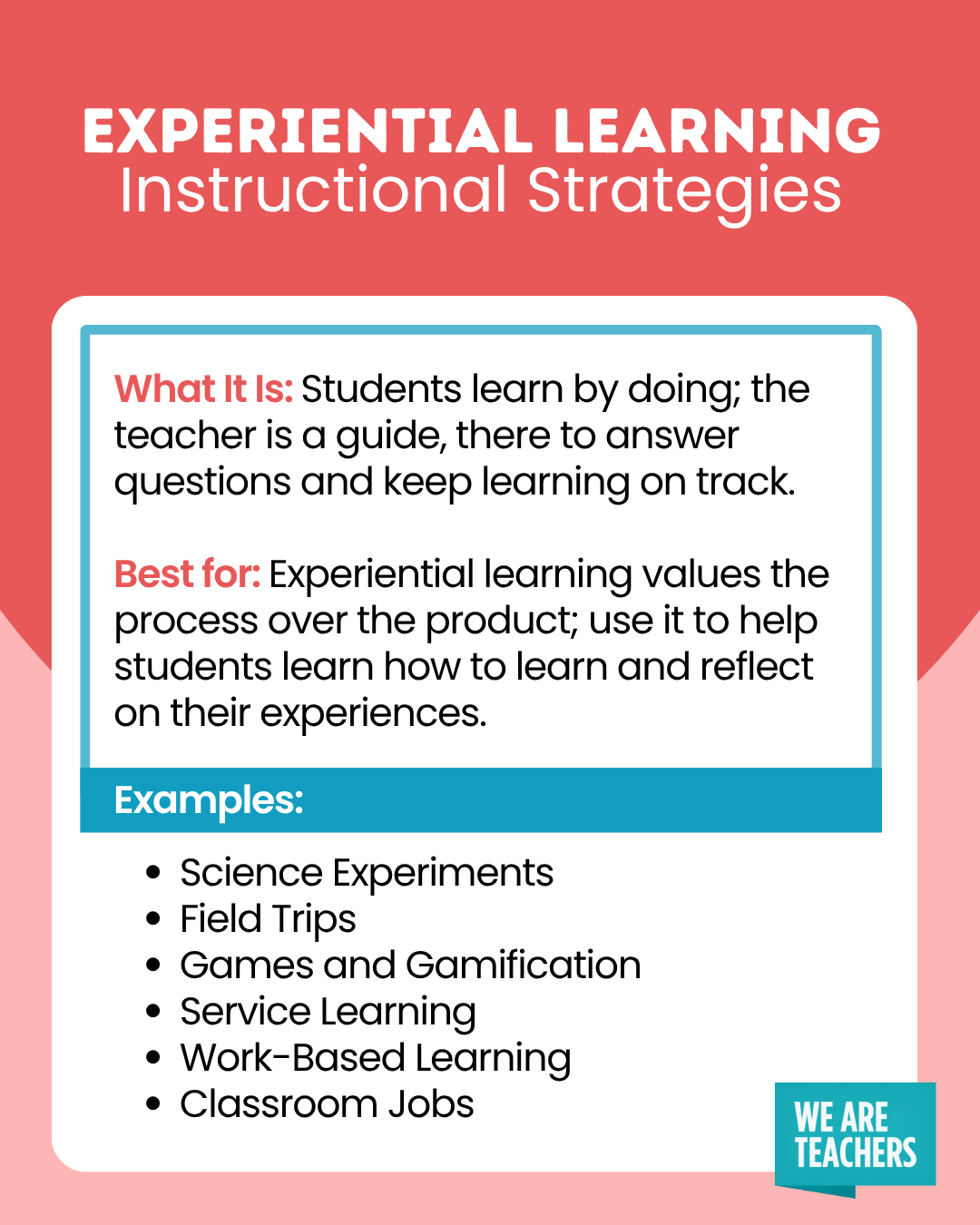
Science Experiments
This is experiential learning at its best. Hands-on experiments let kids learn to establish expectations, create sound methodology, draw conclusions, and more.
Learn more: Hundreds of science experiment ideas for kids and teens

Field Trips
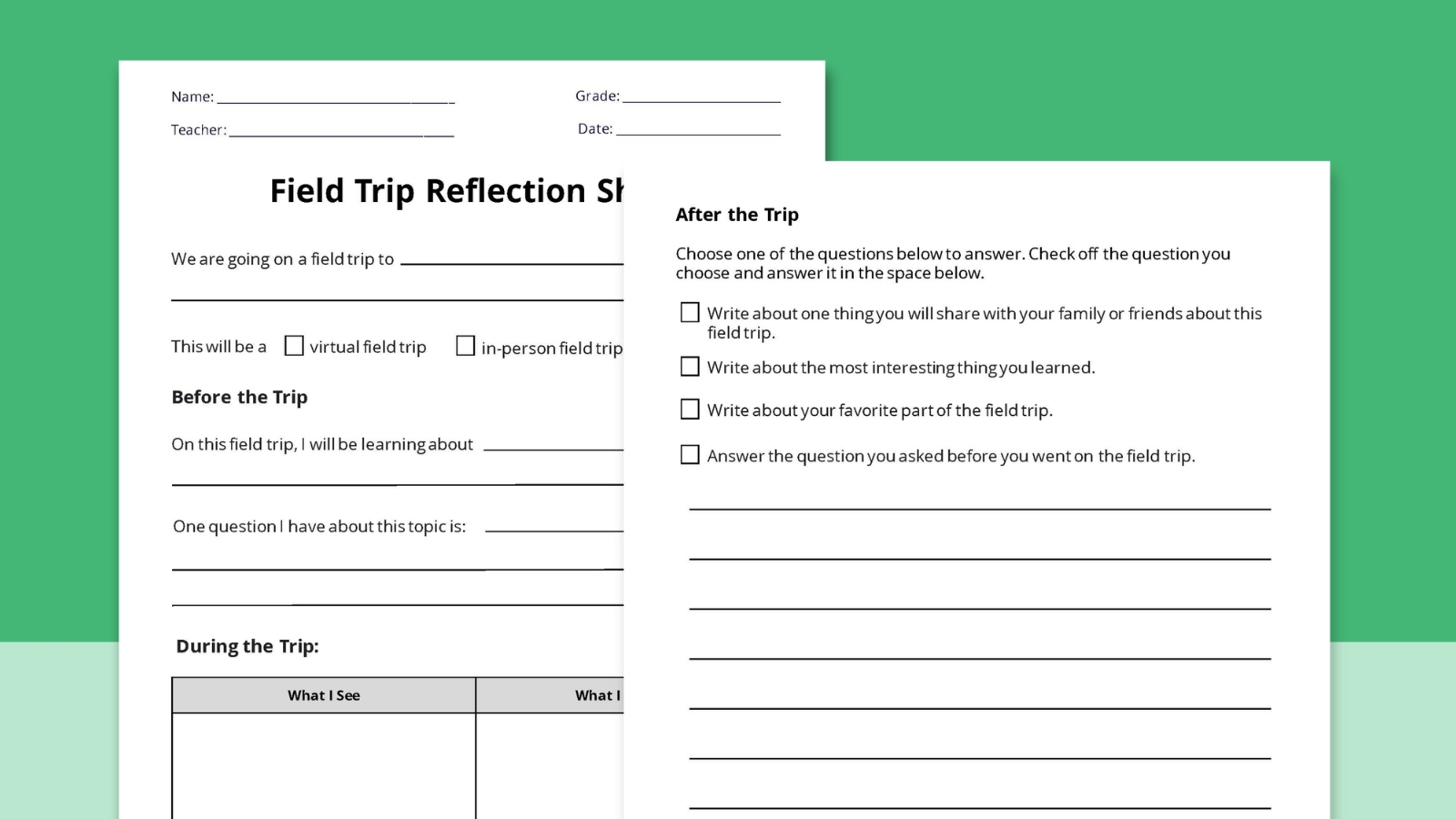
Heading out into the real world gives kids a chance to learn indirectly through experiences. They may see concepts they already know put into practice or learn new information or skills from the world around them.
Learn more: The Big List of Pre-K to Grade 12 Field Trip Ideas
Games and Gamification
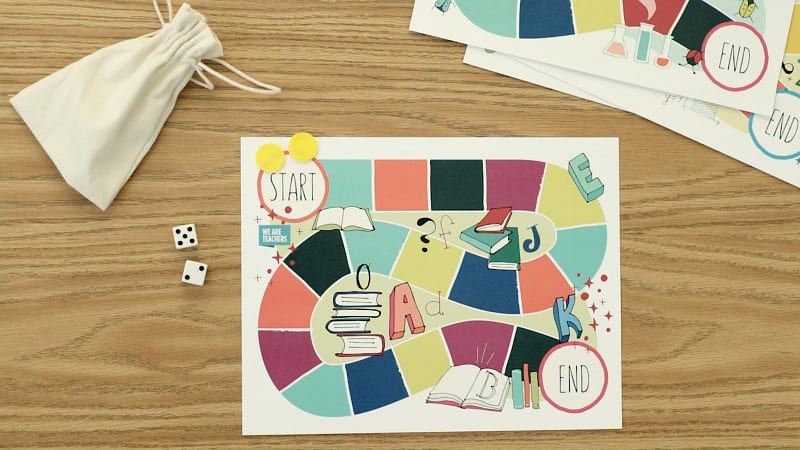
Teachers have long known that playing games is a fun (and sometimes sneaky) way to get kids to learn. You can use specially designed educational games for any subject. Plus, regular board games often involve a lot of indirect learning about math, reading, critical thinking, and more.
Learn more: Classic Classroom Games and Best Online Educational Games
Service Learning
This is another instructional strategies example that takes students out into the real world. It often involves problem-solving skills and gives kids the opportunity for meaningful social-emotional learning.
Learn more: What Is Service Learning?
Work-Based Learning
Work-based learning includes things like internships and apprenticeships, giving students a chance to learn on the job. This type of learning is generally more appropriate for older students, who are ready to begin exploring potential careers and job opportunities.
Classroom Jobs
Younger students can learn on the job too, but their focus is usually in the classroom instead. Classroom jobs provide a sense of responsibility and pride, while also teaching practical housekeeping and administrative skills.
Learn more: The Big List of Classroom Jobs for Pre-K to Grade 12
Interactive Instruction Instructional Strategies Examples
As you might guess, this strategy is all about interaction between the learners and often the teacher. The focus is on discussion and sharing. Students hear other viewpoints, talk things out, and help one another learn and understand the material. Teachers can be a part of these discussions, or they can oversee smaller groups or pairings and help guide the interactions as needed. Interactive instruction helps students develop interpersonal skills like listening and observation.
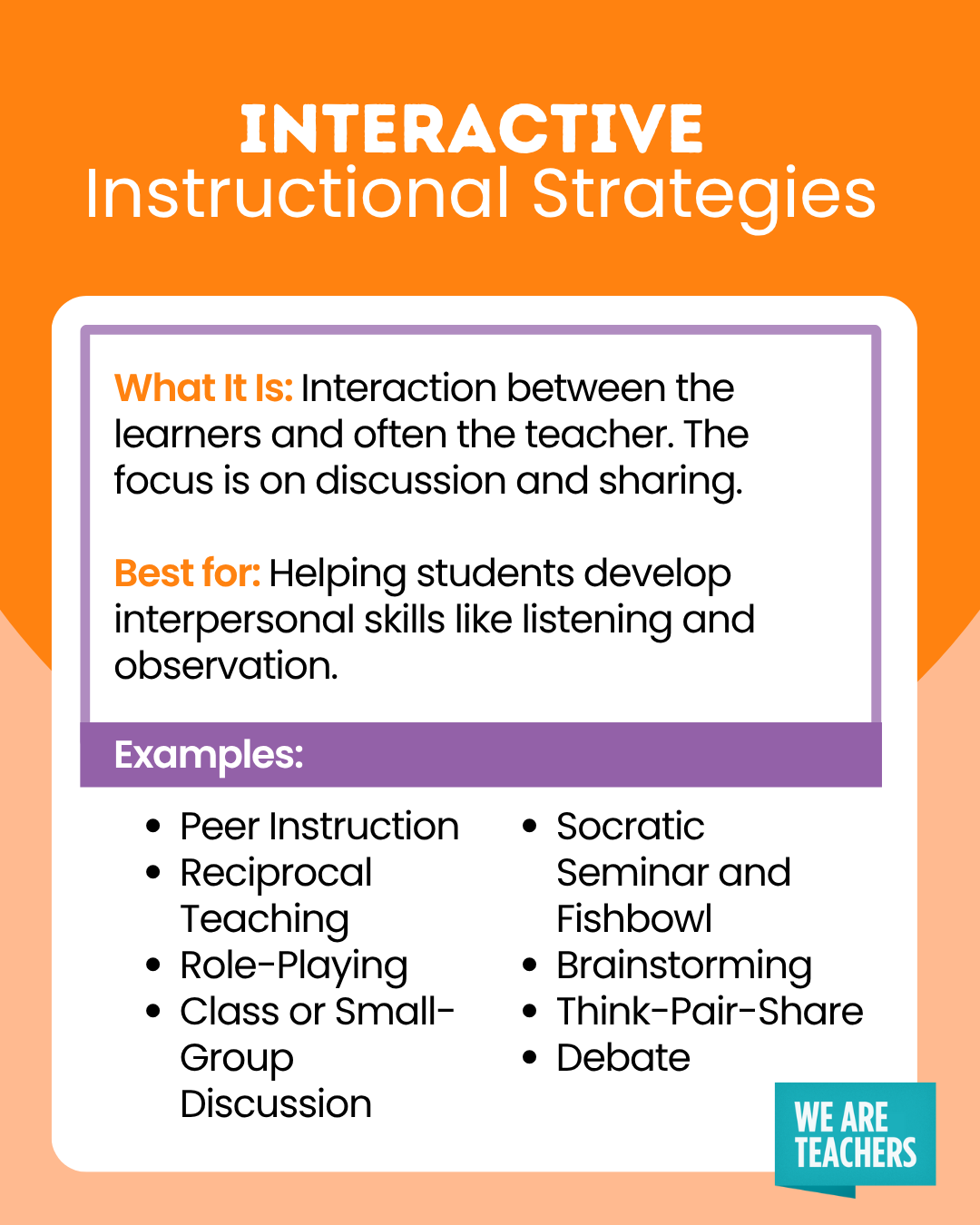
Peer Instruction
It’s often said the best way to learn something is to teach it to others. Studies into the so-called “protégé effect” seem to prove it too. In order to teach, you first must understand the information yourself. Then, you have to find ways to share it with others—sometimes in more than one way. This deepens your connection to the material, and it sticks with you much longer. Try having peers instruct one another in your classroom, and see the magic in action.
Reciprocal Teaching
This method is specifically used in reading instruction, as a cooperative learning strategy. Groups of students take turns acting as the teacher, helping students predict, clarify, question, and summarize. Teachers model the process initially, then observe and guide only as needed.
Partner Reading
Two students sit side-by-side, sharing a text. Students take turns reading out loud while the other listens and helps if needed. Often, the more fluent reader takes the first turn to model expression, pronunciation, and more. Students may also read in unison, a technique known as “choral reading.”
One strategy I believe more classrooms should use consistently is partner reading. In many classrooms, the amount of time students actually spend reading is surprisingly low. Partner reading dramatically increases what I call “miles on the page” (the amount of actual reading students do during a lesson), and that practice is one of the fastest ways to improve literacy.
It also creates an important layer of psychological safety. When students read with a peer, they can ask questions, clarify meaning, and practice fluency without the pressure of performing in front of the whole class. This is especially powerful for multilingual learners, who benefit from having space to practice language and comprehension in a low-stakes setting before sharing publicly.
—Jo Lein, @educoachbyjo
Debate
Some teachers shy away from debate in the classroom, afraid it will become too adversarial. But learning to discuss and defend various points of view is an important life skill. Debates teach students to research their topic, make informed choices, and argue effectively using facts instead of emotion.
Learn more: High School Debate Topics To Challenge Every Student

Class or Small-Group Discussion
Class, small-group, and pair discussions are all excellent interactive instructional strategies examples. As students discuss a topic, they clarify their own thinking and learn from the experiences and opinions of others. Of course, in addition to learning about the topic itself, they’re also developing valuable active listening and collaboration skills.
Learn more: Strategies To Improve Classroom Discussions
Socratic Seminar and Fishbowl
Take your classroom discussions one step further with the fishbowl method. A small group of students sits in the middle of the class. They discuss and debate a topic, while their classmates listen silently and make notes. Eventually, the teacher opens the discussion to the whole class, who offer feedback and present their own assertions and challenges.
Learn more: How I Use Fishbowl Discussions To Engage Every Student
Brainstorming
Rather than having a teacher provide examples to explain a topic or solve a problem, students do the work themselves. Remember the one rule of brainstorming: Every idea is welcome. Ensure everyone gets a chance to participate, and form diverse groups to generate lots of unique ideas.
Role-Playing
Role-playing is sort of like a simulation but less intense. It’s perfect for practicing soft skills and focusing on social-emotional learning. Put a twist on this strategy by having students model bad interactions as well as good ones and then discussing the difference.
Think-Pair-Share
This structured discussion technique is simple: First, students think about a question posed by the teacher. Pair students up, and let them talk about their answer. Finally open it up to whole-class discussion. This helps kids participate in discussions in a low-key way and gives them a chance to “practice” before they talk in front of the whole class.
Learn more: Think-Pair-Share and Fun Alternatives
Samples of Independent Learning Instructional Strategies
Also called independent study, this form of learning is almost entirely student-led. Teachers take a backseat role, providing materials, answering questions, and guiding or supervising. It’s an excellent way to allow students to dive deep into topics that really interest them, or to encourage learning at a pace that’s comfortable for each student.

Learning Centers
Foster independent learning strategies with centers just for math, writing, reading, and more. Provide a variety of activities, and let kids choose how they spend their time. They often learn better from activities they enjoy.
Learn more: The Big List of K-2 Literacy Centers
Computer-Based Instruction
Once a rarity, now a daily fact of life, computer-based instruction lets students work independently. They can go at their own pace, repeating sections without feeling like they’re holding up the class. Teach students good computer skills at a young age so you’ll feel comfortable knowing they’re focusing on the work and doing it safely.
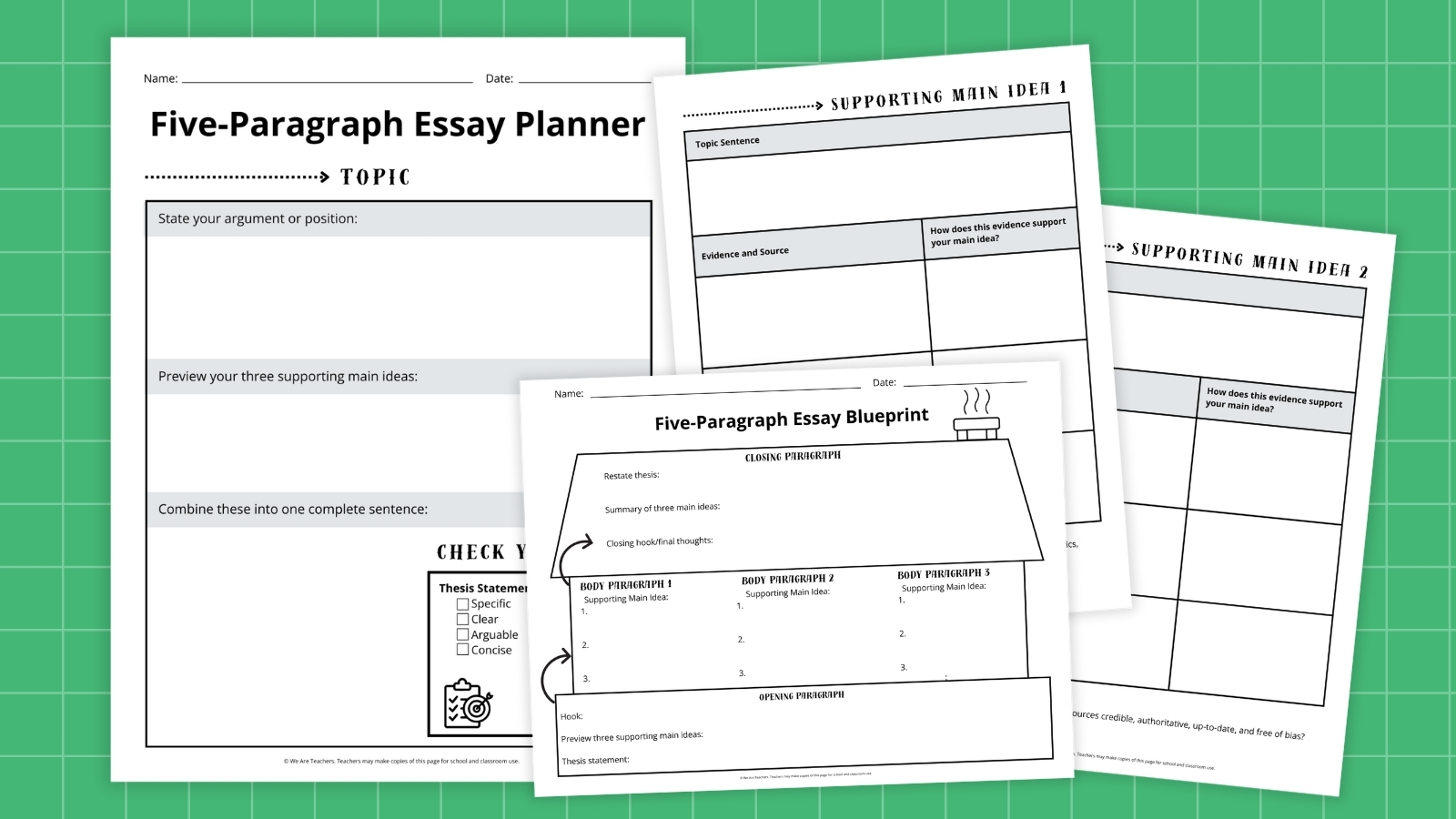
Essays
Writing an essay encourages kids to clarify and organize their thinking. Written communication has become more important in recent years, so being able to write clearly and concisely is a skill every kid needs. This independent instructional strategy has stood the test of time for good reason.
Learn more: The Big List of Essay Topics for High School
Research Projects
Here’s another oldie but goodie! When kids work independently to research and present on a topic, their learning is all up to them. They set the pace, choose a focus, and learn how to plan and meet deadlines. This is often a chance for them to show off their creativity and personality too.
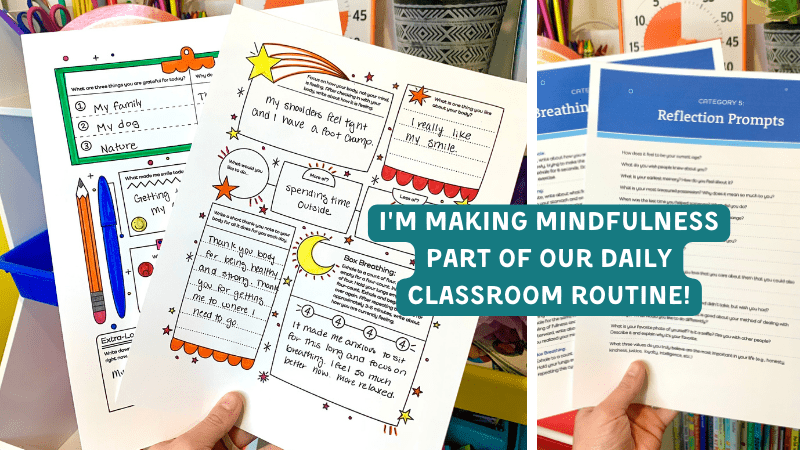
Journaling
Personal journals give kids a chance to reflect and think critically on topics. Whether responding to teacher prompts or simply recording their daily thoughts and experiences, this independent learning method strengthens writing and intrapersonal skills.
Learn more: The Benefits of Journaling in the Classroom
Play-Based Learning
In play-based learning programs, children learn by exploring their own interests. Teachers identify and help students pursue their interests by asking questions, creating play opportunities, and encouraging students to expand their play.
Learn more: What Is Play-Based Learning?
More Instructional Strategies Examples
Don’t be afraid to try new strategies from time to time—you just might find a new favorite! Here are some of the most common instructional strategies examples.
Simulations
This strategy combines experiential, interactive, and indirect learning all in one. The teacher sets up a simulation of a real-world activity or experience. Students take on roles and participate in the exercise, using existing skills and knowledge or developing new ones along the way. At the end, the class reflects separately and together on what happened and what they learned.
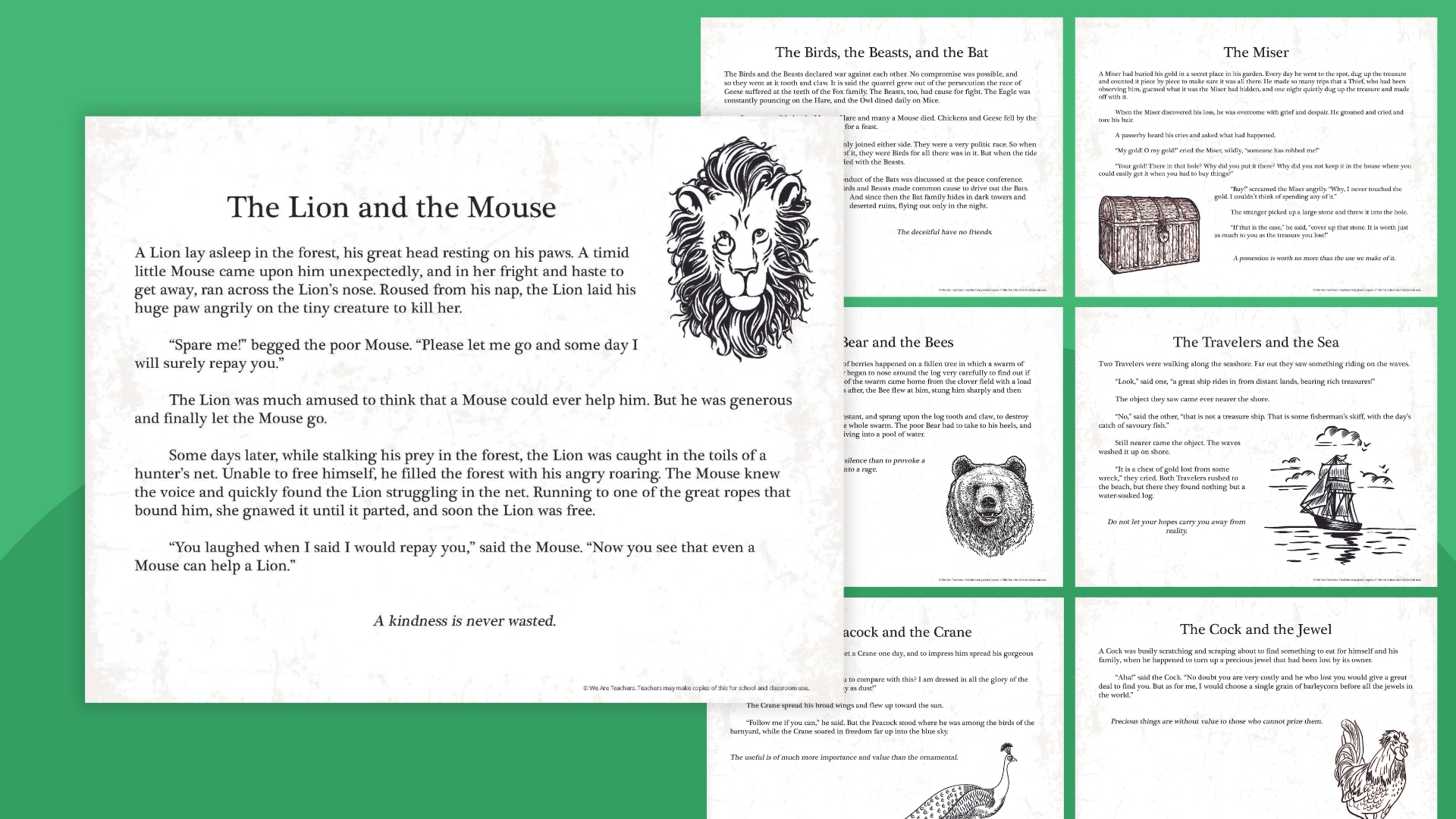
Storytelling
Ever since Aesop’s fables, we’ve been using storytelling as a way to teach. Stories grab students’ attention right from the start and keep them engaged throughout the learning process. Real-life stories and fiction both work equally well, depending on the situation.
Learn more: Teaching as Storytelling
Scaffolding
Scaffolding is defined as breaking learning into bite-sized chunks so students can more easily tackle complex material. It builds on old ideas and connects them to new ones. An educator models or demonstrates how to solve a problem, then steps back and encourages the students to solve the problem independently. Scaffolding teaching gives students the support they need by breaking learning into achievable sizes while they progress toward understanding and independence.
Learn more: What Is Scaffolding in Education?
Spaced Repetition
Often paired with direct or independent instruction, spaced repetition is a method where students are asked to recall certain information or skills at increasingly longer intervals. For instance, the day after discussing the causes of the American Civil War in class, the teacher might return to the topic and ask students to list the causes. The following week, the teacher asks them once again, and then a few weeks after that. Spaced repetition helps make knowledge stick, and it is especially useful when it’s not something students practice each day but will need to know in the long term (such as for a final exam).
Graphic Organizers
Graphic organizers are a way of organizing information visually to help students understand and remember it. A good organizer simplifies complex information and lays it out in a way that makes it easier for a learner to digest. Graphic organizers may include text and images, and they help students make connections in a meaningful way.
Learn more: Graphic Organizers 101: Why and How To Use Them
Jigsaw
Jigsaw combines group learning with peer teaching. Students are assigned to “home groups.” Within that group, each student is given a specialized topic to learn about. They join up with other students who were given the same topic, then research, discuss, and become experts. Finally, students return to their home group and teach the other members about the topic they specialized in.
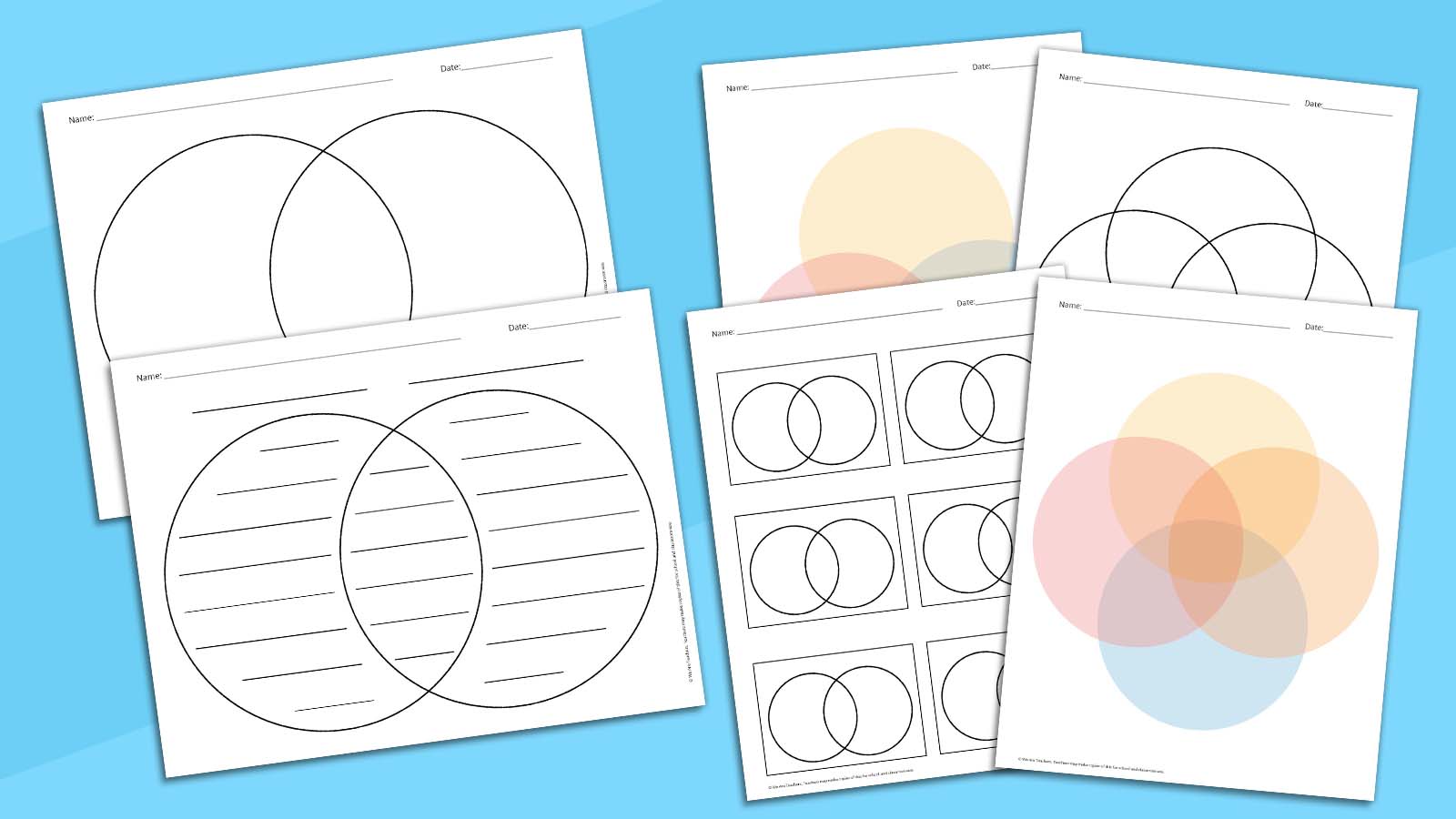
Venn Diagrams
Teaching students how to compare and contrast? The visual aspect of a Venn diagram is a really helpful instructional strategy!
Multidisciplinary Instruction
As the name implies, this instructional strategy approaches a topic using techniques and aspects from multiple disciplines, helping students explore it more thoroughly from a variety of viewpoints. For instance, to learn more about a solar eclipse, students might explore scientific explanations, research the history of eclipses, read literature related to the topic, and calculate angles, temperatures, and more.
Interdisciplinary Instruction
This instructional strategy takes multidisciplinary instruction a step further, using it to synthesize information and viewpoints from a variety of disciplines to tackle issues and problems. Imagine a group of students who want to come up with ways to improve multicultural relations at their school. They might approach the topic by researching statistical information about the school population, learning more about the various cultures and their history, and talking with students, teachers, and more. Then, they use the information they’ve uncovered to present possible solutions.
Differentiated Instruction
Differentiated instruction means tailoring your teaching so all students, regardless of their ability, can learn the classroom material. Teachers can customize the content, process, product, and learning environment to help all students succeed. There are lots of differentiated instructional strategies to help educators accommodate various learning styles, backgrounds, and more.
Learn more: What Is Differentiated Instruction?
Culturally Responsive Teaching
Culturally responsive teaching is based on the understanding that we learn best when we can connect with the material. For culturally responsive teachers, that means weaving their students’ various experiences, customs, communication styles, and perspectives throughout the learning process.
Learn more: What Is Culturally Responsive Teaching?
Response to Intervention
Response to Intervention, or RTI, is a way to identify and support students who need extra academic or behavioral help to succeed in school. It’s a tiered approach with various “levels” students move through depending on how much support they need.
Learn more: What Is Response to Intervention?
Inquiry-Based Learning
Inquiry-based learning is a great way to engage kids cognitively and get them invested in piecing together new concepts, connecting them to what they know. When we engage kids’ background knowledge questioning and help them use it to guide their learning, they are so much more invested and walk away with more.
—Chrissy Beltran, (@buzzingwithmsb)
Inquiry-based learning means tailoring your curriculum to what your students are interested in rather than having a set agenda that you can’t veer from—it means letting children’s curiosity take the lead and then guiding that interest to explore, research, and reflect upon their own learning.
Learn more: What Is Inquiry-Based Learning?
Growth Mindset
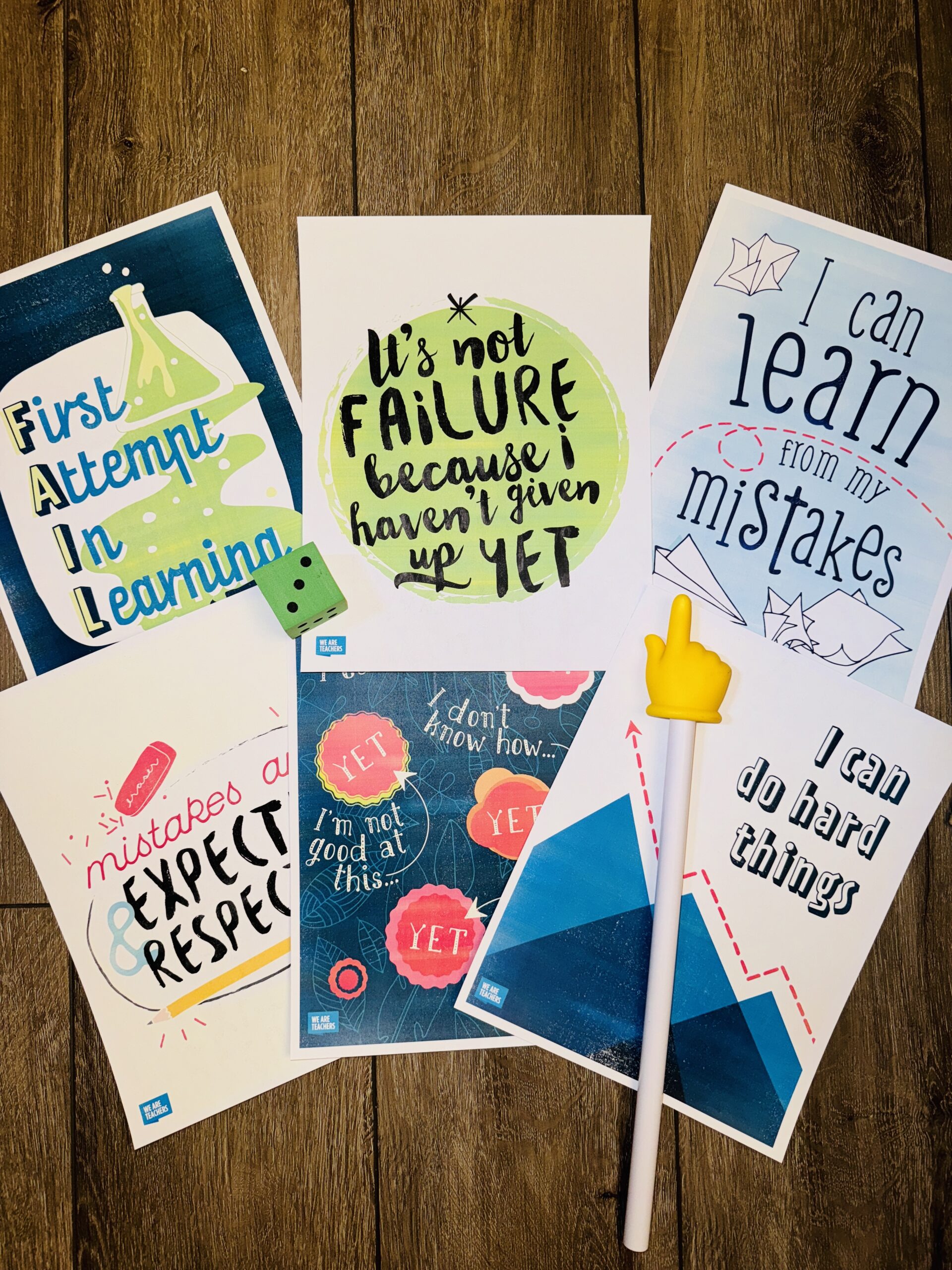
Growth mindset is key for learners. They must be open to new ideas and processes and believe they can learn anything with enough effort. It sounds simplistic, but when students really embrace the concept, it can be a real game-changer. Teachers can encourage a growth mindset by using instructional strategies that allow students to learn from their mistakes, rather than punishing them for those mistakes.
Learn more: Growth Mindset vs. Fixed Mindset and 26 Growth Mindset Activities
Blended Learning
This strategy combines face-to-face classroom learning with online learning, in a mix of self-paced independent learning and direct instruction. It’s incredibly common in today’s schools, where most students spend at least part of their day completing self-paced lessons and activities via online technology. Students may also complete their online instructional time at home.
Asynchronous (Self-Paced) Learning
This fancy term really just describes strategies that allow each student to work at their own pace using a flexible schedule. This method became a necessity during the days of COVID lockdowns, as families did their best to let multiple children share one device. All students in an asynchronous class setting learn the same material using the same activities, but do so on their own timetable.
Learn more: Synchronous vs. Asynchronous Learning
Essential Questions
Essential questions are the big-picture questions that inspire inquiry and discussion. Teachers give students a list of several essential questions to consider as they begin a unit or topic. As they dive deeper into the information, teachers ask more specific essential questions to help kids make connections to the “essential” points of a text or subject.
Learn more: Questions That Set a Purpose for Reading
Choice Boards
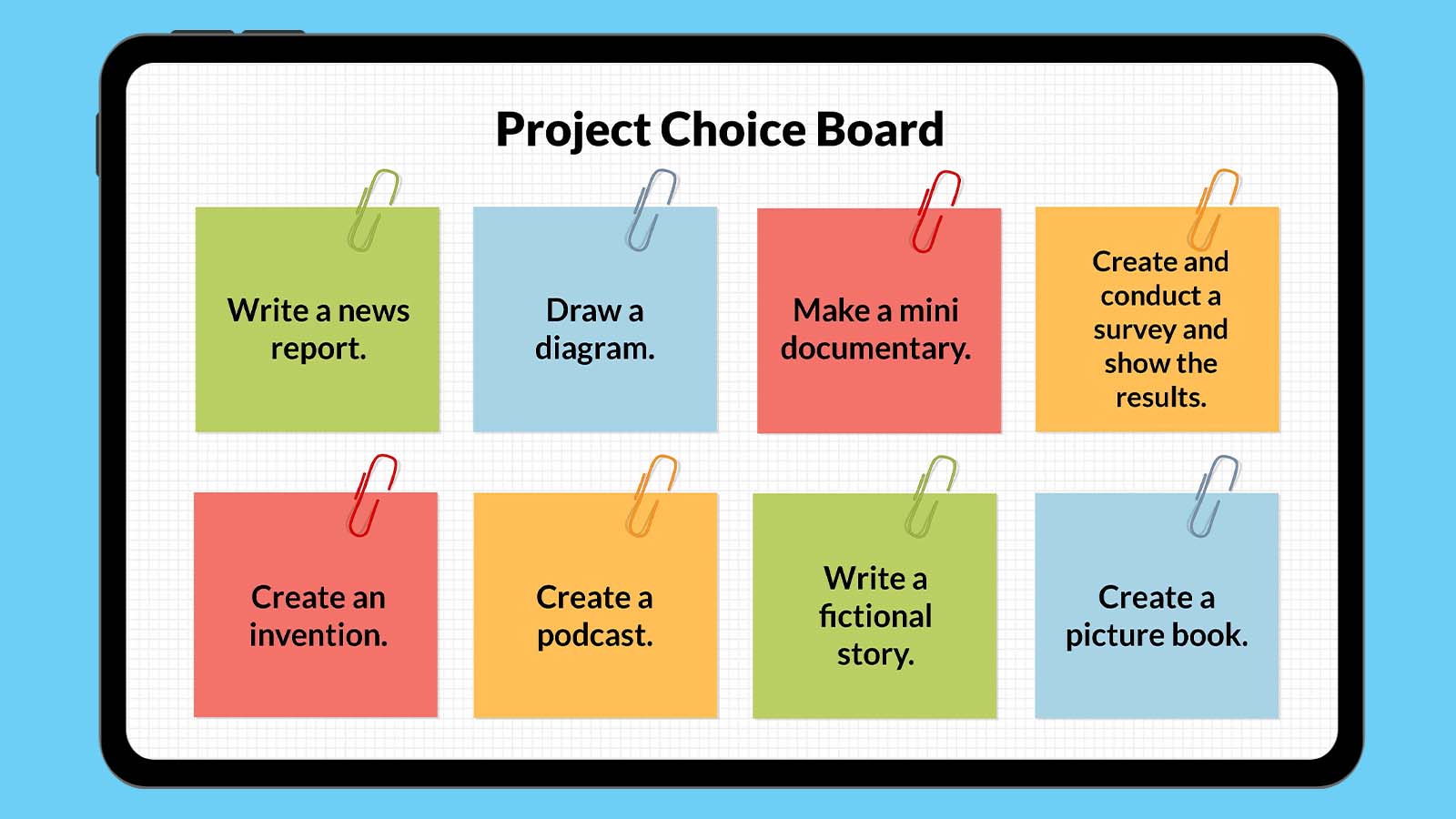
Choice boards are a way to differentiate assignments and allow students to choose from different options when they present their work. The teacher chooses the options available, and the student chooses which to complete. They can be used to give students choices when they finish early, need a brain break, or select a reward.
Learn more: Choice Board Templates (Free Printable Bundle)
KWL (Know–Want To Know–Learned)
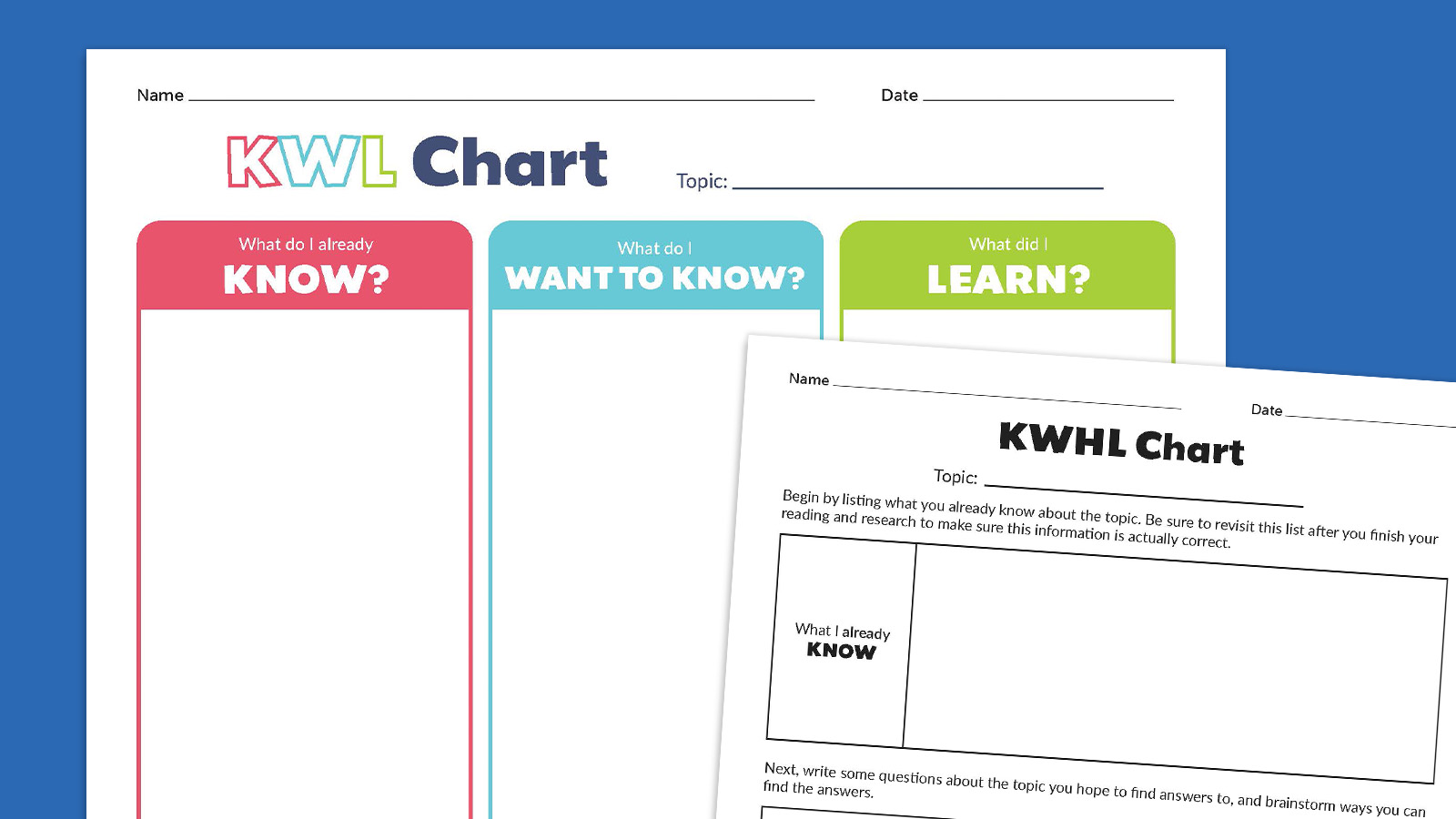
Think of these graphic organizers as a living document, one your students will add to throughout their study of a particular topic. In the “Know” section, students record their background knowledge. Then, they make note of anything they expect or hope to learn, and finally they record the knowledge they’ve gained. Expanded versions include a few additional categories as well.
Learn more: Free Printable KWL Charts Bundle
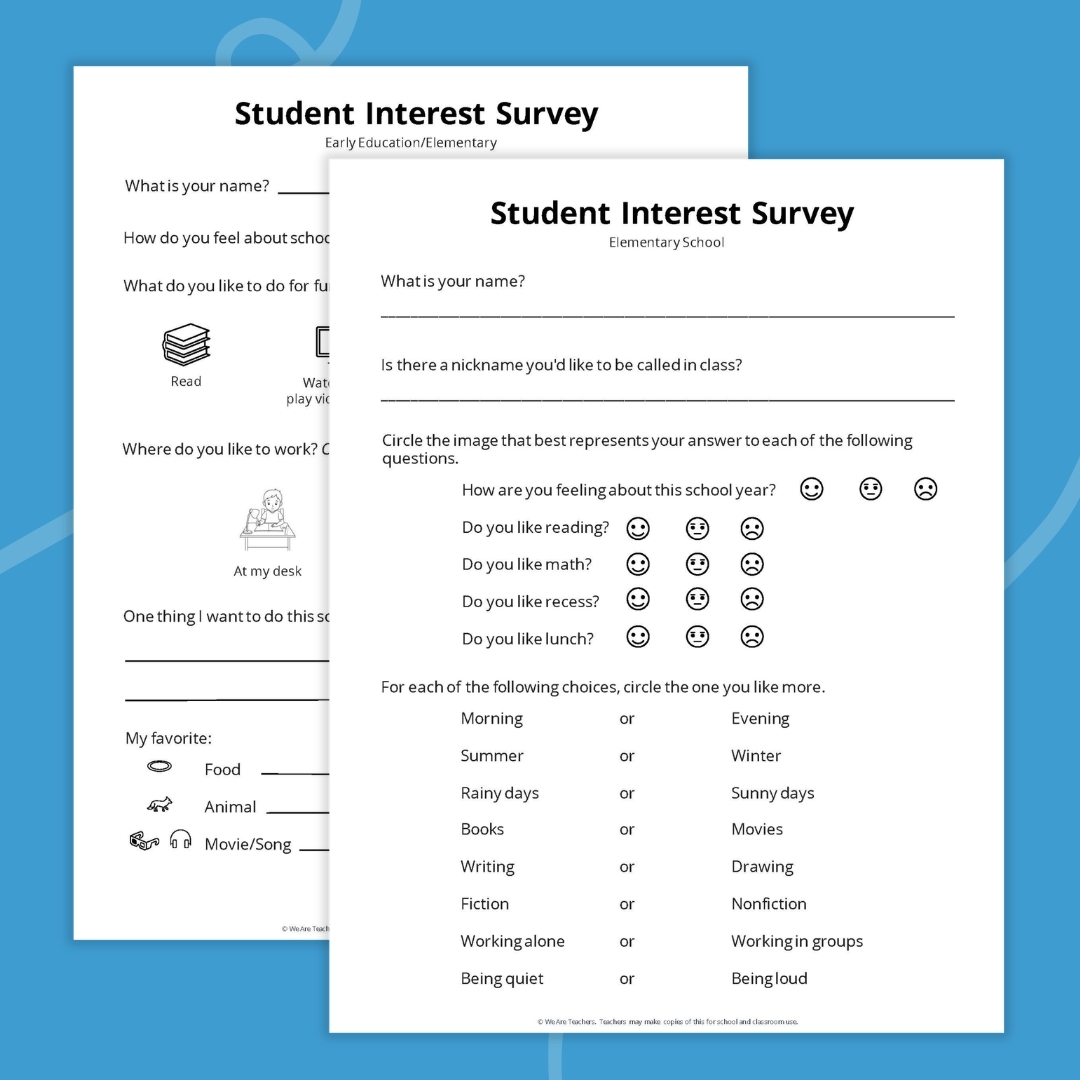
Don’t forget to grab your free Student Interest Surveys!
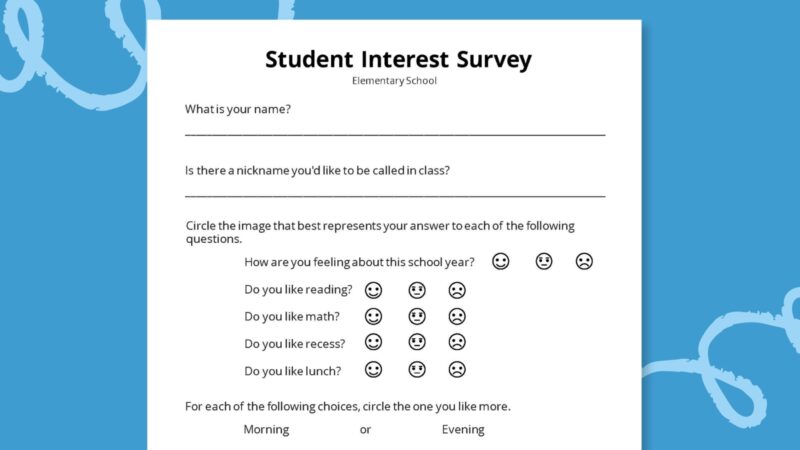
Use these surveys to get to know your students better, so you can choose stronger instructional strategies for your classroom. The surveys are for students in grades K-12. Just click the button below and fill out the form to get them!
Come discuss instructional strategies and ask for advice in the We Are Teachers HELPLINE group on Facebook!