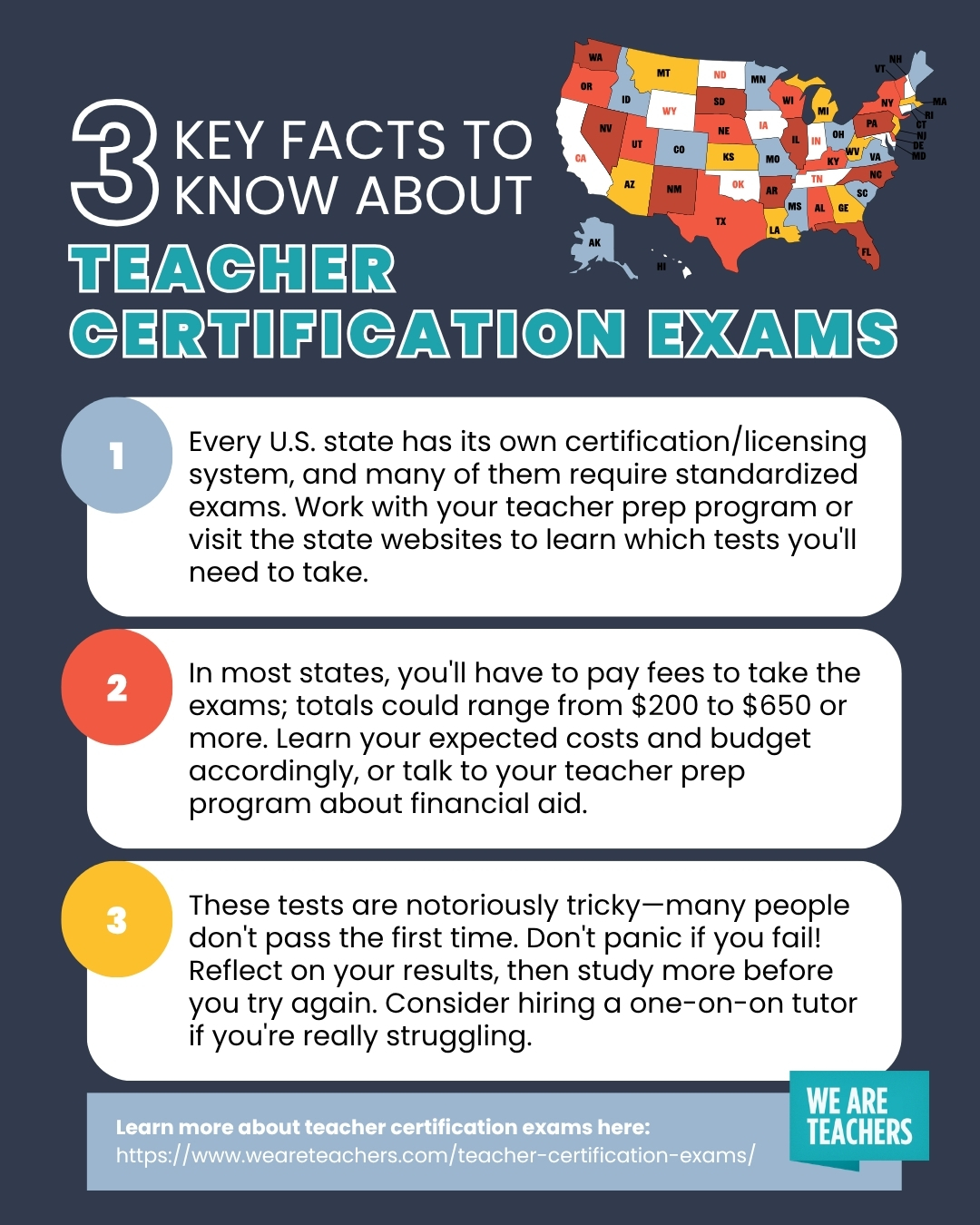

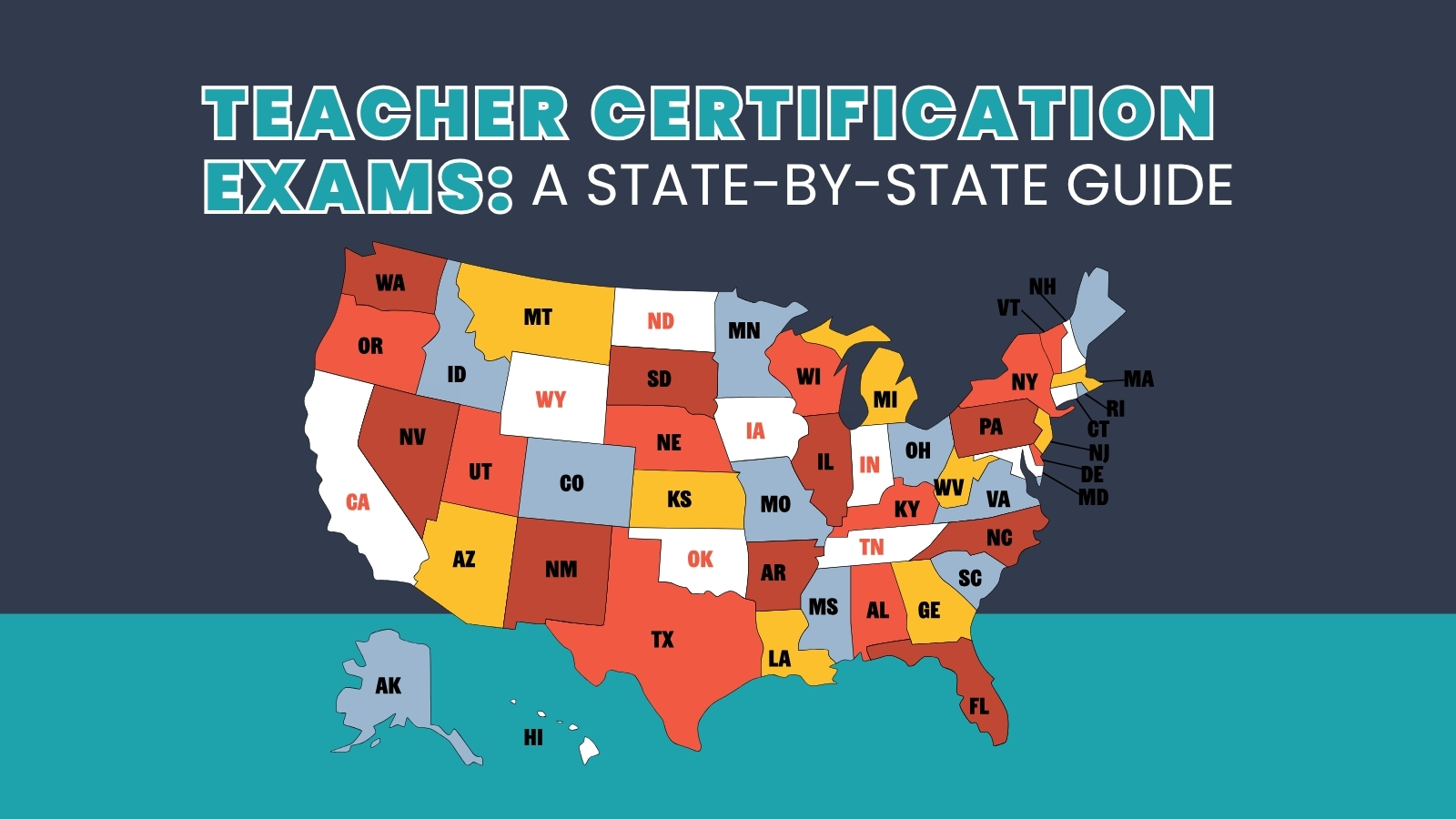
It takes a lot of work to become a teacher. In addition to training, studying, and student teaching, in many cases you also have to pass teacher certification exams. Every single U.S. state requires certification of some sort, but each one is different.
Whether you are studying for the Praxis, NES, or a state-required exam, take a look at this list to get an idea of the tests you may need to take to earn your certificate or license by state. Plus, get tips for taking (and passing!) your exams from the experts!
Jump to:
Teacher Certification Exam Overview
Here are a few notes on teacher tests in general:
- If you’re earning your initial teaching license or certificate through your college training program, good news! They’ll tell you which tests you need to take and may help you arrange for them.
- While most new teachers earn their licenses through college teacher training programs, many states offer alternative routes. In most cases, required tests remain the same, but this can vary by state.
- If you’re moving from one state to another and need a new license, you may or may not need to take teacher certification exams. Use the state-level links on this page to find more information.
- Many states use at least some nationally standardized tests, usually from organizations like ETS Praxis or Pearson NES. You’ll find more info about those tests on the companies’ websites, linked here for your convenience.
- Some states offer endorsements on licenses or certificates, which can require additional tests. Not all of those tests may be listed here, so be sure to check with the state if you have questions.
- Some states require tests for substitute teachers and teachers’ aides, which aren’t listed here. Check with your state for requirements.
And finally: States are constantly changing, revising, and updating their testing requirements. This information is accurate as of spring 2026 but can change at any time. So always verify the tests you’ll need to take before signing up.

Expert Tips and Advice for Teacher Certification Exams
For complimentary tips and strategies that you can use in any state, check out The Educator’s Must-Have Guide to Excel at U.S. Teacher Certification Exams from Moreland University. Moreland also provides many free state-specific guides for teacher certification processes including certification exams.
7 Tips From the Experts
Dedicate just 20 minutes a day to study. Consistent daily practice over a longer period yields better results than three-hour cram sessions.
—Kathleen Jasper, Ed.D. (@kj_kathleenjasper)
We asked two test-prep professionals to give us their top tips for prepping for and taking your teacher certification exams: Kathleen Jasper, Ed.D. (@kj_kathleenjasper) and Robin Cornecki (@robin.cornecki). Both have popular Instagram accounts where they regularly share helpful advice—be sure to follow them for more great tips!
1. Access the test blueprint.
“Search for and download the specific test blueprint and specifications by searching for your test name, number, and the term ‘test blueprint and specification,’” Kathleen recommends. The test blueprint outlines the content, learning objectives, and cognitive levels of an exam, so you’ll know exactly what information the test covers.
2. Study the categories—not just random problems.
“Certification exams like the Praxis are built around specific content domains,” Robin explains. “Instead of jumping between random questions, organize your studying by category (algebra, functions, statistics & probability, teaching tasks). When you do this, you start to recognize the patterns of questions that show up again and again—and that’s when the test starts to feel predictable.”
3. Think like a test maker.
“Review the specifications in the blueprint and note key words and phrases,” advises Kathleen. “These terms often appear in the correct answer choices. This shift in perspective helps you approach the exam from the maker’s point of view rather than the test taker’s.”
4. Study incrementally.
Kathleen also offers this simple tip: “Dedicate just 20 minutes a day to study. Whether it is reading a short section or completing part of a practice test, consistent daily practice over a longer period yields better results than three-hour cram sessions.”
5. Focus on understanding, not just answers.
“These exams don’t just test if you can get the right answer—they test if you understand why,” Robin stresses. “Practice explaining your reasoning out loud or writing a quick justification. This is especially important for teaching-task questions, where your explanation matters just as much as your math.”
6. Work backward from the answer choices.
“Look for ‘good words’ in potential answers and eliminate choices containing ‘bad words,” Kathleen suggests. “This strategy is particularly effective for scenario-based questions. Practice this method while studying to see if it works for you before applying it on test day.”
7. Practice like it’s the real test.
“A lot of people study passively but never build test-day stamina,” cautions Robin. “Use a timer, work through a full set of questions without notes, and then review your mistakes. Also pay attention to pacing. For example, the middle school math exam has 66 questions in 180 minutes—that’s about 2.5 minutes per question. Training your timing ahead of time makes a huge difference in confidence.”
Dealing With Teacher Certification Test Anxiety
Struggling with a certification exam does NOT mean you’re a bad teacher. You will pass! Just keep trying and you will succeed!
—Robin Cornecki (@robin.cornecki)
Both Robin and Kathleen offered one major tip that may help you if you’re feeling nervous about the test: It’s OK if you don’t pass the first time!
“Remember that many people take these exams more than once before earning their certification; needing multiple attempts is normal,” assures Kathleen. In fact, according to Robin, only 45% of people pass these exams on their first try!
“These tests measure a very specific combination of content knowledge and test-taking strategy—and many strong educators need more than one attempt,” Robin shares. “And at the end of the day, passing isn’t about knowing everything—it’s about knowing enough of the right things.”
With that in mind, here are some tips from these test pros to help calm your test anxiety:
- “Eliminate the fear of the unknown. Understanding the structure and specifications of the exam is the best way to reduce anxiety,” Kathleen recommends. That’s why she suggests downloading the test blueprint in advance.
- Use practice tests to get familiar with the question style. Robin says, “A lot of anxiety comes from not knowing what to expect. The more you practice with questions that look like the actual exam, the less intimidating it becomes.”
- Don’t let your study sessions stress you out. “Break studying into small, structured sessions,” urges Robin. “Focus on one topic at a time instead of trying to cover everything at once. Small wins build confidence quickly.”
- One last tip from Robin: “Focus on progress, not perfection. You do not need to know everything to pass. These exams are designed so you can miss questions and still succeed. The goal is steady improvement—not perfection. You can always flag a problem and return to it to eliminate the pressure of getting every item correct.”
Get more general test-taking tips and strategies here.
State-by-State Testing Requirements for 2026
And now, on to the testing requirements by state! Remember, this information is accurate according to individual state websites as of spring 2026. Always check with your teacher prep program or state department of education for the most up-to-date info as it applies to your own personal journey toward becoming a teacher.
Jump to:
The Alabama Educator Certification Assessment Program (AECAP) requires teachers to pass these exams:
Alaska requires two types of tests for teacher certification:
Arizona uses a combination of NES and AEPA assessments, collectively referred to as the Arizona Educator Proficiency Assessments.
Arkansas exam requirements depend on the age and subject(s) you plan to teach.
California administers its own set of teacher certification exams. Required tests vary by age and subject and include:
In Colorado, you may not need to take any content knowledge tests if you complete approved teacher prep college programs. Some endorsements or other paths to certification may require Praxis subject assessments. Learn more about Colorado licensing exams here.
Connecticut requires content knowledge exams, mainly offered by Praxis and Pearson.
In Delaware, you’ll need to pass content knowledge exams.
Florida uses its own teacher certification exams program, known as FTCE (Florida Teacher Certification Examinations). There are three types of tests all teachers need to pass:
- General Knowledge Test: This four-part test measures your basic reading, writing, and math skills. It includes multiple-choice questions and an essay.
- Professional Education Test: The pedagogy and professional skills test is comprised of approximately 120 multiple-choice questions.
- Subject Area Examinations: Subject area examinations may be multiple-choice only or might include written and oral sections, depending on the subject and age. Some tests have several subtests.
Georgia has developed its own teaching testing program, GACE (Georgia Assessments for the Certification of Educators). Beginning in 2025, these tests are administered through Evaluation Systems, Pearson. Tests include:
- Content Examinations: These test your knowledge of subject matter. Different tests are required based on the age and subject(s) you plan to teach. See the full list of Georgia content exams here.
- Georgia Ethics Assessment: This assessment includes training modules and scenario-based questions focused on ethical decision-making and the Georgia Code of Ethics for Educators. It is required for candidates seeking teacher certification in Georgia.
Hawaii allows candidates to demonstrate required teaching competencies through approved preparation programs, Praxis exams, or other verification methods, depending on the certification pathway. See full details of Hawaii Praxis tests here.
- Praxis Core Academic Skills for Educators: This tests your basic reading, writing, and math skills. Candidates can sometimes meet the basic skills requirement through SAT/ACT scores or other measures.
- Principles of Learning and Teaching: There are several versions of the PLT test, based on the age level(s) you plan to teach.
- Praxis Subject Assessment Tests: You’ll take a different test or series of tests depending on the age and subject(s) you’ll be teaching.
Idaho requires the appropriate Praxis Subject Assessments for the area and subject(s) you plan to teach. Some tests have multiple subtests built in. Learn more about Idaho’s required Praxis tests here.
NOTE: Illinois previously required the edTPA. In 2025, this requirement was suspended and is currently waived through August 31, 2029.
- ILTS Content Knowledge Tests: Illinois requires candidates to pass the appropriate Illinois Licensure Testing System (ILTS) content-area test, administered by Pearson, for the subject and grade level they plan to teach.
Indiana uses Praxis to administer its teacher certification tests, listed below. Learn more about Indiana Praxis tests here.
- Principles of Learning and Teaching: There are several versions of the PLT test, based on the age level(s) you plan to teach.
- Praxis Subject Assessments: The required content knowledge exams vary based on the certification you’re seeking.
In Iowa, if you complete a state-approved teacher prep program, licensure exams are not required. You’ll be granted your initial teaching license after completing the program and meeting state requirements.
If moving to the state of Iowa, teachers need to show proof of completing an accredited out-of-state program including transcript review. Learn more about Iowa’s out-of-state program here.
As of 2023, Kansas no longer requires the Principles of Learning and Teaching (PLT) Praxis exam. Kansas still requires Praxis Subject Assessments specific to the ages and subject(s) you’ll be teaching.
Kentucky has several teacher testing requirements. Learn more about Kentucky Praxis tests here.
- Praxis Core Academic Skills for Educators: This tests your basic reading, writing, and math skills. Teacher prep programs require it for admission (minimum ACT and GRE scores may also accepted).
- Principles of Learning and Teaching (PLT): There are several versions of the Praxis PLT test, based on the age level(s) you plan to teach.
- Praxis Subject Assessments: These test your knowledge of the subject area(s) you wish to teach, depending on grade level. See the Kentucky required tests here.
Louisiana requires the following teacher exams. Find out more about Louisiana’s Praxis exams here.
- Principles of Learning and Teaching (PLT): There are several versions of the Praxis PLT test, based on the age level(s) you plan to teach.
- Praxis Subject Assessments: These test your knowledge of the subject area(s) you wish to teach, depending on grade level. See the full list of required Louisiana tests here.
In 2022, Maine eliminated its Praxis testing requirements. Instead, teachers must complete an approved teacher prep college with an average GPA of 3.0 in required courses, OR undergo a portfolio review by the Maine Department of Education. Learn more about Maine’s teacher certification process here.
Maryland has several teacher testing requirements. Explore the Maryland Praxis assessments here.
- Praxis Core Academic Skills for Educators: This tests your basic reading, writing, and math skills. You may waive this exam requirement with minimum scores on the ACT, SAT, or GRE.
- Praxis Subject Assessments: These test your knowledge of the subject area(s) you wish to teach, depending on grade level. See the Maryland required tests here.
- Pedagogy Performance Assessment: Maryland is in a transition period for this assessment category. Until August 31, 2026, the Praxis Principles of Learning and Teaching (PLT) exam, the edTPA, OR the Praxis PPAT (Praxis Performance Assessment of Teachers) are all acceptable options. Beginning September 1, 2026, candidates must take the edTPA to fulfill this requirement.
The Massachusetts Tests for Educator Licensure (MTEL) program oversees teacher testing in the state. Here’s an overview of the current test requirements for most teacher licensure candidates:
NOTE: In 2025, Massachusetts began accepting approved alternatives to the MTEL assessments for some candidates. Find out more about these alternatives for Massachusetts here.
You’ll need to pass the appropriate MTTC (Michigan Test for Teacher Certification) content exams. These Pearson-administered tests vary based on the ages and subject(s) you’ll be teaching. Some candidates must also pass the MTTC Professional Knowledge and Skills exam that evaluates teaching and pedagogical knowledge. Learn more about MTTC exams here.
As of 2023, Minnesota removed the statutory MTLE exam (Minnesota Teacher Licensure Exams) requirements for Tier 3 and 4 candidates who complete an approved licensure program. However, nearly all candidates do need to take the edTPA to meet Minnesota licensure requirements.
Mississippi has multiple testing requirements. See the Mississippi Praxis test details here.
In Missouri, teacher candidates must pass Praxis Subject Assessments, which vary based on the ages and subjects you plan to teach. Explore Missouri’s required Praxis exams here.
Montana candidates may take the Praxis Subject Assessments tests appropriate to the ages and subject(s) they’ll be teaching, or meet this requirement with a passing score on a student teaching portfolio verified by the appropriate college/university official from the EPP, OR a 3.00 or higher coursework GPA, as verified by the appropriate college/university official from the EPP.
In Nebraska, candidates who complete an approved teacher preparation program are no longer required to take Praxis exams. Some other pathways to teacher certification may still require these tests. Learn more about Nebraska’s teacher certification here.
Nevada uses Praxis exams—find the specific tests required for Nevada teachers here.
- Praxis Core Academic Skills for Educators: This tests your basic reading, writing, and math skills. (You may be able to submit qualifying scores from other exams such as the ACT, SAT, or GRE to meet this requirement.)
- Principles of Learning and Teaching (PLT): There are several versions of the Praxis PLT, based on the age level(s) you plan to teach. Elementary Education endorsement candidates are not required to take this test.
- Praxis Subject Assessment Tests: These test your knowledge of the subject area(s) you wish to teach, depending on grade level. See the Nevada required tests here.
New Hampshire’s teacher testing requirements include:
- Basic Academic Skills Assessment: To show proficiency in reading, writing, and math, you have several options. You can take the Pearson Essential Academic Skills test, OR score at or above the 50th percentile in the ACT, SAT, GRE, and other tests, or use other options. Learn more here.
- Pearson Subject Area Tests: These test your content knowledge of the subject area(s) you wish to teach, depending on grade level. See the New Hampshire required tests here.
New Jersey uses Praxis Subject Assessments, which vary based on the subject(s) and ages you plan to teach. (The state no longer requires the Praxis Core Academic skills test.) Find out more about New Jersey’s Praxis tests here.
New Mexico uses a teaching portfolio assessment in place of standardized exams for many candidates. However, all elementary education candidates must take the Praxis Teaching Reading: Elementary Exam. Special education licenses require the Praxis: Special Education: Foundational Knowledge exam. See New Mexico’s Praxis exams here.
These Pearson exams are required in New York:
North Carolina requires several tests for teacher certification.
North Dakota uses Praxis exams for teacher licensure. See the full set of North Dakota Praxis exams here.
- Praxis Core Academic Skills for Educators: This tests your basic reading, writing, and math skills. Teacher prep programs require it for admission.
- Principles of Learning and Teaching (PLT): There are several versions of the Praxis PLT, based on the age level(s) you plan to teach.
- Praxis Subject Assessments: These test your knowledge of the subject area(s) you wish to teach, depending on grade level. See the North Dakota required tests here.
In Ohio, these are the testing requirements:
Oklahoma requires these tests:
Most candidates in Oregon take the appropriate Oregon Educator Licensure Assessments (ORELA), administered by Pearson. A few subject areas still require Praxis tests because Oregon has not adopted a corresponding ORELA exam.
Here are Pennsylvania’s teacher certification exam requirements:
Rhode Island uses Praxis tests for teacher certification. These tests include pedagogy and content knowledge assessment. See Rhode Island’s testing requirements here.
South Carolina teacher tests include:
South Dakota uses these tests:
Tennessee uses the following tests:
Teacher certification exams in Texas include:
In Utah, teacher candidates earning their teaching license in the areas of early childhood, elementary education, and special education must pass the Utah Foundations of Reading Assessment.
Vermont requires several Praxis tests. See the details for Vermont’s test requirements here.
In Virginia, testing requirements include:
Washington requires two types of teacher assessments:
West Virginia uses Praxis tests for teacher licensing. See the full list of West Virginia Praxis tests here.
- Praxis Core Academic Skills for Educators: This tests your basic reading, writing, and math skills. It’s required for admission to teacher prep programs, but can be waived with minimum ACT/SAT scores or by meeting other requirements.
- Principles of Learning and Teaching (PLT): There are several versions of the Praxis PLT, based on the age level(s) you plan to teach.
- Praxis Subject Assessments: These test your knowledge of the subject area(s) you wish to teach, depending on grade level.
Wisconsin teacher certification exams include:
Wyoming has only these requirements:
- Content Knowledge: Only two initial licensures require these Praxis tests—Early Childhood, Elementary Education, and Social Studies Composite.
- U.S. & Wyoming Constitution: You can meet this requirement by passing an approved college course or passing two 20-question multiple-choice tests.
Teacher Certification Exams FAQs
How do I know which exams to take?
Every state has its own teacher certification requirements, many of which require standardized exams. If you’re enrolled in a teacher prep program in the state where you plan to teach, they’ll help you understand the local testing requirements. If you’re planning to teach in a different state after you graduate from your program, visit the individual state’s website (listed above) for all the details.
How much does it cost to take teacher certification exams?
The total costs of the exams varies depending on your state and the tests that are required. For standardized tests offered by companies like Praxis, tests tend to range from $90 to $200. Most states require more than one test, so average testing costs may range from about $400 to $650.
Important note: Some states offer tests for free, reimburse teachers once they pass, or offer vouchers to help reduce costs. Check with your state for complete details. If you’re having trouble affording the testing fees, talk to your teacher prep program advisor about potential financial aid options.
Where do you go to take teacher certification exams?
Once again, this varies from state to state. Many standardized tests are offered in-person at testing centers, and you may be able to take some of them online from a remote location. Note that you’ll need to register for your tests in advance—you can’t just show up on the testing day.
What’s the best way to prepare for certification exams?
Download the test blueprint (do a search for your test name and number with the phrase “test blueprint”) to learn the specific content, learning objectives, and cognitive levels of an exam. Study in short increments over a longer period of time, rather than trying to cram all at once. Take practice exams, and replicate the testing conditions as closely as possible (timing, setting, etc.). The more you prepare, the more familiar everything will be on testing day—and the more relaxed you’ll feel.
I failed my teacher certification exam—now what?
Don’t panic! Many people don’t pass these difficult exams on their first try. Learn about your test’s specific retest policies (you’ll usually need to pay the fee again for retakes). Then, think about the parts of the test you found most difficult, and review any information the test administrators provided about your performance. Spend some time focusing on those specific areas before you attempt a retake. Still struggling? Consider working with a one-on-one tutor for personalized assistance.
Don’t forget to grab your free teaching portfolio templates before you go!
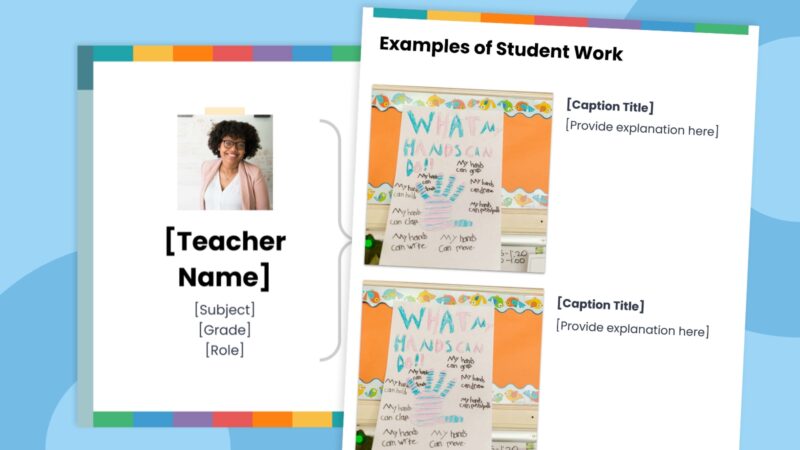
A strong teaching portfolio can help you land your first teaching job! Learn how to put one together and get free customizable templates by clicking the button below and filling out the form.
Looking for a place to ask more questions about teacher certification exams and other new-teacher topics? Join the We Are Teachers HELPLINE group on Facebook!
Plus, check out 40 Philosophy of Education Examples for Job-Hunting Teachers.