
[ad_1]
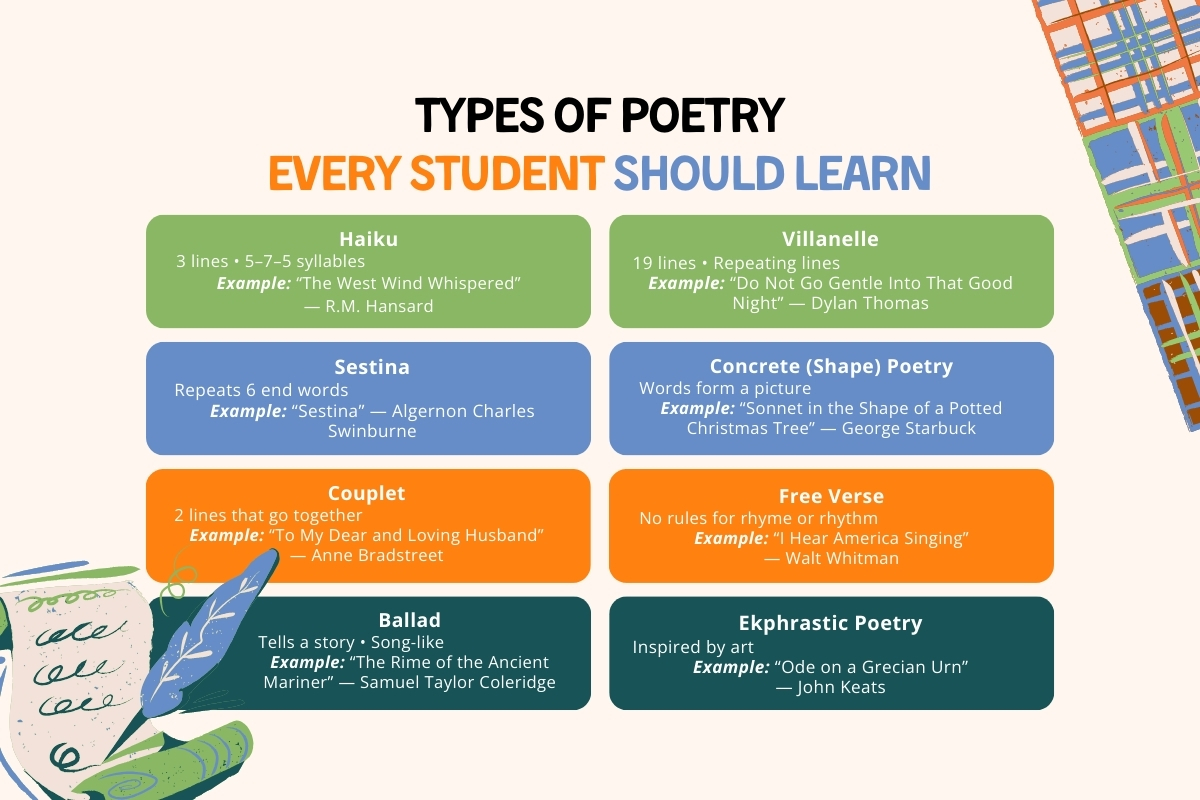
Poetry can be a hard sell for kids. It’s not always easy for them to connect with, and getting them to try writing their own is even harder. But it might help them to learn that there are many types of poetry, not just Shakespearean sonnets. Show them these 25 poetry types, including engaging poem examples for each, and they might just find something they really like!
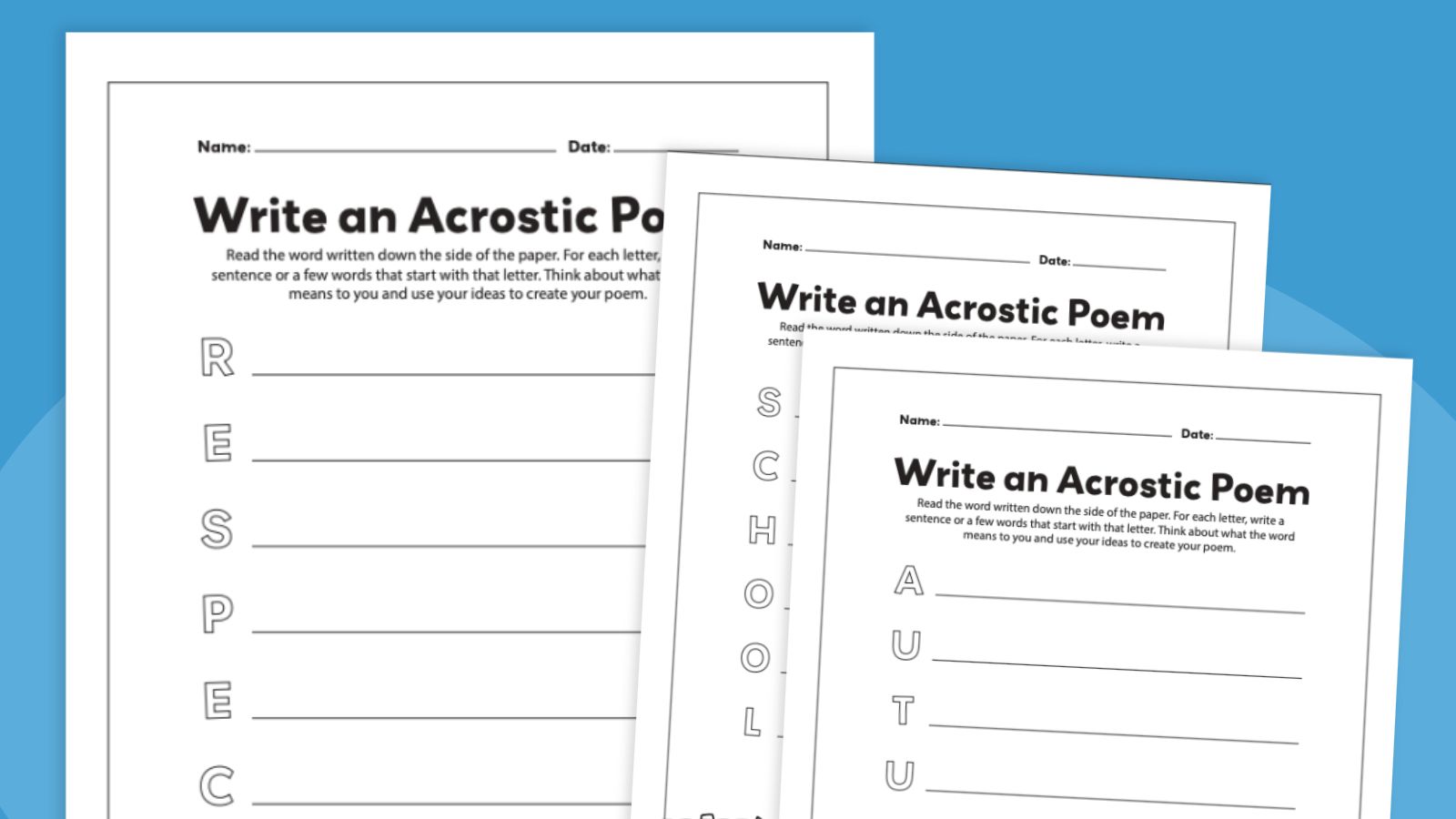
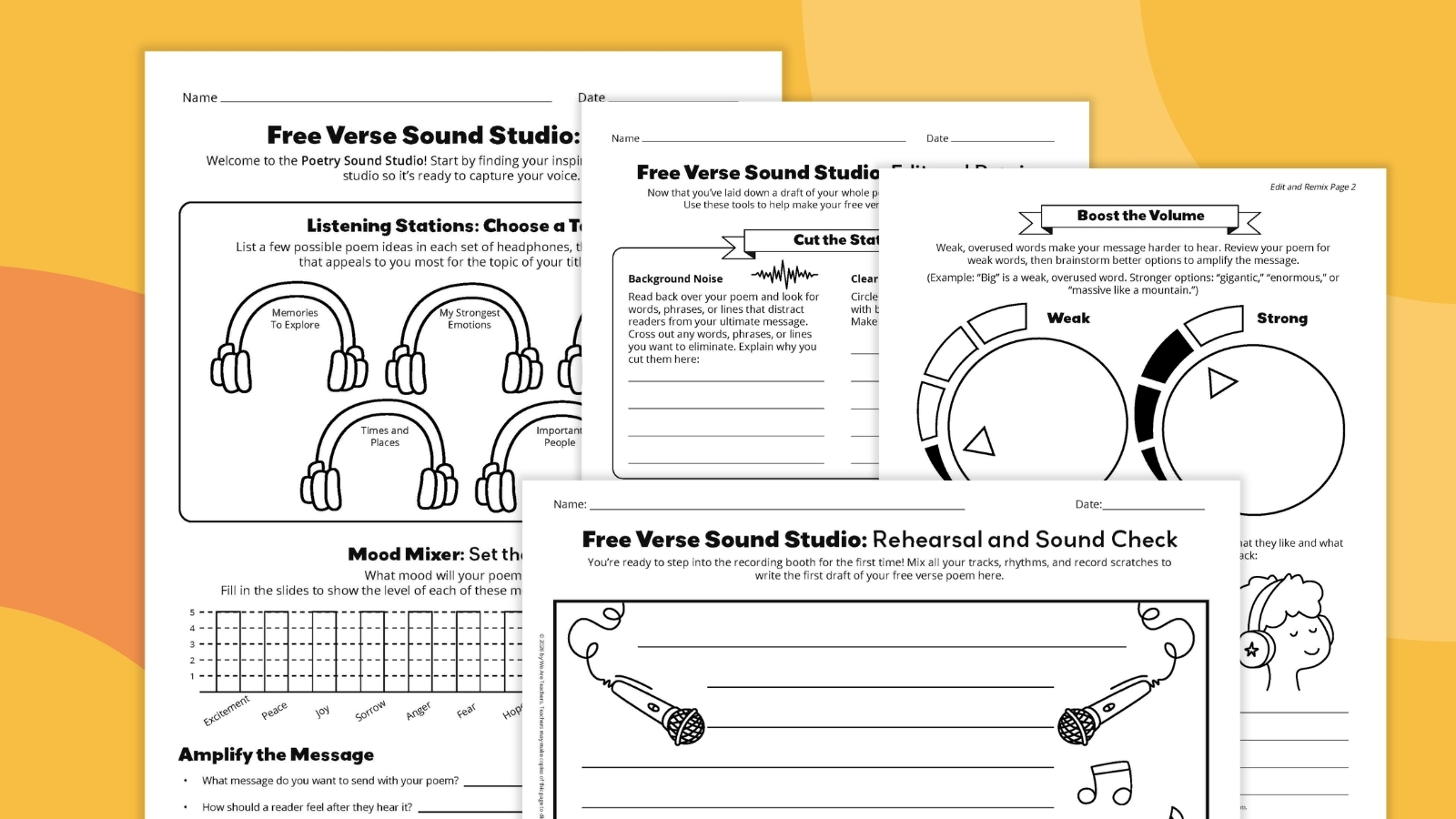
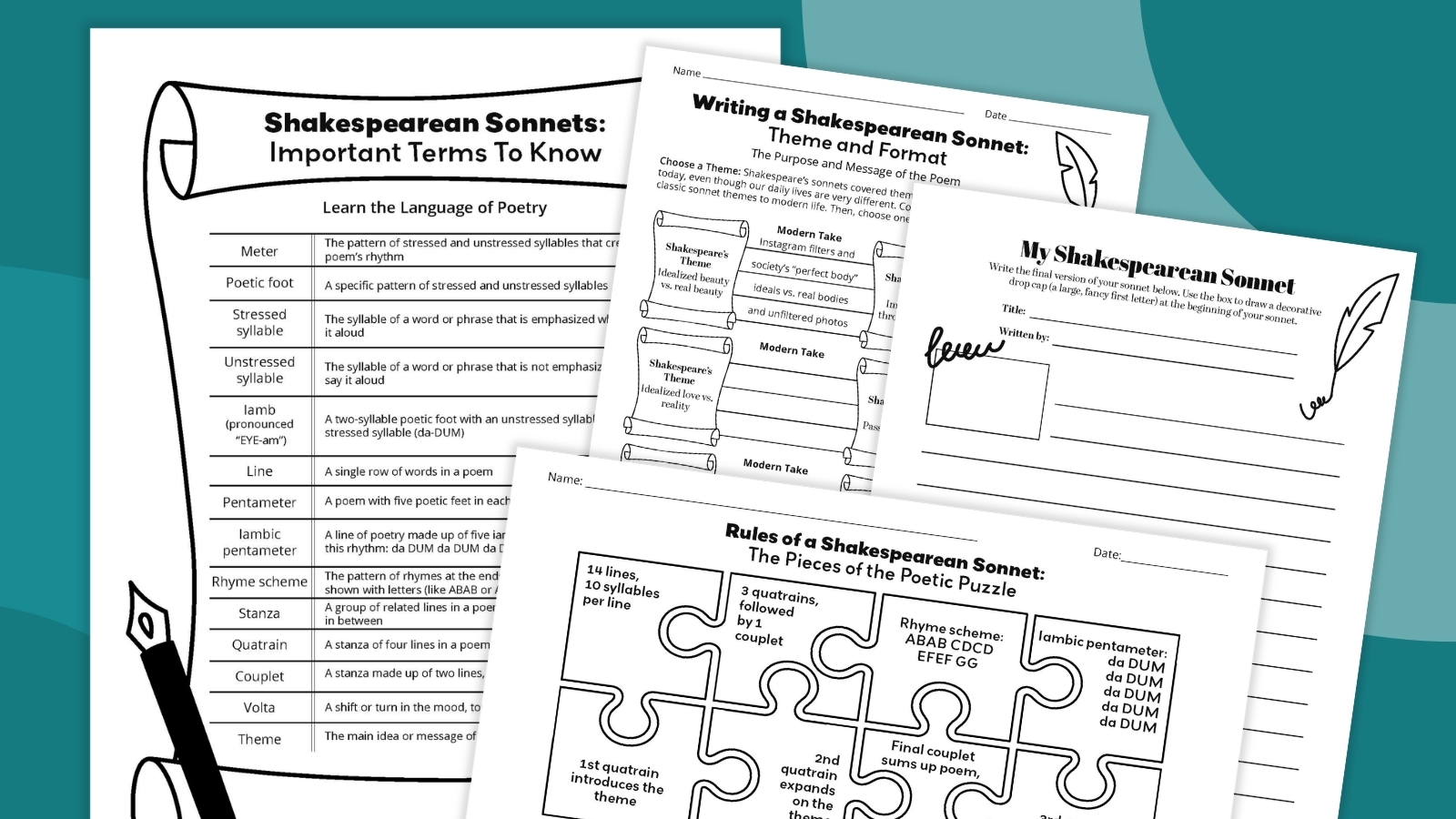
If you’d like to help your students learn to write some of these types of poetry, we’ve got you covered too! Check out our complete bundle of poetry worksheets, or grab the free printables for your specific poetry style from our list below.

Acrostic
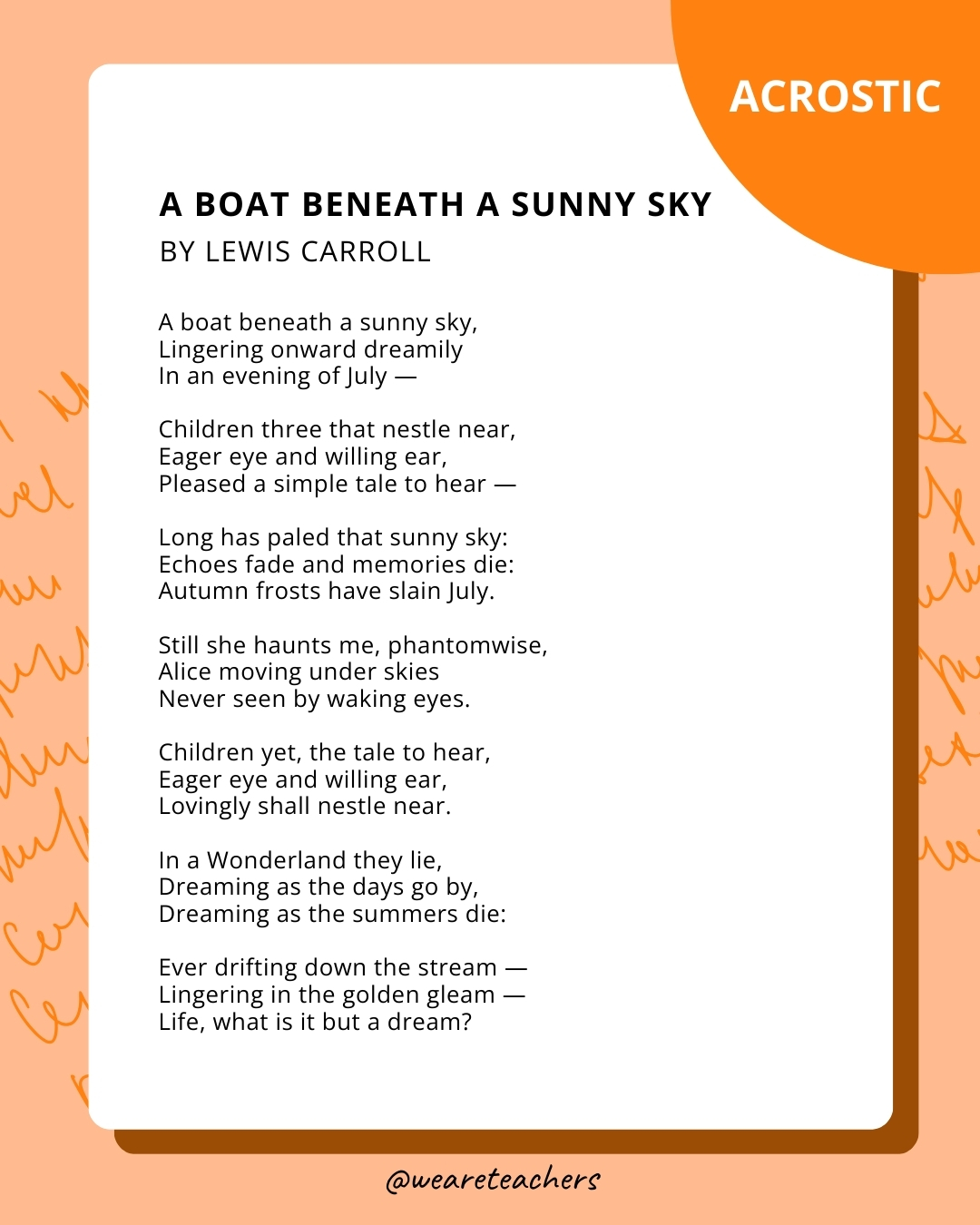
In an acrostic, the first letter of each line combined spells out a word or phrase that’s generally related to the topic of the poem. There are several different types of acrostic, including a double acrostic where both the first and last letters of each line spell out a message. Another type of acrostic is the abecedarian, where the first letter of each line goes in alphabetical order. Acrostics are often one of the first types of poetry kids learn, by writing a poem using the letters of their own name. The acrostic in Carroll’s “A Boat Beneath a Sunny Sky” is “Alice Pleasance Liddell,” the real-life inspiration for Alice in Wonderland.
Poem Example: A Boat Beneath a Sunny Sky, by Lewis Carroll
Ballad
This is one of the oldest types of poetry, with ancient examples that were passed down orally through the centuries. A ballad tells the story of a person or event. Traditional ballades had four stanzas, with a repeated line called a refrain and a set rhyme scheme. Over time, they evolved to a slightly less structured form, with shorter rhyming stanzas (often four lines, known as a “quatrain”). Ballads and epics are similar, since both tell stories of people or events, but ballads are shorter.
Poem Example: The Rime of the Ancient Mariner, by Samuel Taylor Coleridge

Blackout Poetry
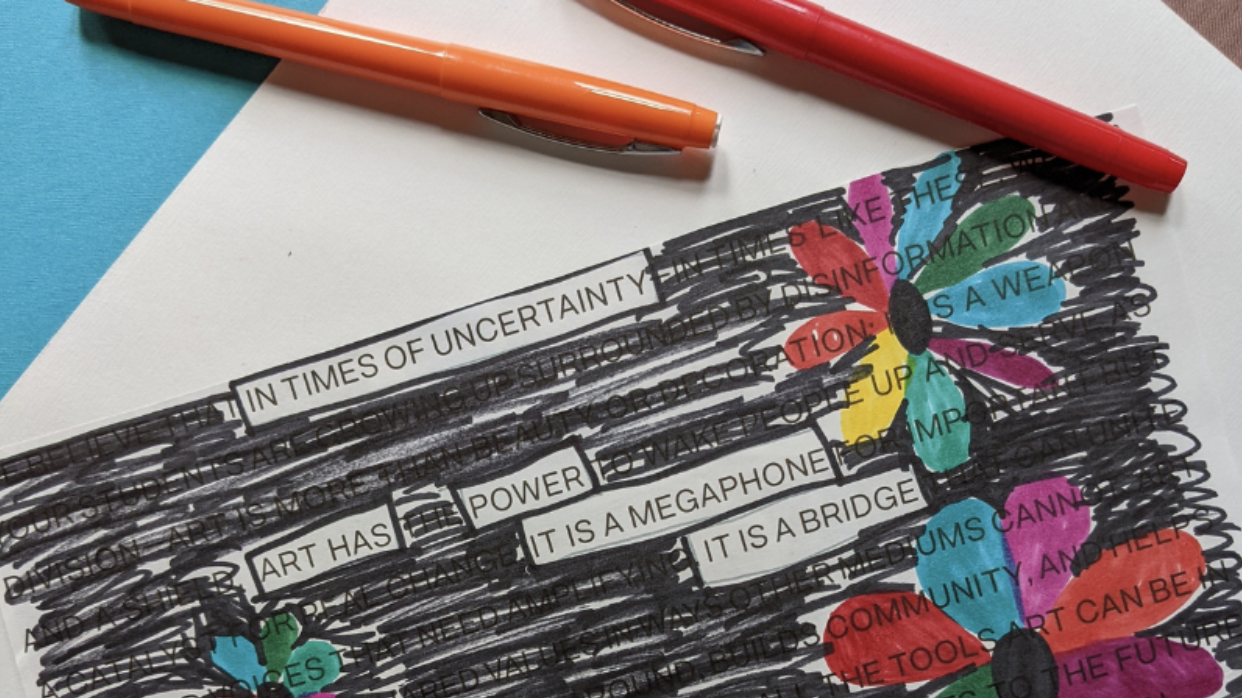
These poems are unique in that they use something that’s already been written and strike out most of the text to leave only selected words and phrases. Blackout poetry is usually non-rhyming free verse, since the author is limited to the words already on the page. Contemporary author Austin Kleon has become well known for his newspaper blackout poems. These are fun for kids to play around with, using pages from books or magazines. Learn more about blackout poetry here.
Poem Example: How To Improve, by Austin Kleon
Blank Verse
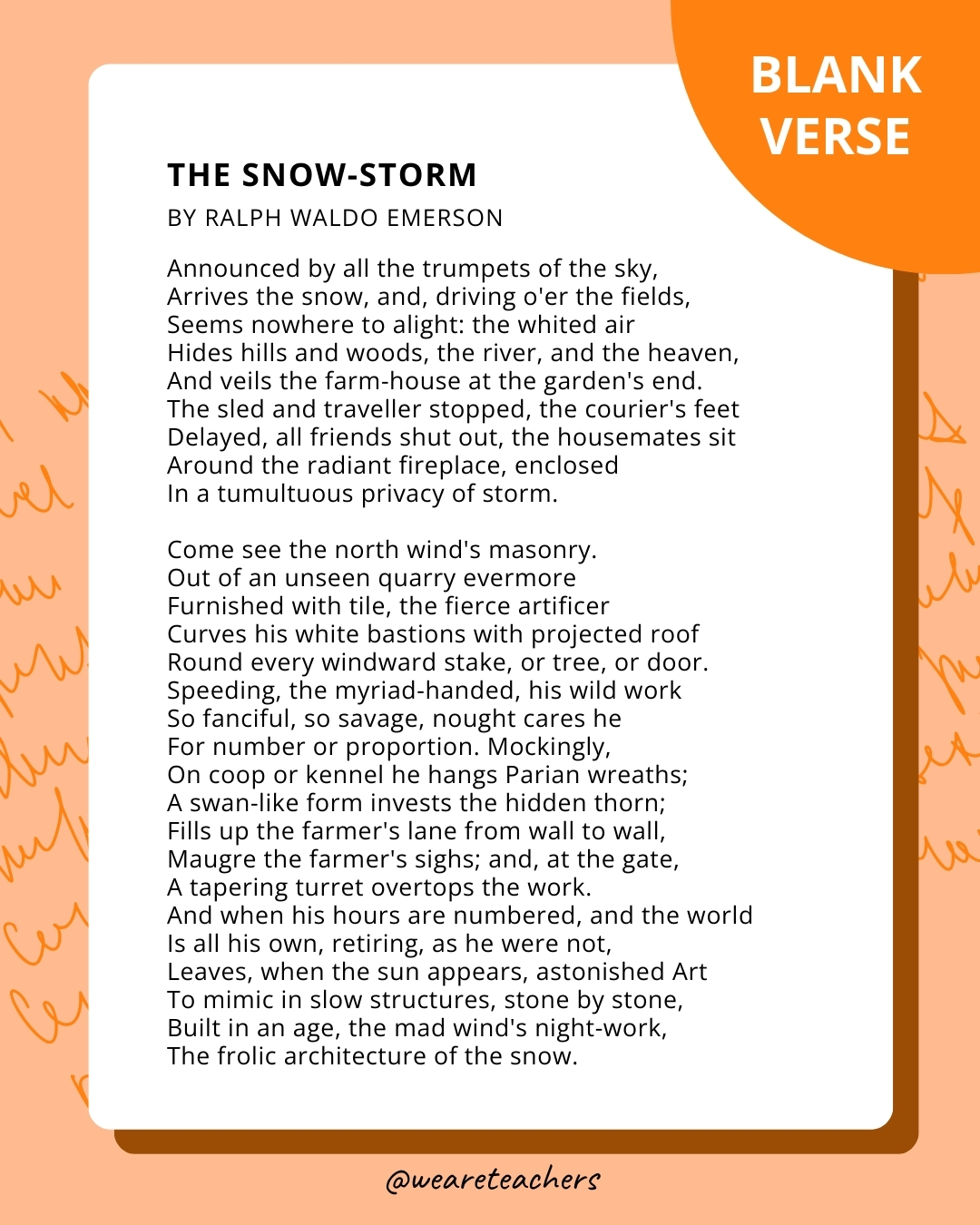
Blank verse doesn’t rhyme, but it’s a structured form of poetry in terms of meter. These poems are almost always written in iambic pentameter (da DUM da DUM da DUM da DUM da DUM). It was particularly popular during Shakespeare’s time and remained a common choice for poets like William Wordsworth, John Keats, and Robert Frost.
Poem Example: The Snow-Storm, by Ralph Waldo Emerson
Cinquain
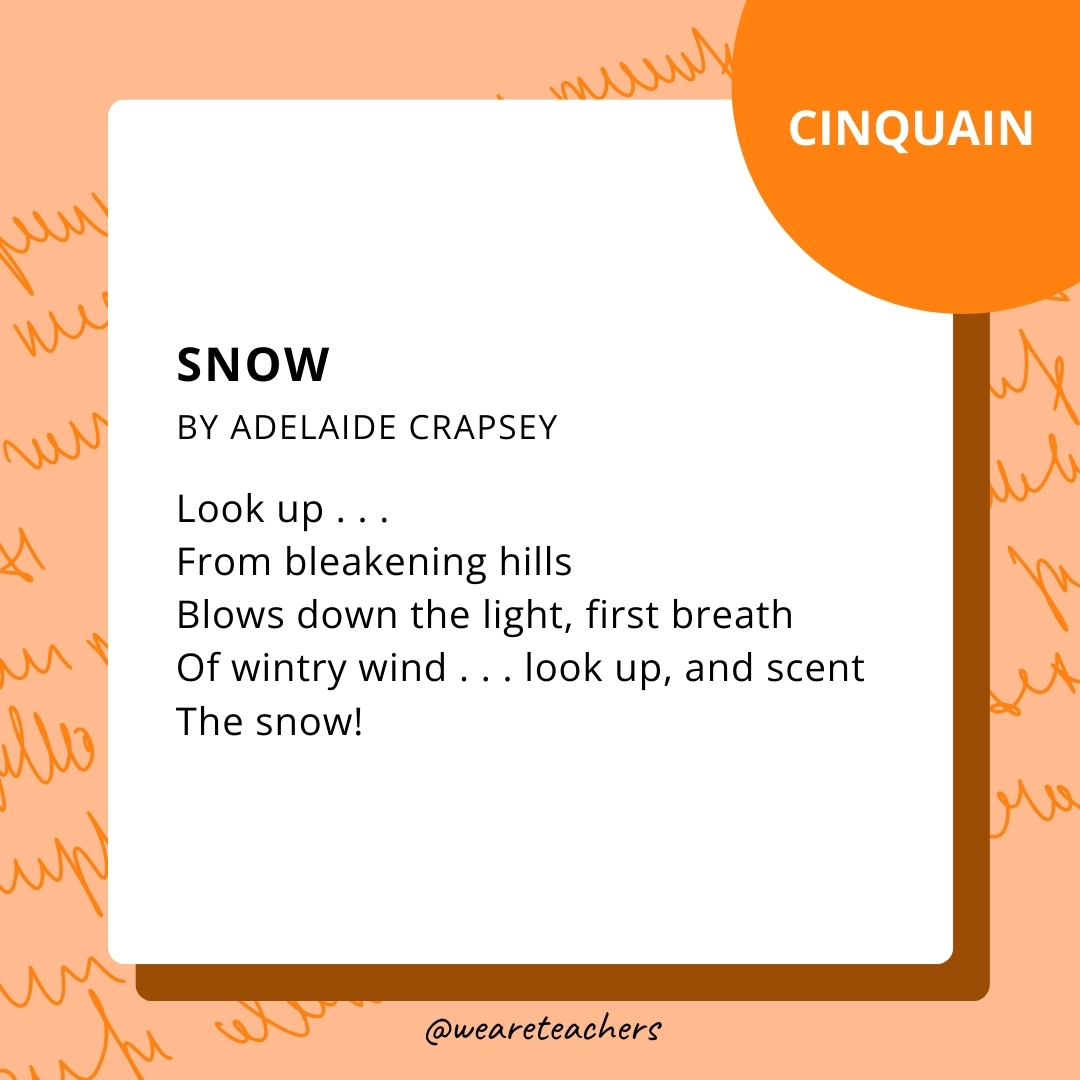
Anyone who recognizes that “cinq” often indicates the number five will find it easy to remember that a cinquain (pronounced “sing-KANE”) is a five-line poem. According to Poets.org, cinquains generally follow a rhyme scheme of ABABB, ABAAB, or ABCCB, though they are not required to rhyme at all. Multiple cinquains can be linked together to form a longer poem.
Poet Adelaide Crapsey invented a specific type of cinquain (sometimes called the American cinquain), which has one stress in the first line, two in the second, three in the third, four in the fourth, and one in the fifth. This poetry type is popular in classrooms, since the strict structure helps students create their own poems.
Poem Example: Snow, by Adelaide Crapsey
Concrete Poetry
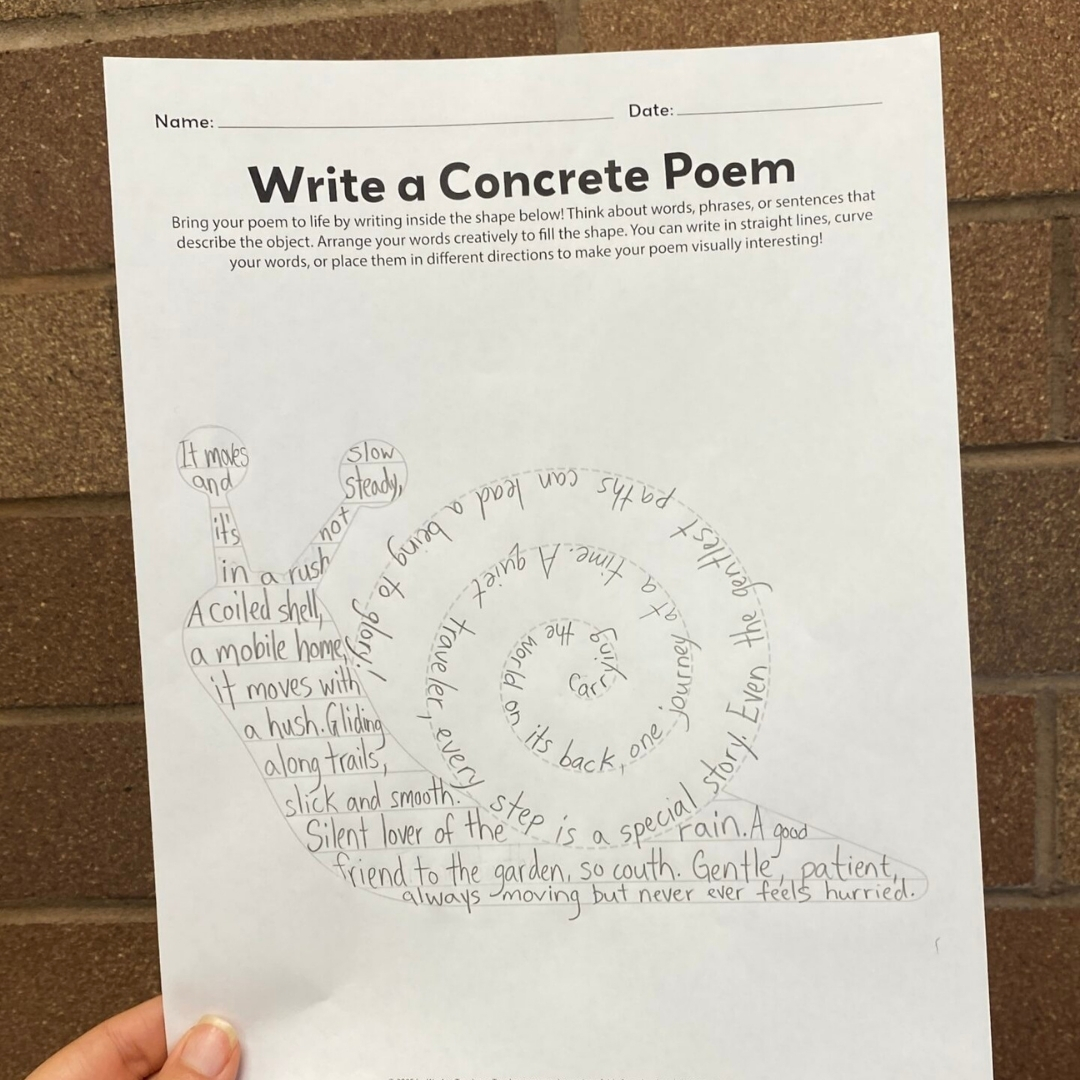
Poems written in this form take the shape of the item they’re describing. They can be written in any style, as long as the formatting creates a shape related to the words.
Poem Example: Sonnet in the Shape of a Potted Christmas Tree, by George Starbuck

Couplet
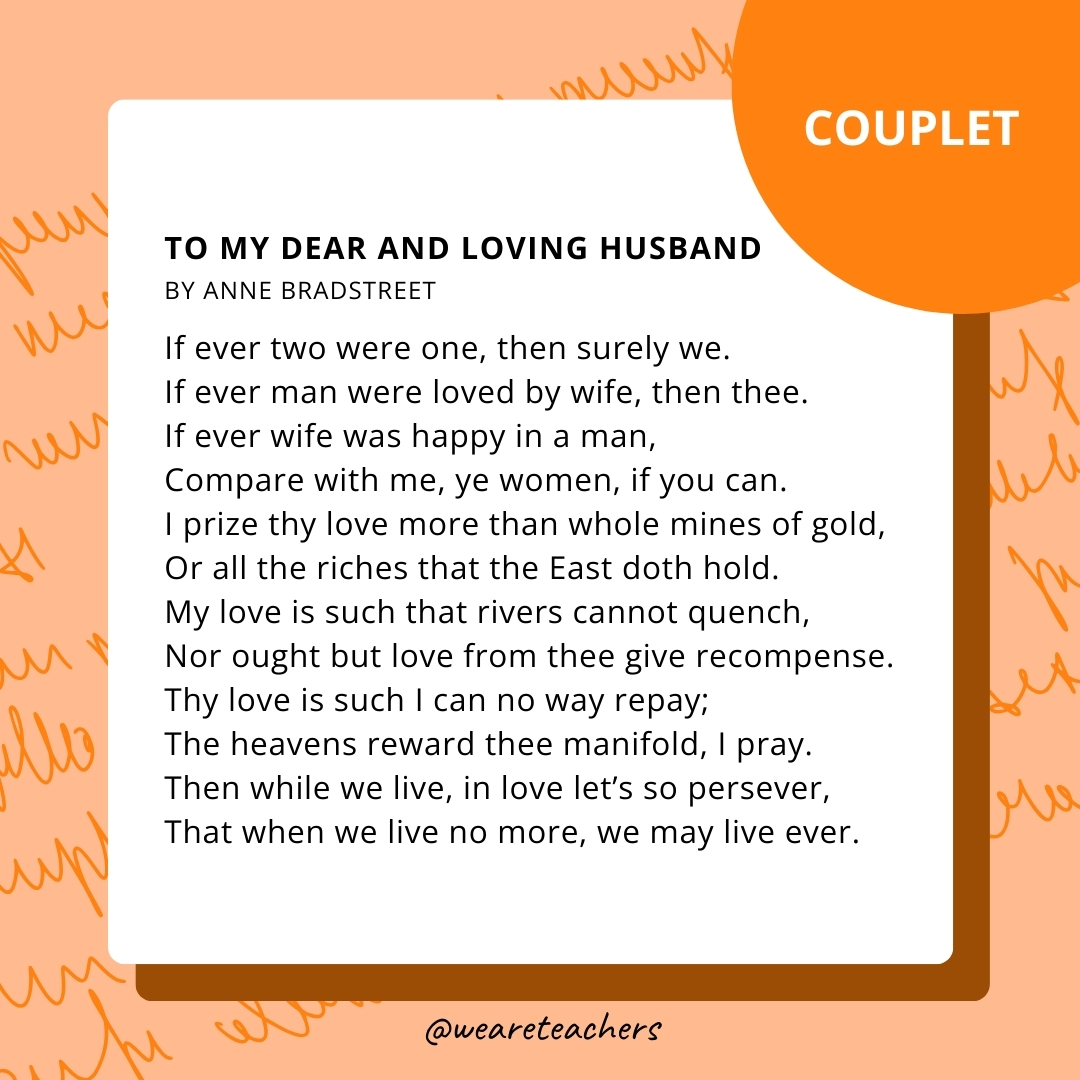
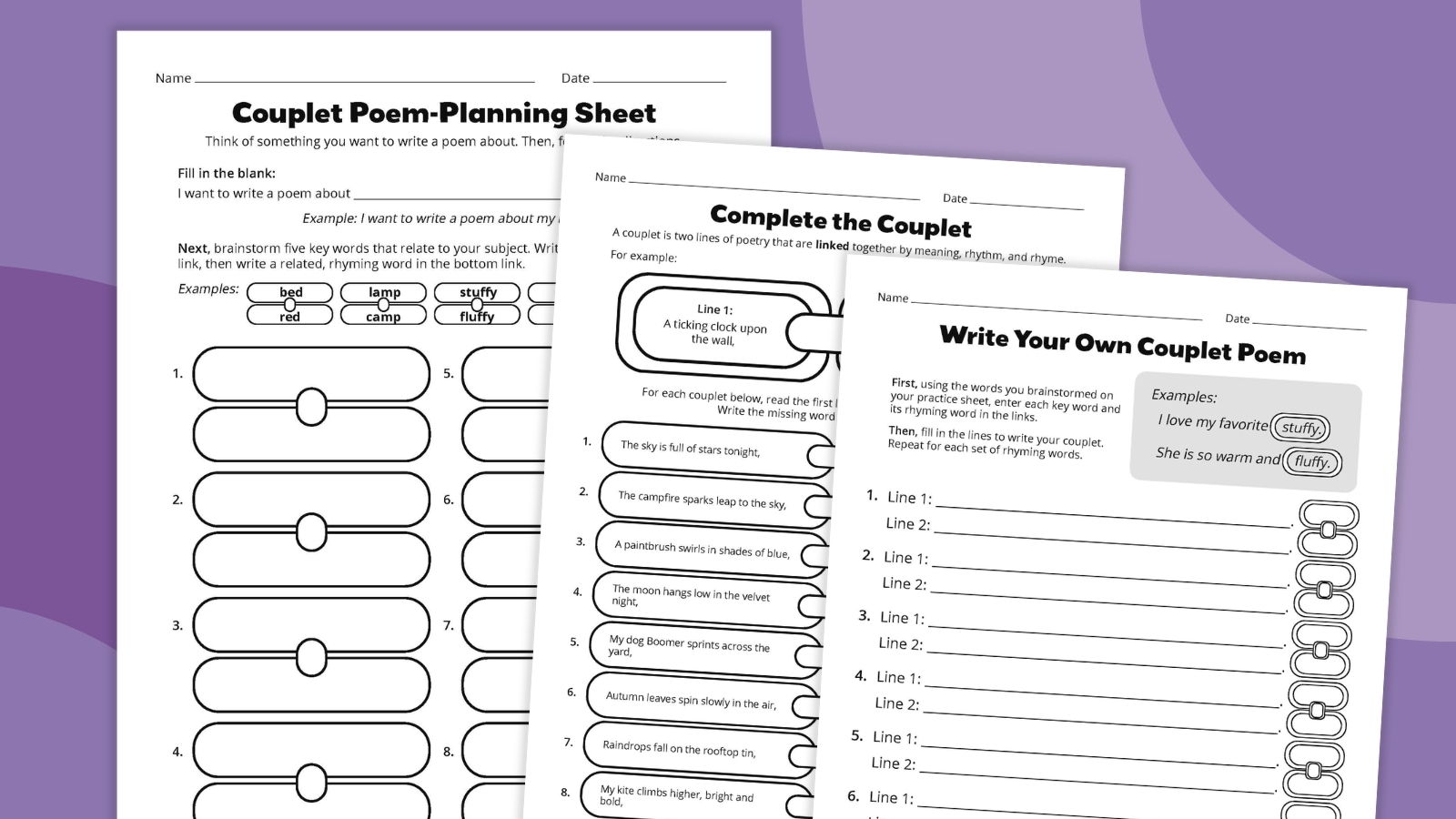
In poetry, a couplet is any two lines that go together. They might be two lines that form one complete thought, those that share the same end rhyme, or both. A couplet poem can be one that is made of just one couplet or a series of them.
Poem Example: To My Dear and Loving Husband, by Anne Bradstreet
Diamante
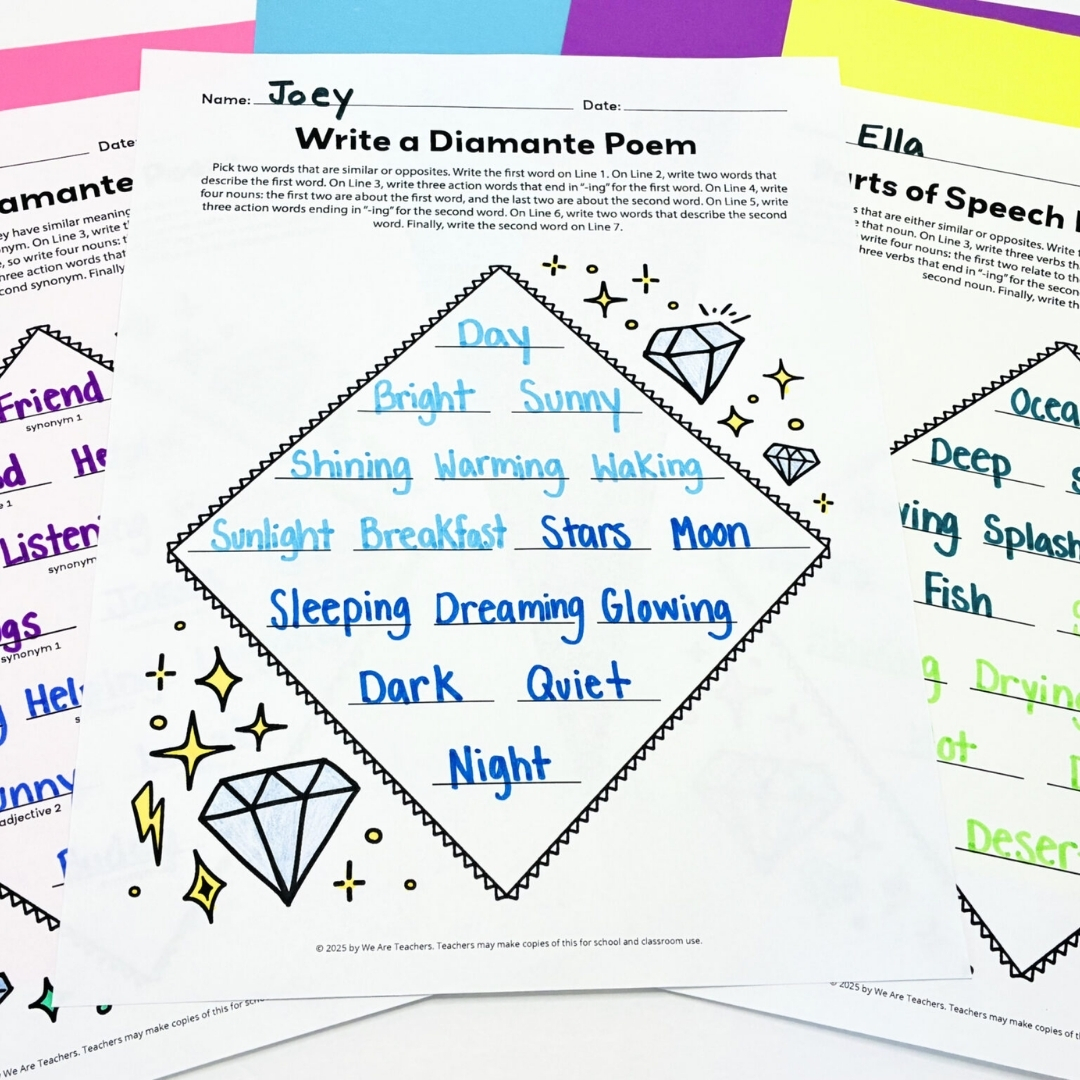
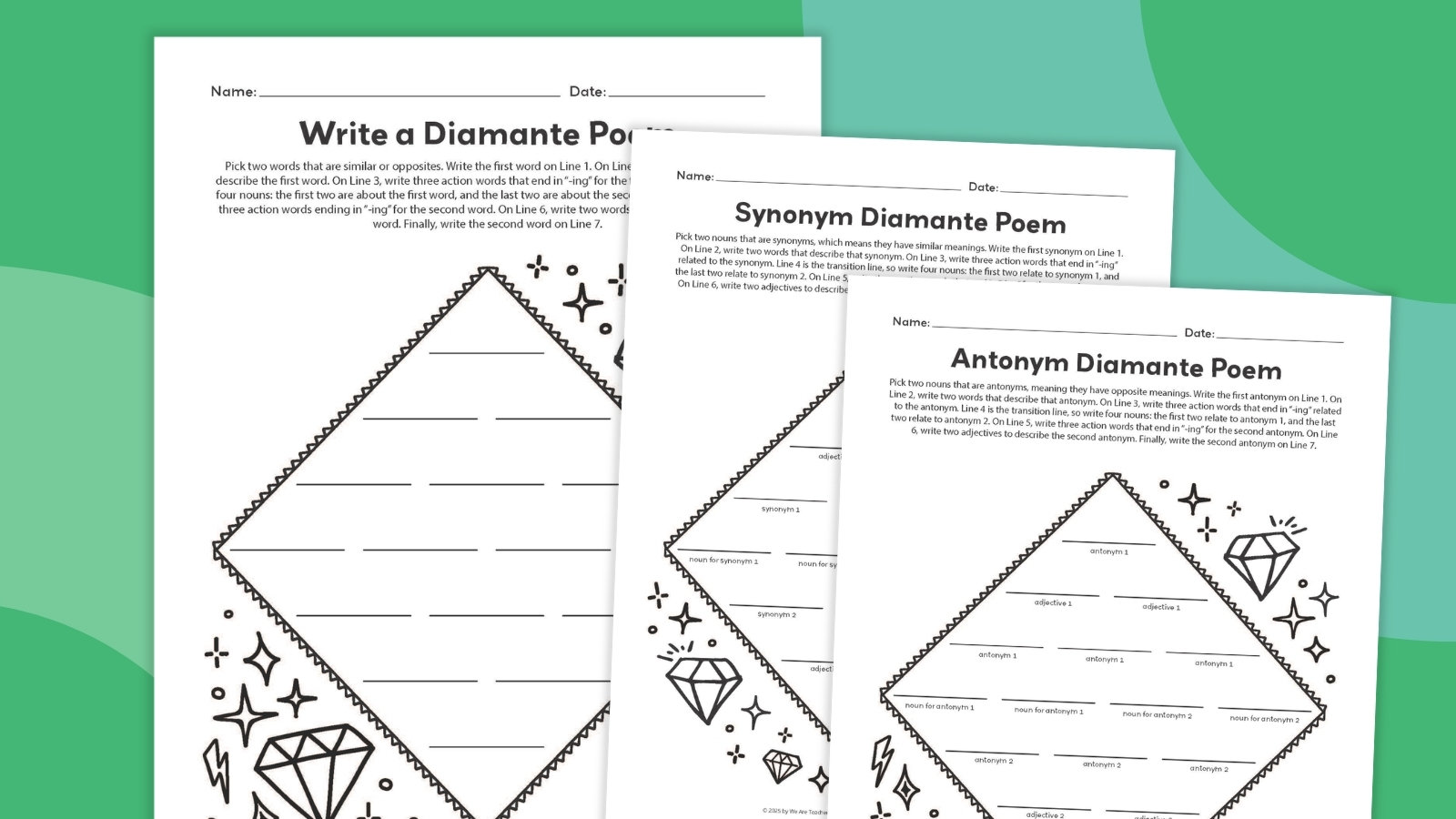
A diamante poem is a seven-line poem that takes the shape of a diamond. The word diamante comes from the Italian word for “diamond,” which reflects the poem’s shape. It’s designed to explore contrasts, relationships, or opposites using concise, powerful language. This type of poem has specific rules and comes in two types: synonym diamantes, where the beginning and end nouns are similar, and antonym diamantes, where the beginning and end nouns are opposites.
Poem Example: Sun and Moon, by Jan Allison
Dramatic Poetry
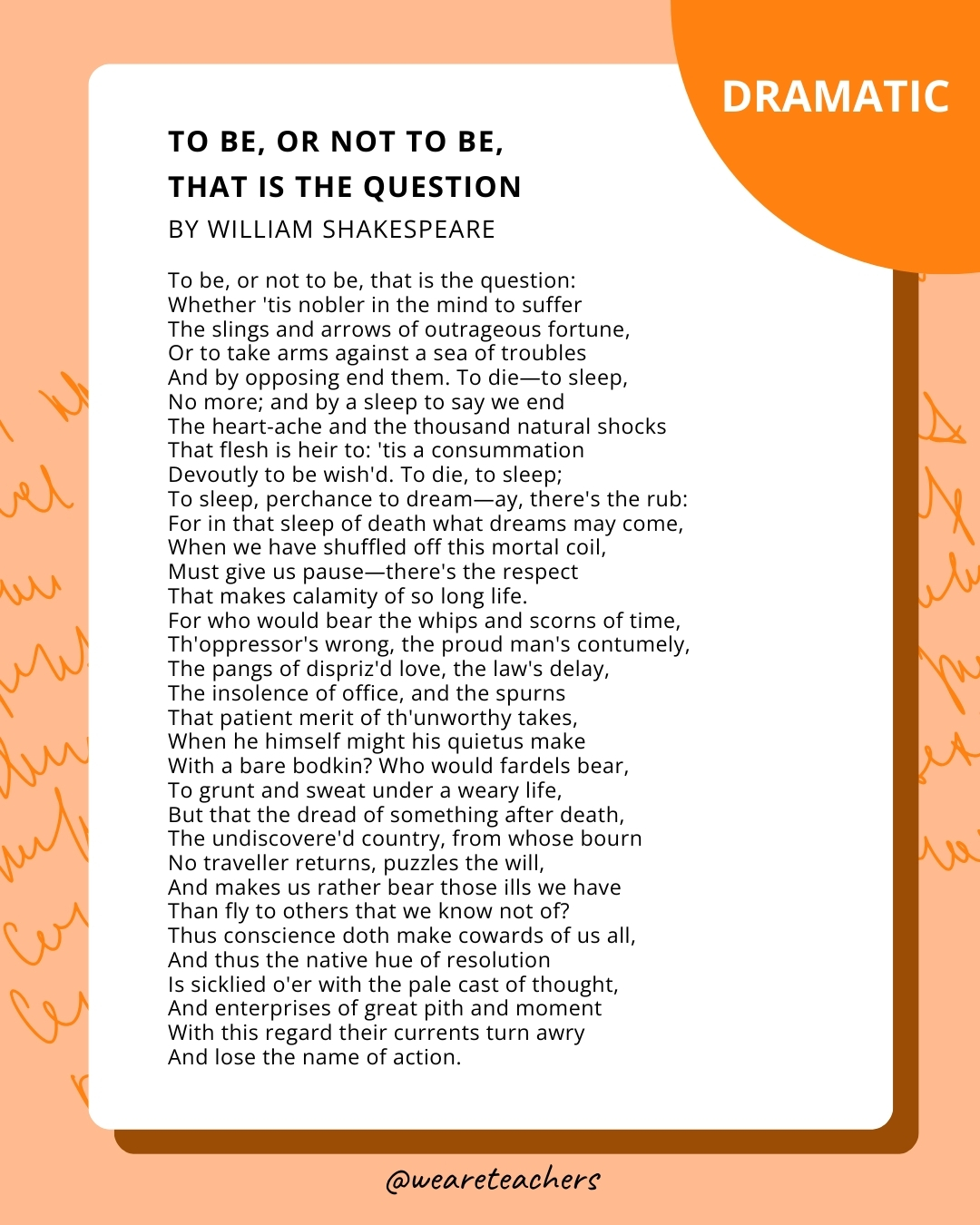
As you might guess, dramatic poetry is meant to be performed or spoken aloud. It’s often part of a larger work, such as a Shakespearean soliloquy. But there are many examples of standalone dramatic poetry, featuring characters telling a story to the audience.
Poem Example: To Be, or Not To Be, soliloquy from Hamlet, by William Shakespeare
Ekphrastic
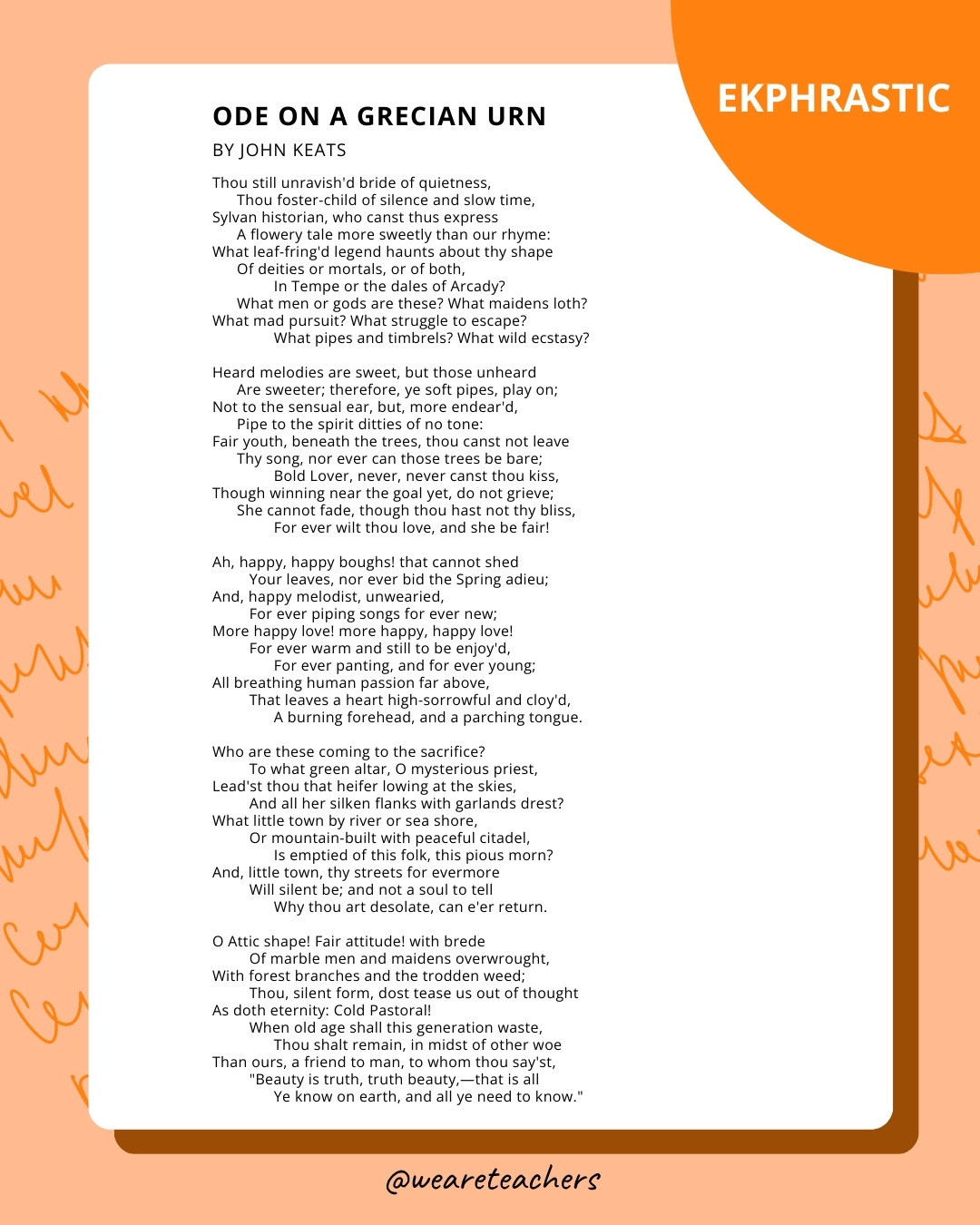
This is a broader category of poem types that describes poetry written to vividly describe a work of art. One of the most famous examples in poetry is John Keats’ Ode on a Grecian Urn. Ekphrastic poems are usually about visual arts like paintings or sculpture, but they can also describe music, performances, or even movies.
Poem Example: Ode on a Grecian Urn, by John Keats
Elegy
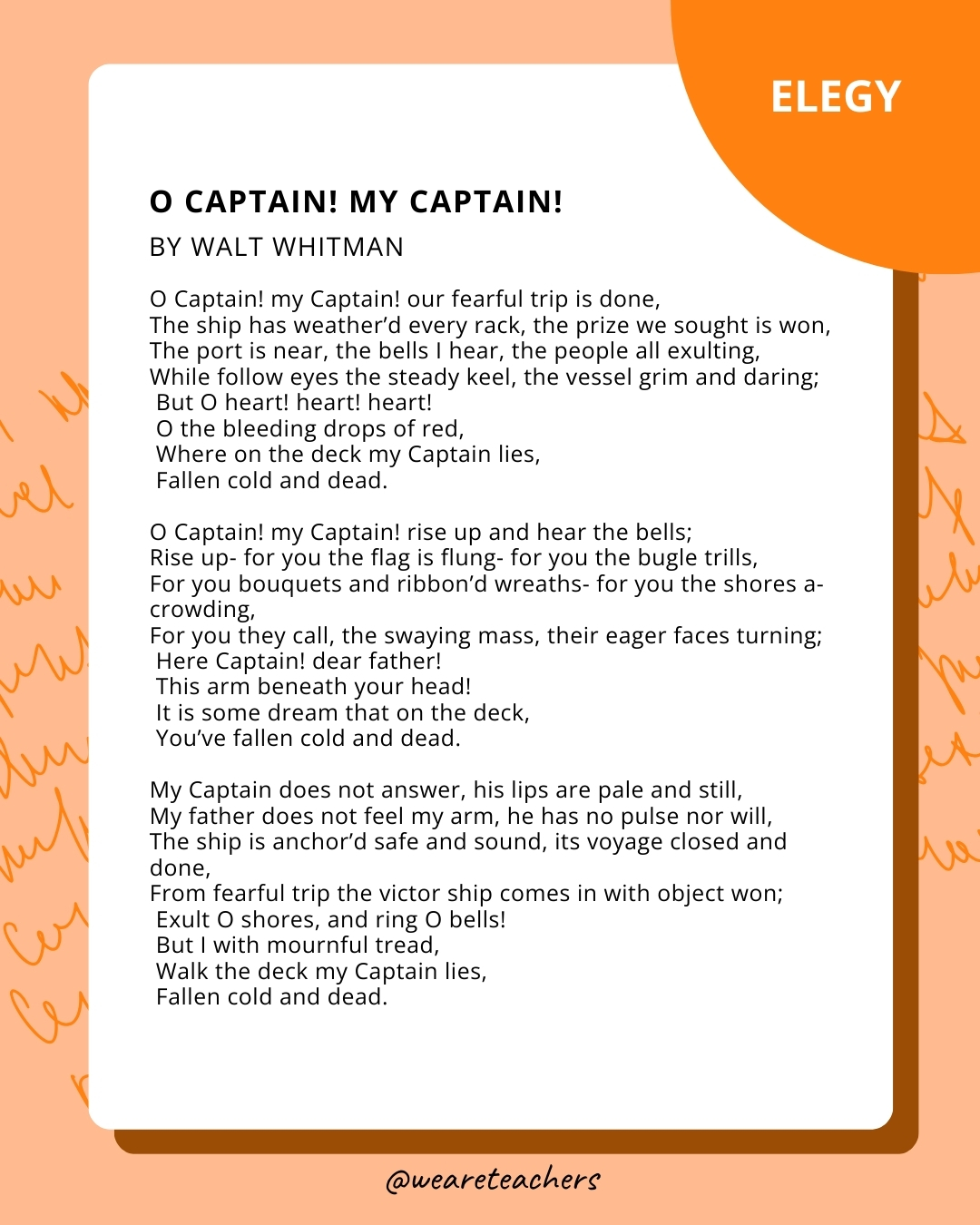
In an elegy, the poet writes of sadness, grief, or loss. They’re often written in response to a death. Elegies can be any sort of poem in terms of meter and rhyme scheme (or they don’t need to rhyme at all). Traditional elegies follow a specific form. First is the “lament,” where the speaker tells of their sadness. Then, the author praises the dead or loss, and finally finishes with words of consolation, offering hope for the future.
Poem Example: O Captain! My Captain!, by Walt Whitman
Epic
Like a ballad, an epic tells the story of an event or person. Epics are much longer than ballads, though, often even book-length. Like ballads, this form of narrative poetry has been around for centuries and frequently tells tales of superhuman deeds and incredible adventures.
Poem Example: The Odyssey, by Homer
Epigram
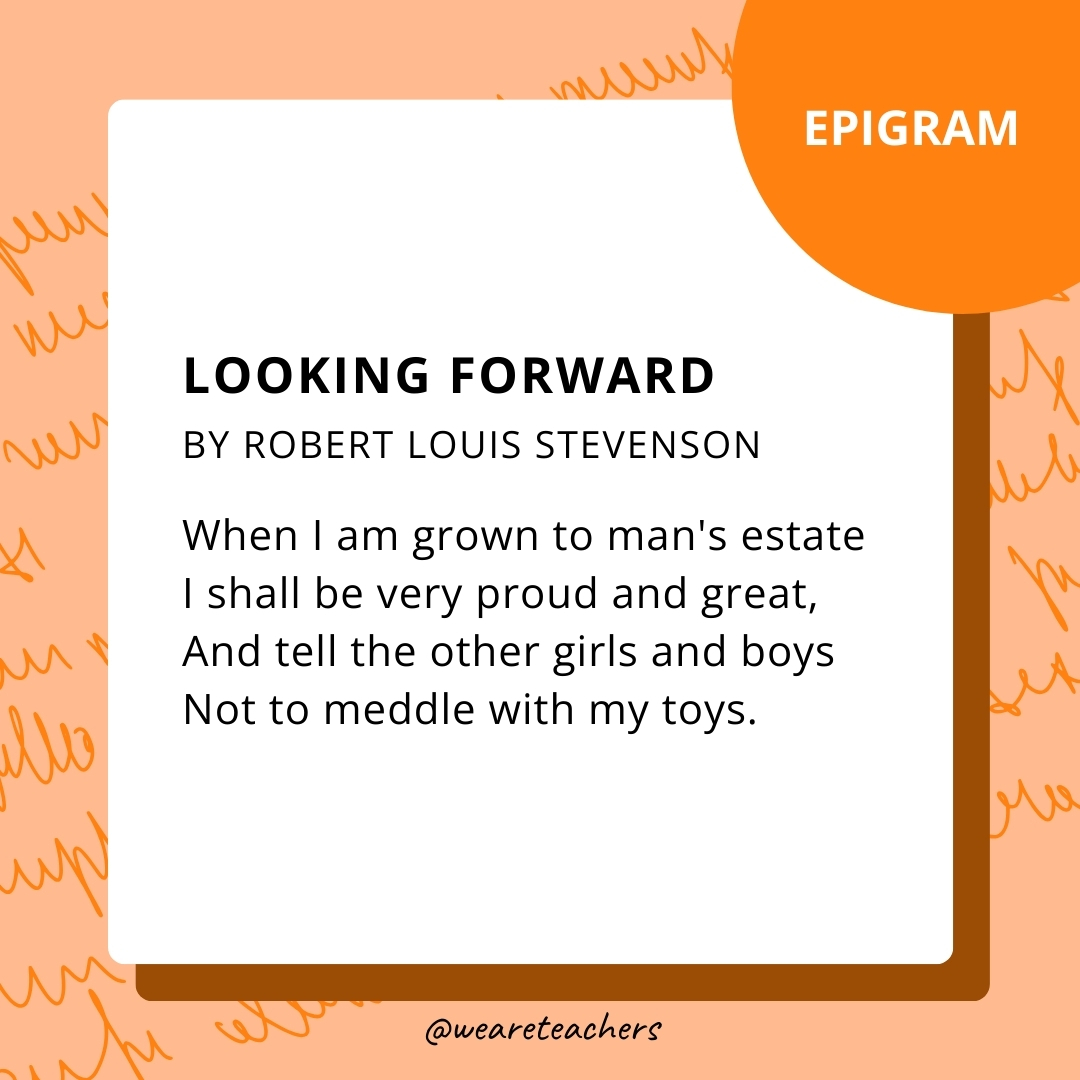
These short poems (generally six lines or less) express a witty thought in pithy, concise language. This term is also used for clever thoughts that aren’t written in verse, like Oscar Wilde’s “I can resist everything except temptation.” Epigrammatic poems are fun to read, making them one of the best poem types to share with kids.
Example: Looking Forward, by Robert Louis Stevenson
Free Verse
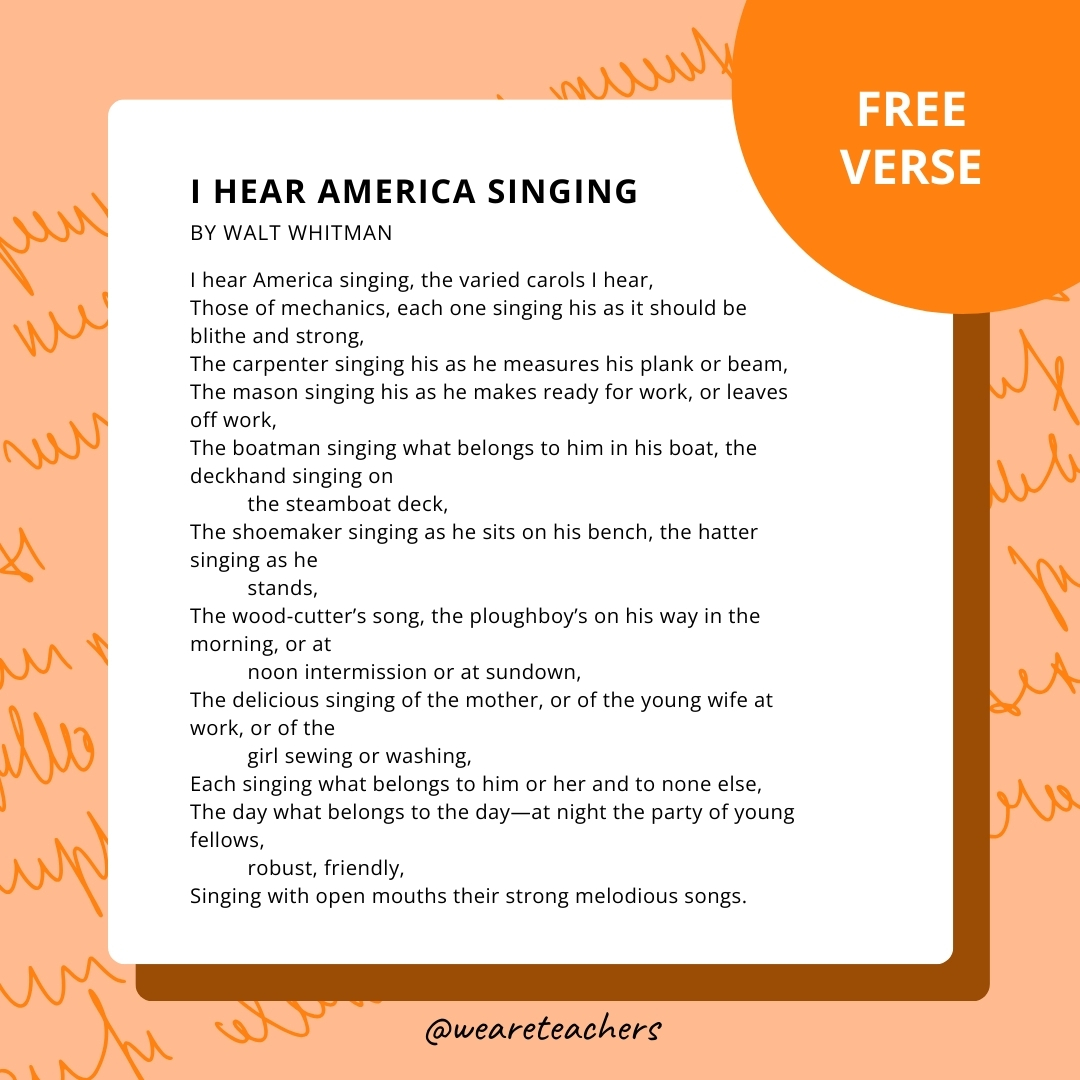
This is the most open form of poetry, with no rhythmical, rhyme, or other requirements. It often mimics the flow of regular speech, but it is set apart from prose by its use of line breaks and poetic devices like imagery, alliteration, and more.
Poem Example: I Hear America Singing, by Walt Whitman (Plus, 63 More Free Verse Poems for Kids)
Haiku
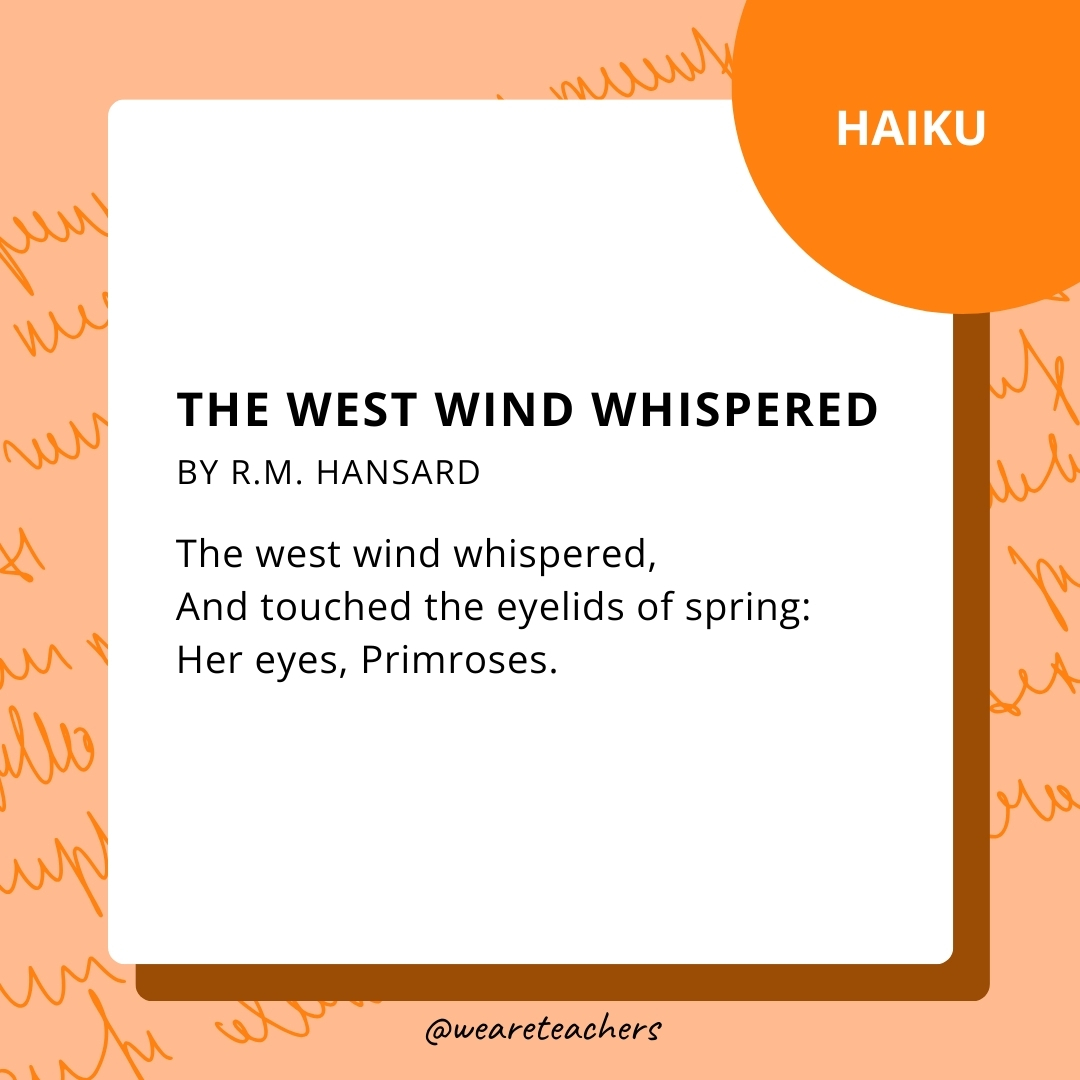
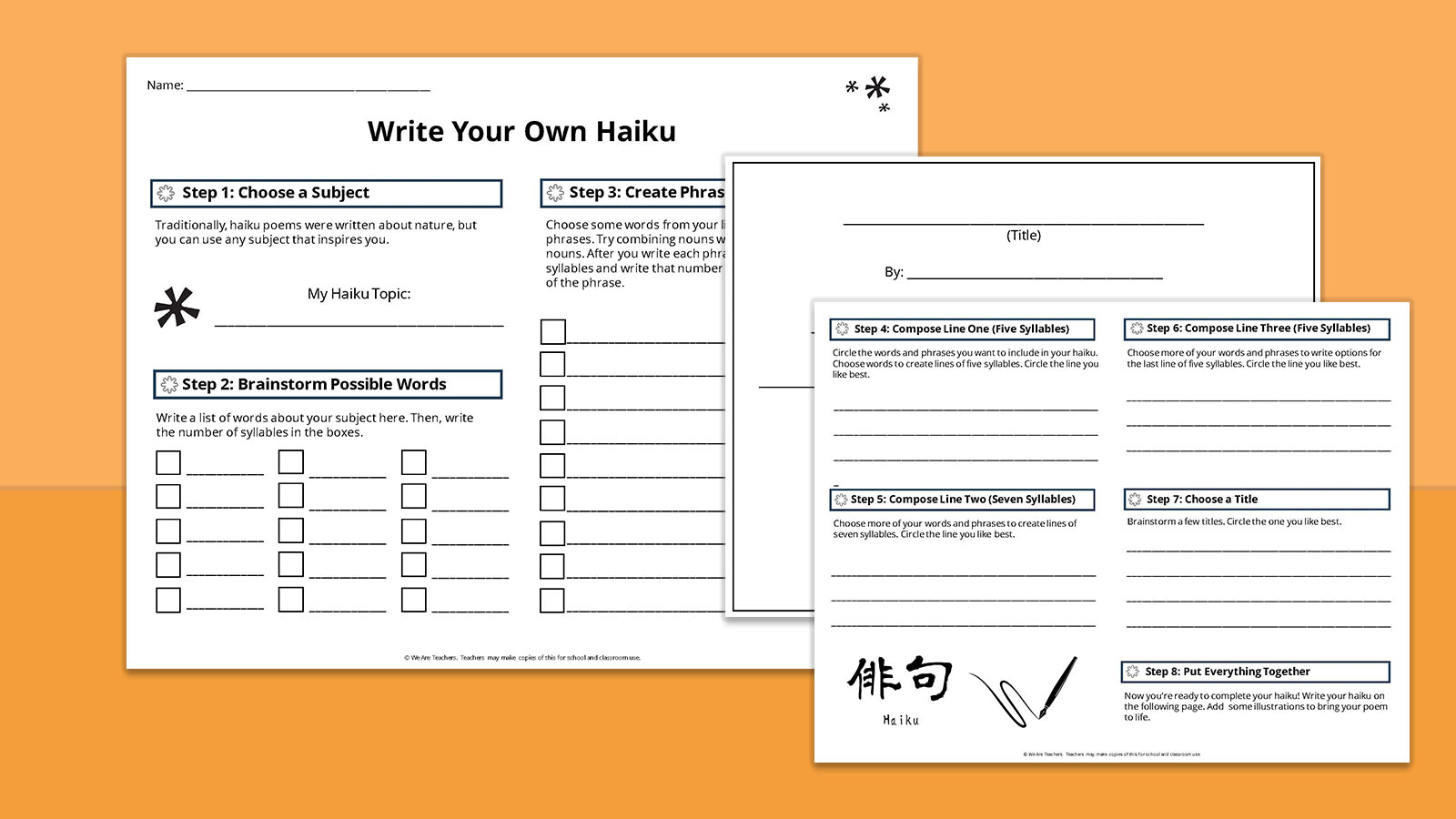
This Japanese style is highly structured and often focuses on nature. Haiku seeks to capture a brief moment in time in powerful words and phrases. This is one of the shortest types of poetry, with poems written in three lines: five syllables in the first, seven syllables in the second, and five in the third. That format is sometimes broken, especially when poems are translated from one language to another, but they will always contain just three meaningful lines.
Poem Example: The West Wind Whispered, by R.M. Hansard (Plus, 58 More Captivating Haiku Examples)
Limerick
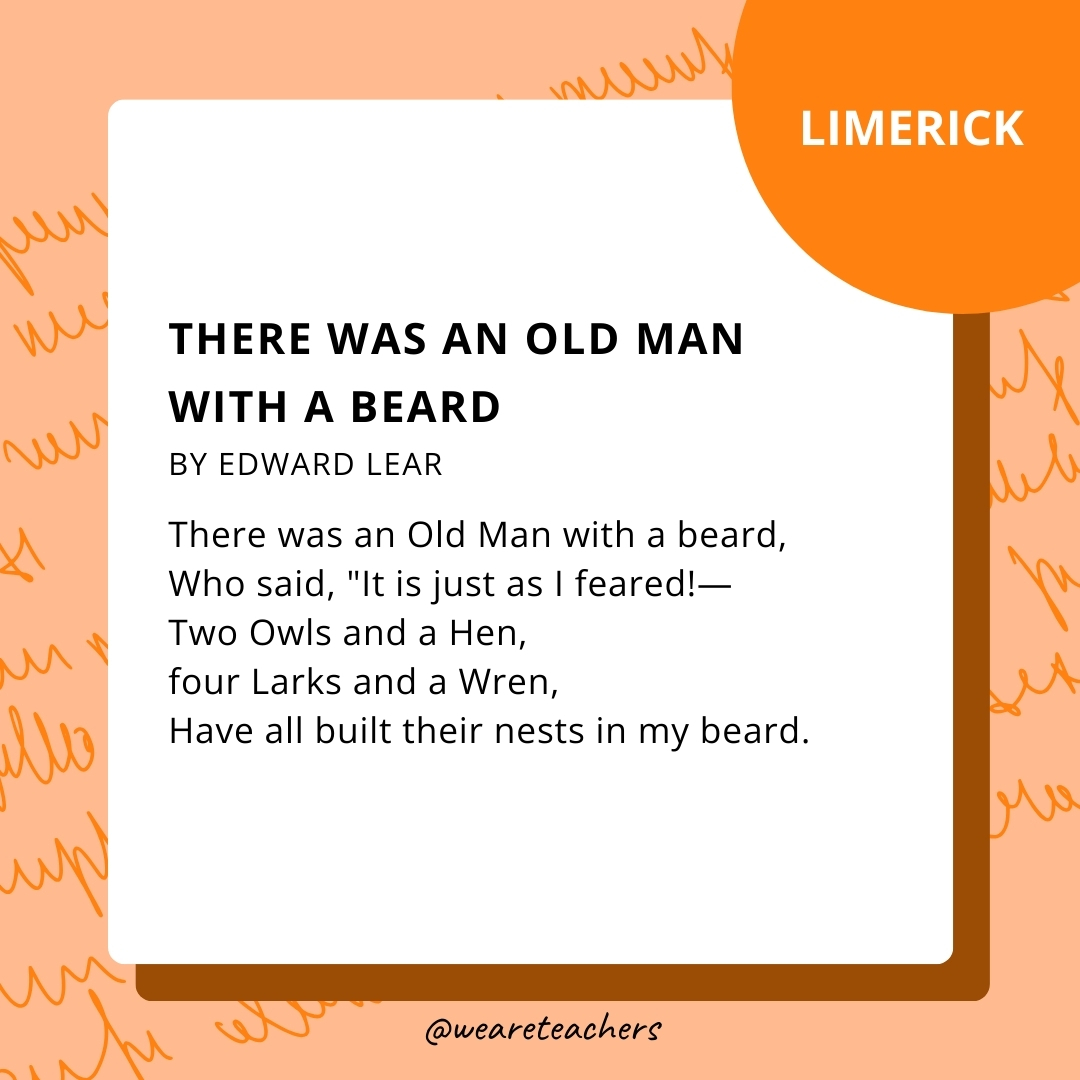
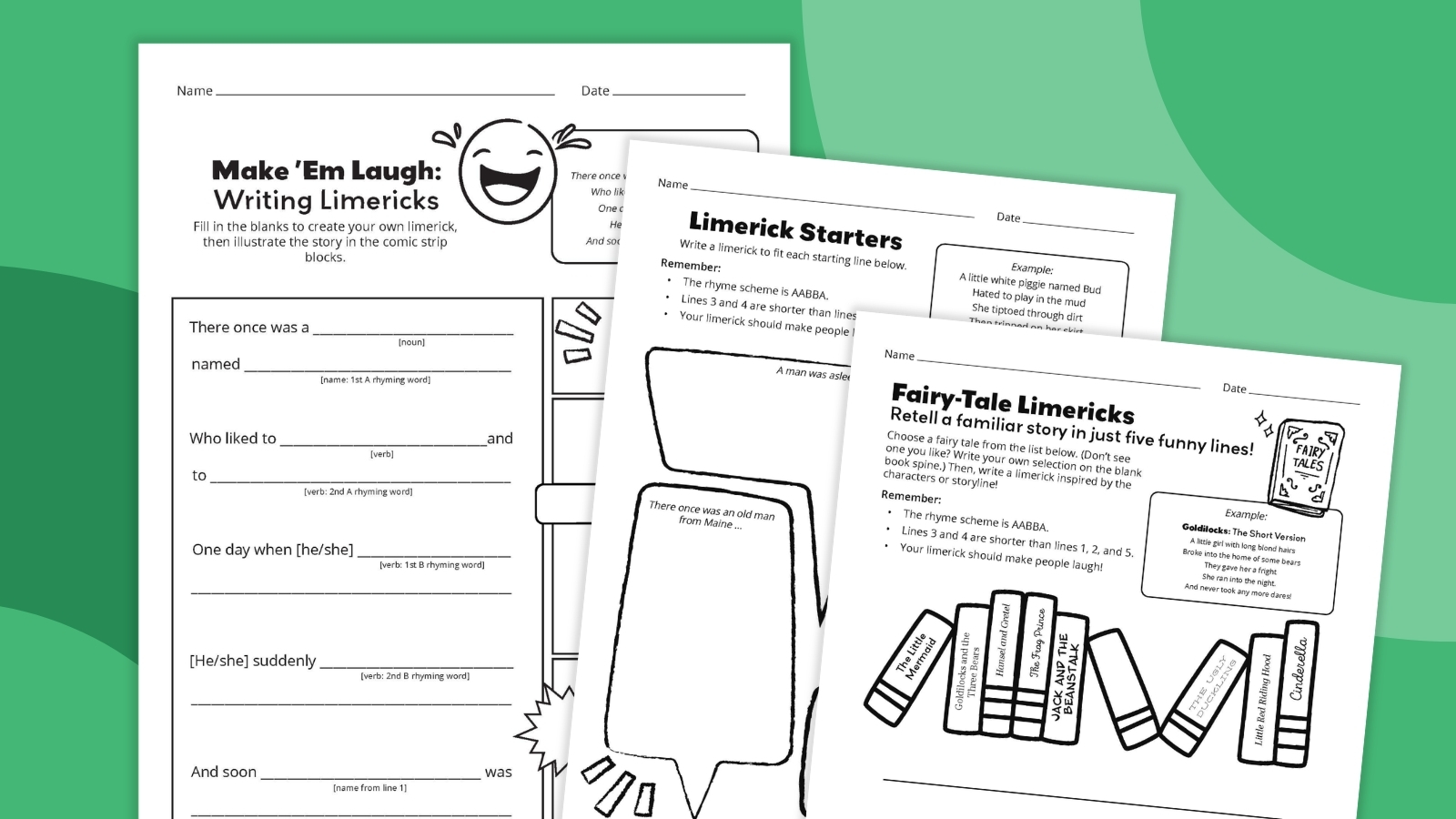
Want a laugh? Read some limericks! These structured poems have been around for a long time. They contain five lines, using the AABBA rhyme scheme. Generally, the first, second, and fifth lines are longer, while the third and fourth are shorter. The fifth line is often like the punchline to the joke. Some limericks are downright bawdy, but there are lots of kid-friendly examples. They’re also a fun form for kids to experiment with. Edward Lear was a master of limericks.
Poem Example: There Was an Old Man With a Beard, by Edward Lear (Plus, 40 More Silly and Fun Limericks for Kids)
Lyric Poetry
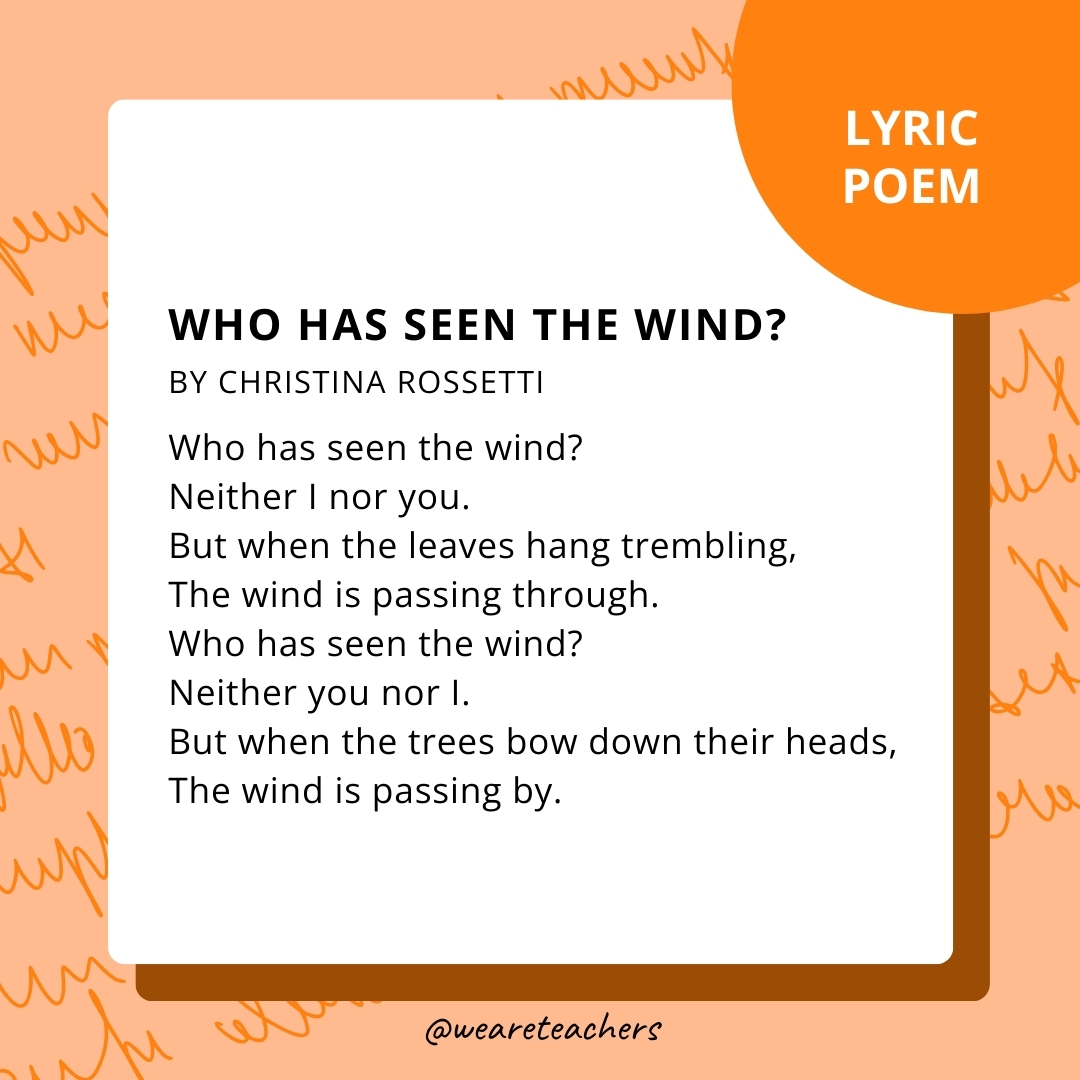
This category of poetry describes poems that are personal reflections on a topic. They’re often written in the first person, and they seek to capture a mood or scene through imagery and emotional language. The meter of the poem may feel musical in nature, as indicated by the category name.
Poem Example: Who Has Seen the Wind?, by Christina Rossetti
Narrative Poetry
This is a broad category, and it includes types of poetry like epics and ballads. You’ll know you’re reading a narrative poem when it has a plot, with a beginning, middle, and end. Over the years, they’ve been written to record history and extol the virtues of famous people. Narrative poetry has been popular since the days of the Greeks, and it continues to be beloved today.
Poem Example: Paul Revere’s Ride, by Henry Wadsworth Longfellow
Ode
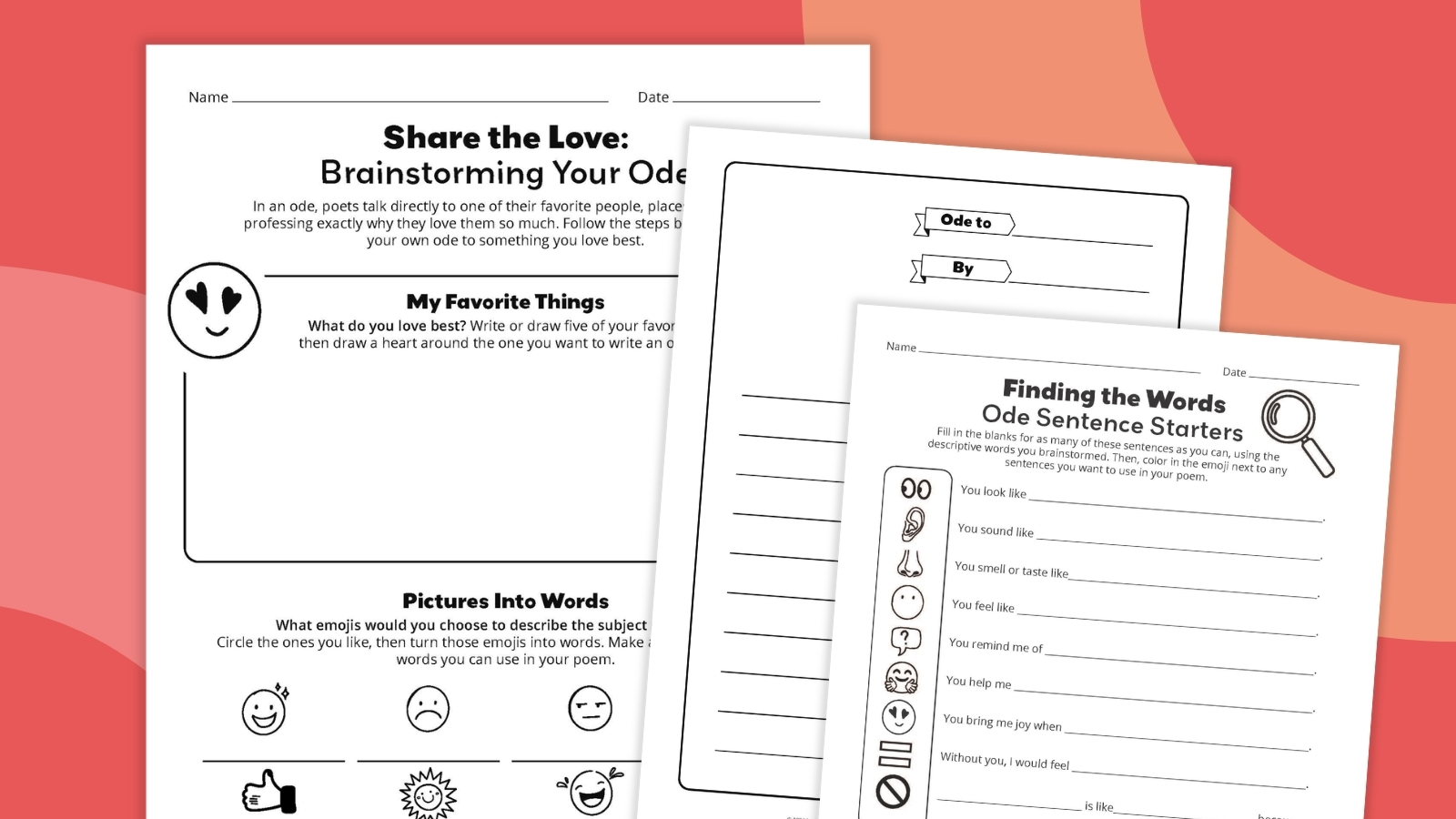
These poems celebrate a person, place, thing, or idea. They can be written in any form (though there are odes that have specific formats, like Horatian odes) and be of any length. Odes differ from ballads or epics in that they don’t generally have a plot. Unlike elegies, they don’t focus on grief or loss. Instead, they tell of the subject in glowing, descriptive terms, aiming to impress the reader.
Poem Example: Ode to the West Wind, by Percy Bysshe Shelley
Pastoral Poetry
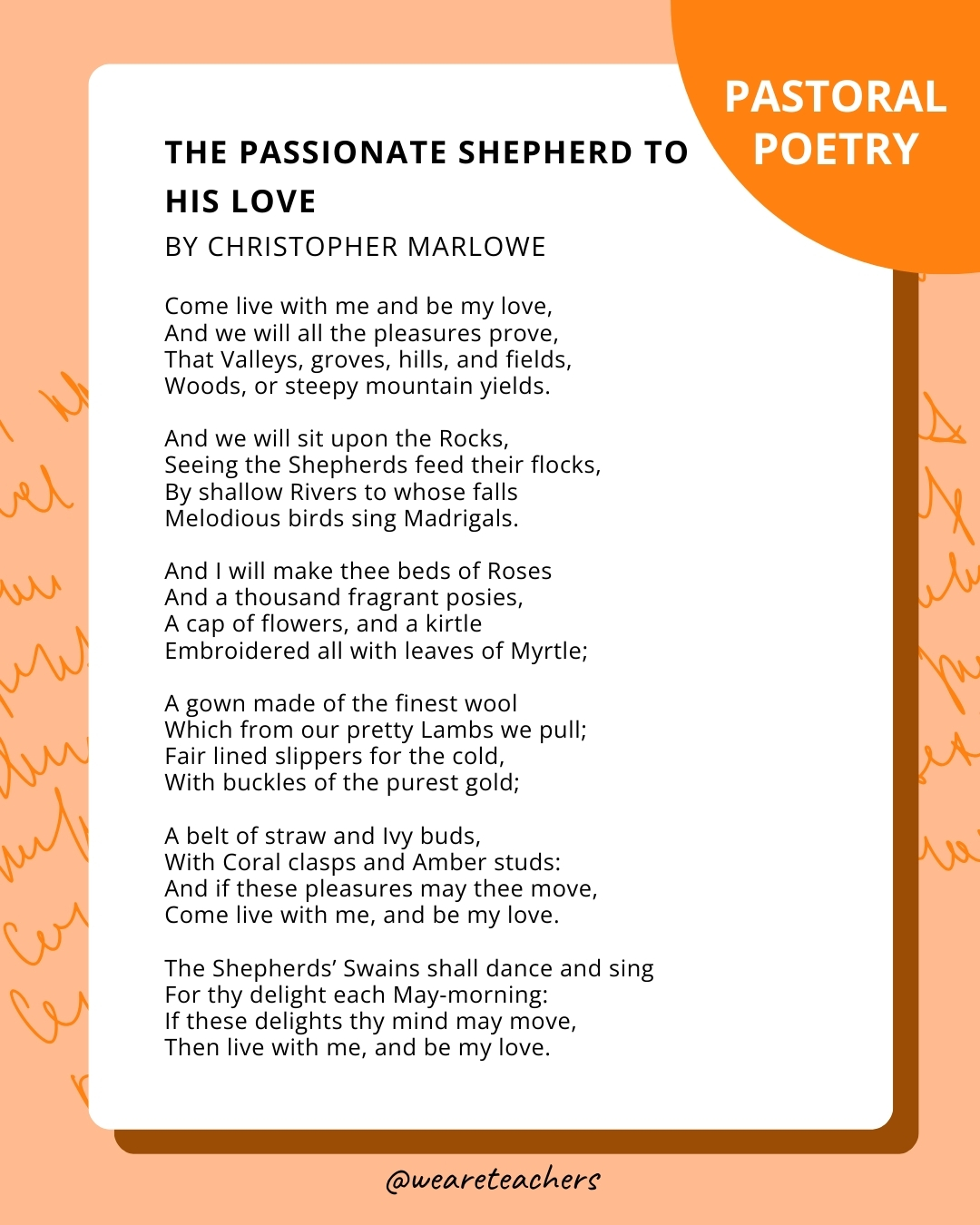
In pastoral poems, the topic is usually rural life, including nature, farmers, shepherds, and people living in the country, often idealized and unrealistic. Many poets use pastoral poems as a contrast with the hustle and bustle of city life, usually favoring the country scene in the end.
Poem Example: The Passionate Shepherd to His Love, by Christopher Marlowe
Sestina
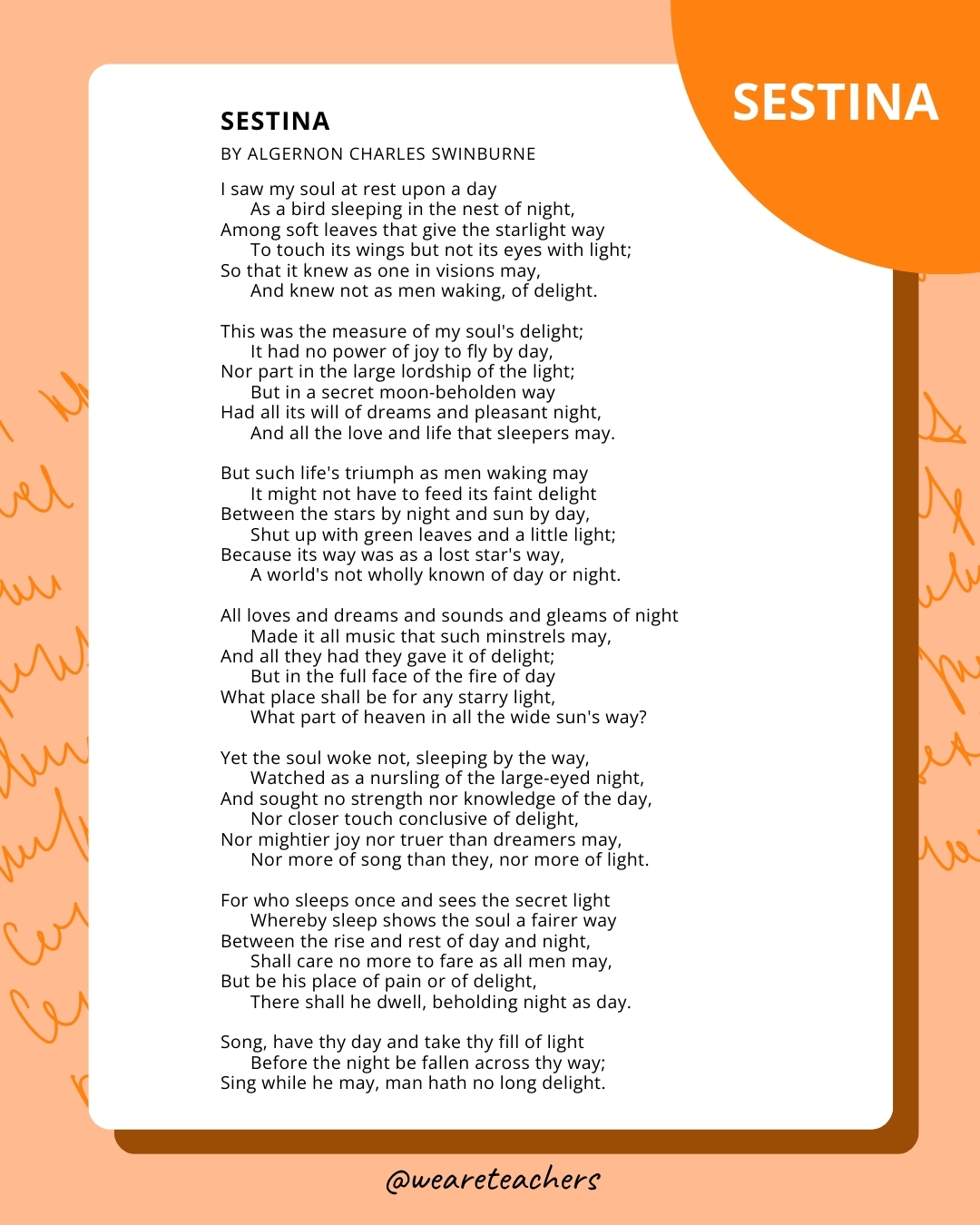
This poem type is highly structured in the number of stanzas, line length, and even syntax. Sestinas have six stanzas of six lines each (36 lines), finished by a three-line stanza called an envoi. To add to the complexity, the same six words appear at the end of each of the six lines, but in a different order in each verse. These six words also appear, two per line, in the final envoi. This can be a really fun and challenging poem type to try with students who appreciate puzzles and logic challenges. Find the complete rules for sestinas here.
Poem Example: Sestina, by Algernon Charles Swinburne
Sonnet
This is one of the most famous (and structured) types of poetry, immortalized by geniuses like Shakespeare and Milton. There are two classic types of sonnets, both with 14 lines written in iambic pentameter.
Petrarchan Sonnet
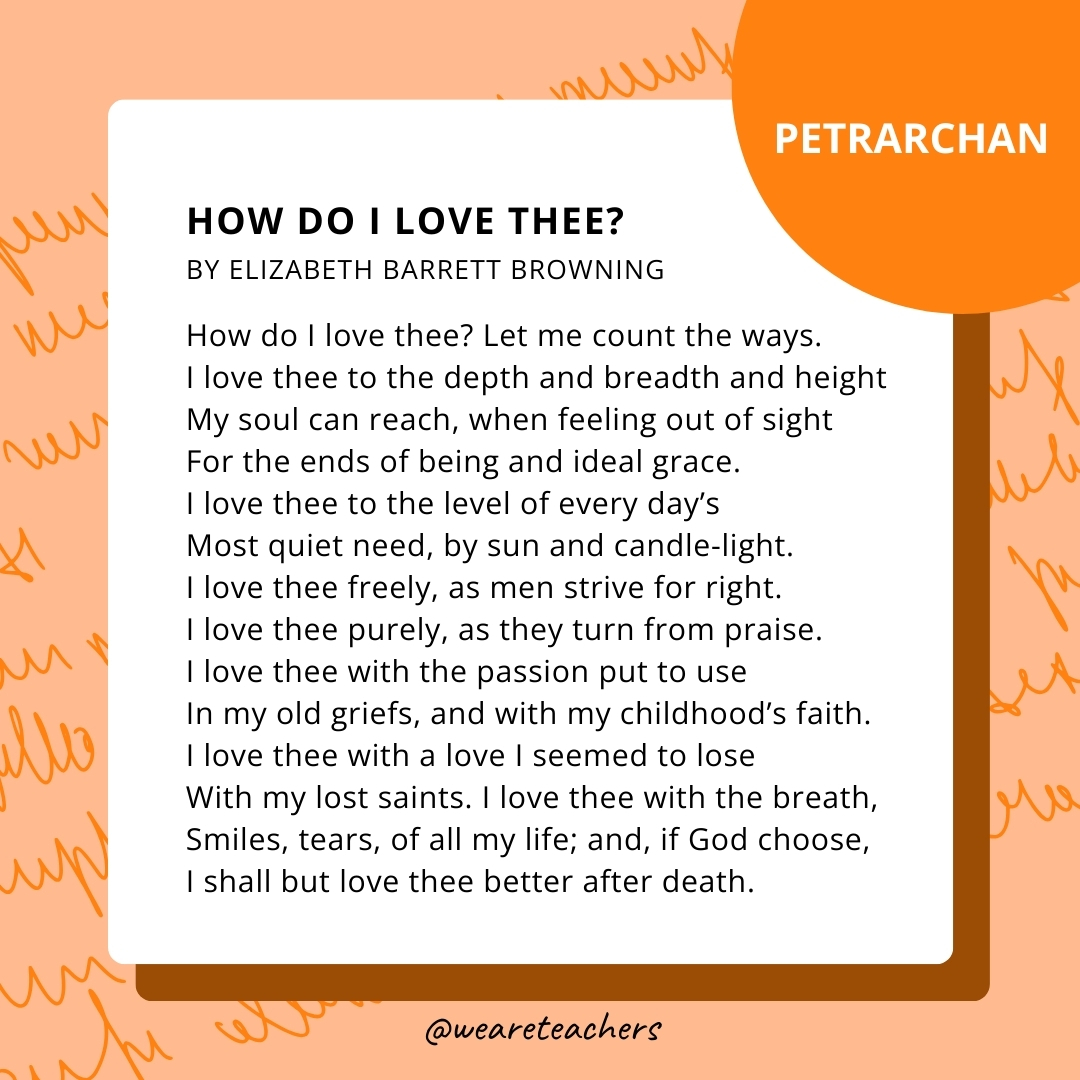
Petrarch was an Italian poet of the 14th century. Though he didn’t invent this form of sonnet, he mastered it so well it’s now known by his name. It has two stanzas. The first stanza has eight lines, with an ABBA, ABBA rhyme scheme. The second stanza has six lines, and the rhyme scheme can be CDE CDE, or CDCDCD. Petrarchan sonnets often present a question or argument in the first half, with a conclusion or counterargument in the second.
Poem Example: How Do I Love Thee? (Sonnet 43), by Elizabeth Barrett Browning
Shakespearean Sonnet
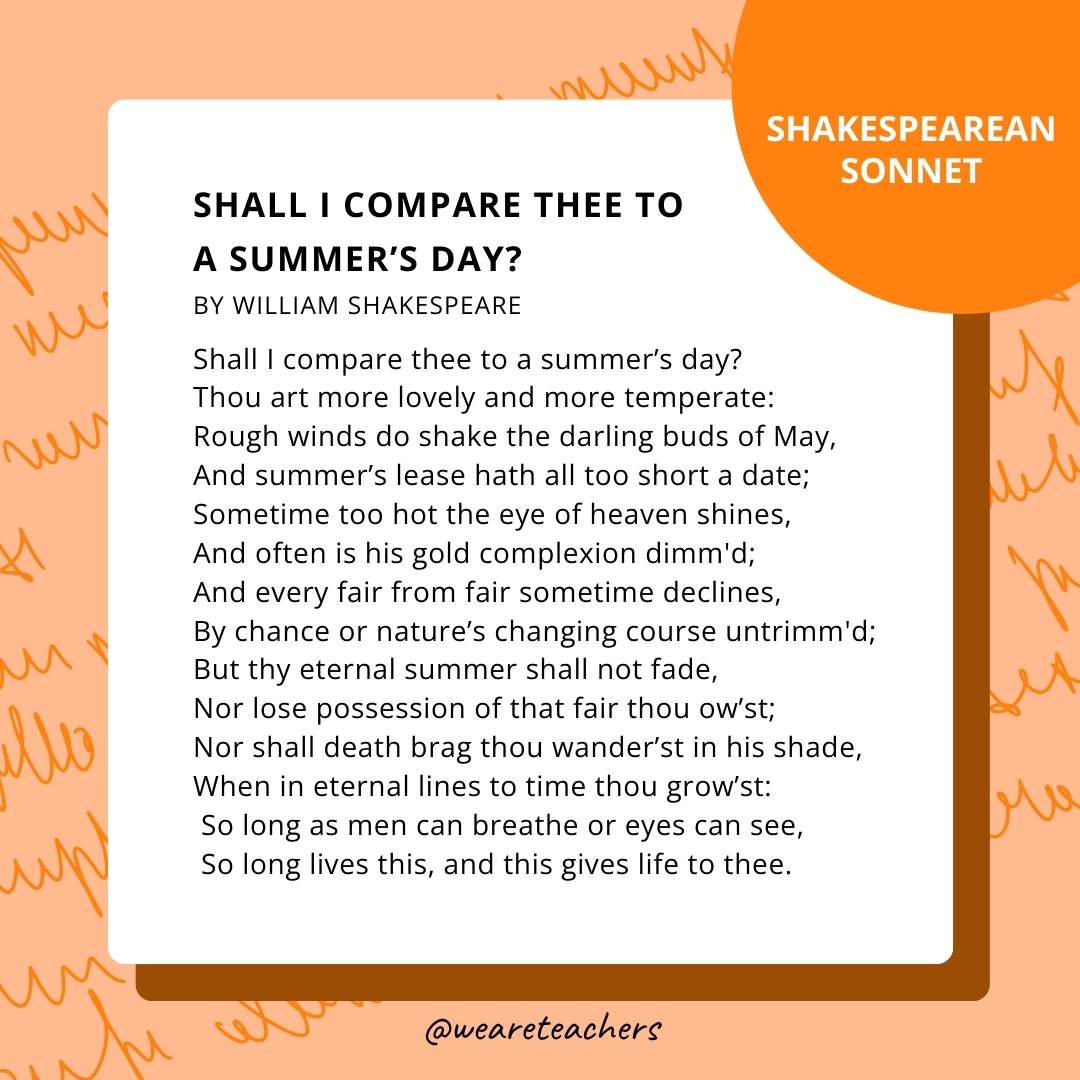
After sonnets were introduced to England, poets made some alterations to the rhyme scheme and format. A Shakespearean sonnet has three quatrains (sections of four lines each), followed by a couplet of two lines. The rhyme scheme is ABAB, CDCD, EFEF, GG. This gave writers a little more leeway, since it can be harder to find rhyming words in English than in the Romance languages. Shakespeare perfected the form, writing 154 sonnets in this style.
Poem Example: Shall I Compare Thee to a Summer’s Day? (Sonnet 18), by William Shakespeare
Villanelle
This is another example in poetry of a composition that has a very specific structure. It contains five three-line stanzas (tercet) and a final four-line stanza (quatrain), for a total of 19 lines. The tercets all use the rhyme scheme ABA, and the quatrain uses ABAA. In addition, the first and third lines of the first tercet are repeated at set places throughout the poem. Here are all the rules for writing villanelles.
Poem Example: Do Not Go Gentle Into That Good Night, by Dylan Thomas
More Types of Poetry for Kids
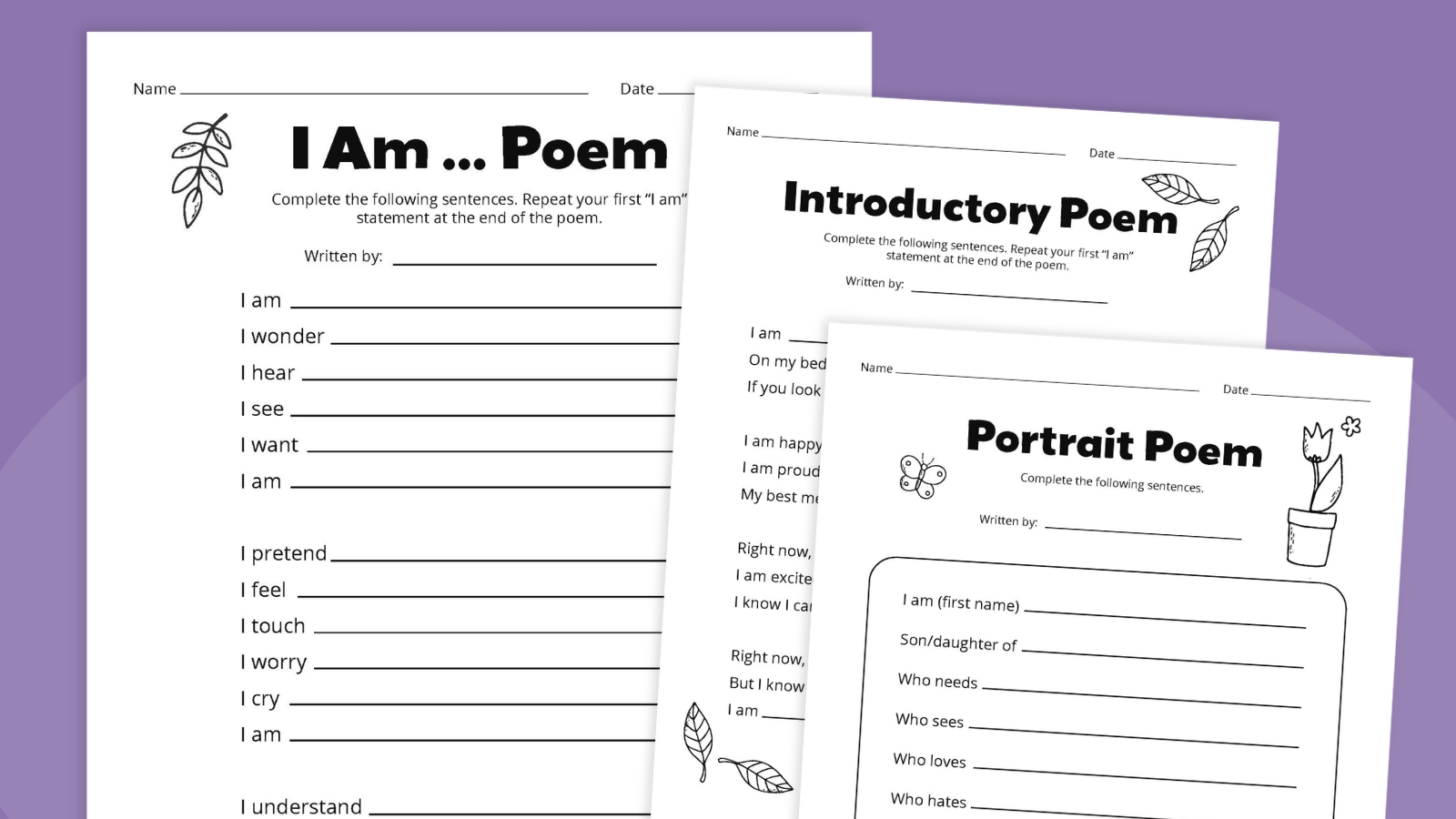
“I Am” Poem
This simple poem style is excellent for introducing poetry to young students. Our fill-in-the-blank–style worksheets help them compose a poem that begins and ends with “I Am” statements, with more “I” statements filling in the lines in between.
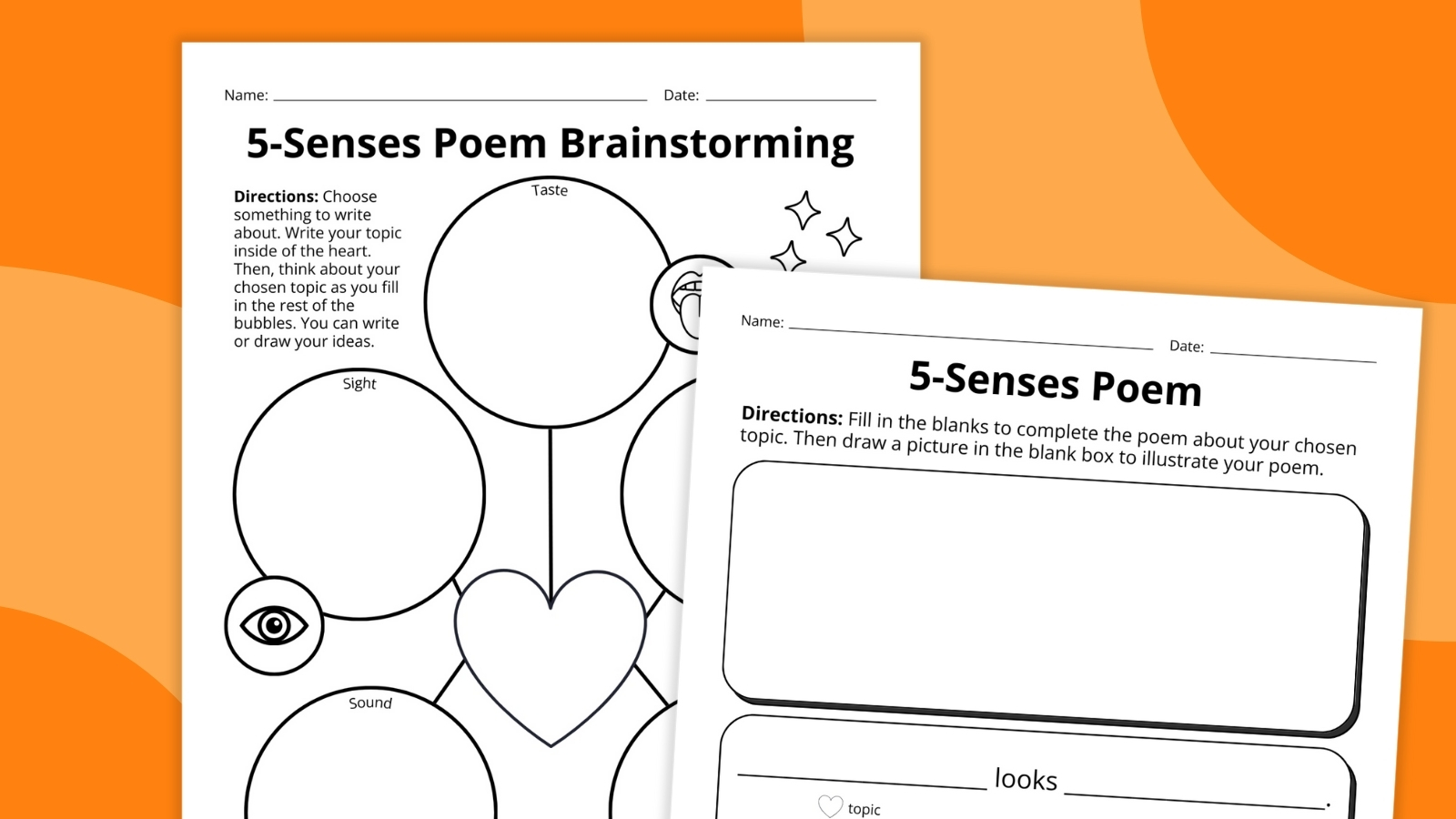
5 Senses Poem
So much poetry is about sensory details: what we see, hear, taste, touch, and smell. A 5 senses poem encourages kids to observe the world around them more closely, then put those observations into words.
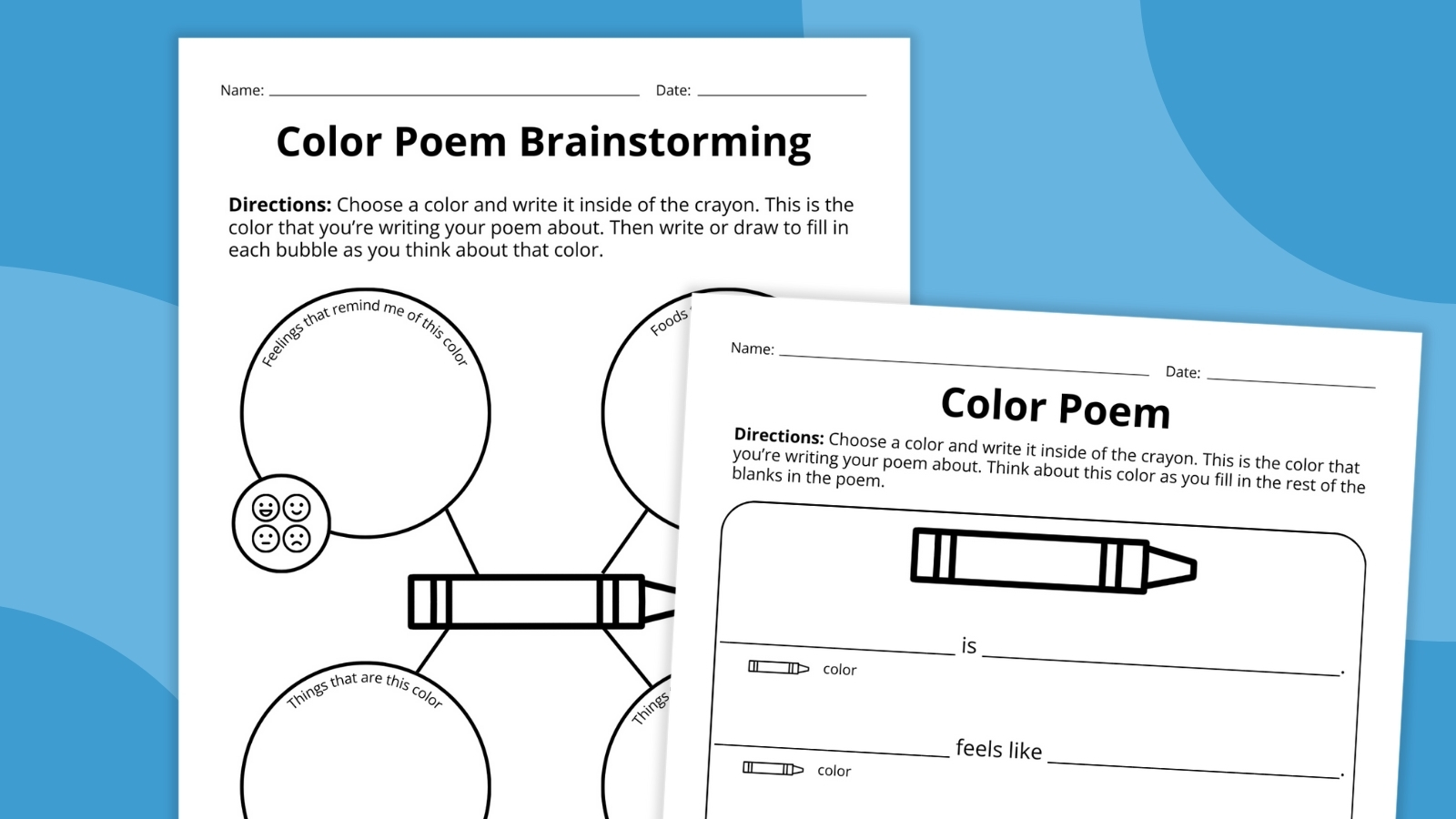
Color Poem
As students write their first poems, it helps to give them a simple topic for inspiration. Start with a color and ask them to brainstorm words, phrases, and images related to it. This leads naturally into a poem about color!
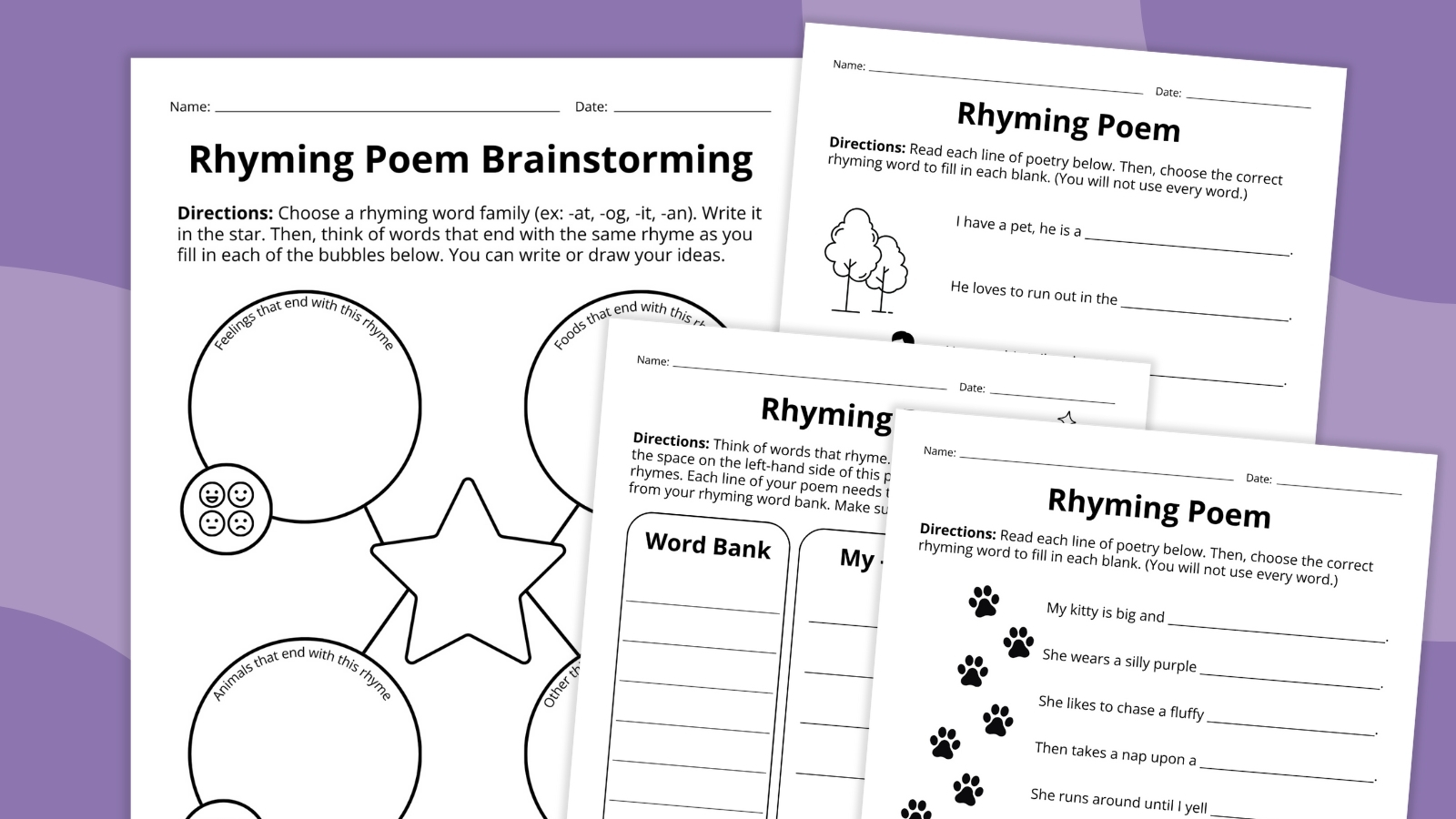
Rhyming Poem
When kids think of poetry, chances are they first think of rhyming poems. Writing one can feel a little tricky, though, so try our big set of rhyming poem worksheets. They help students build a word bank, brainstorm topics, and write their final draft.
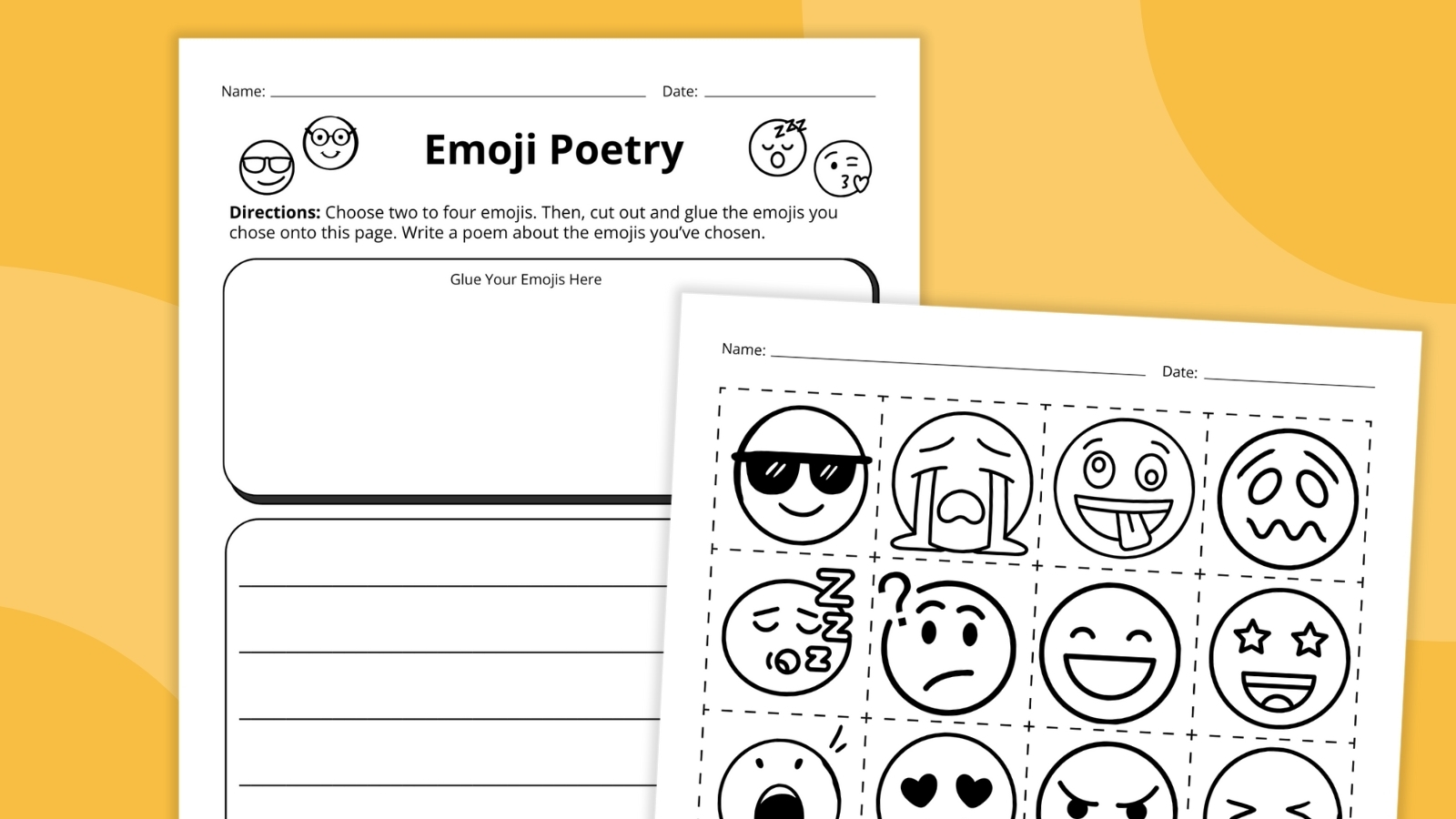
Emoji Poem
An emoji is worth a thousand words! Students first choose their favorite emojis and arrange them on the page. Then, they write lines of their poems to match. So fun and creative for every kind of student!
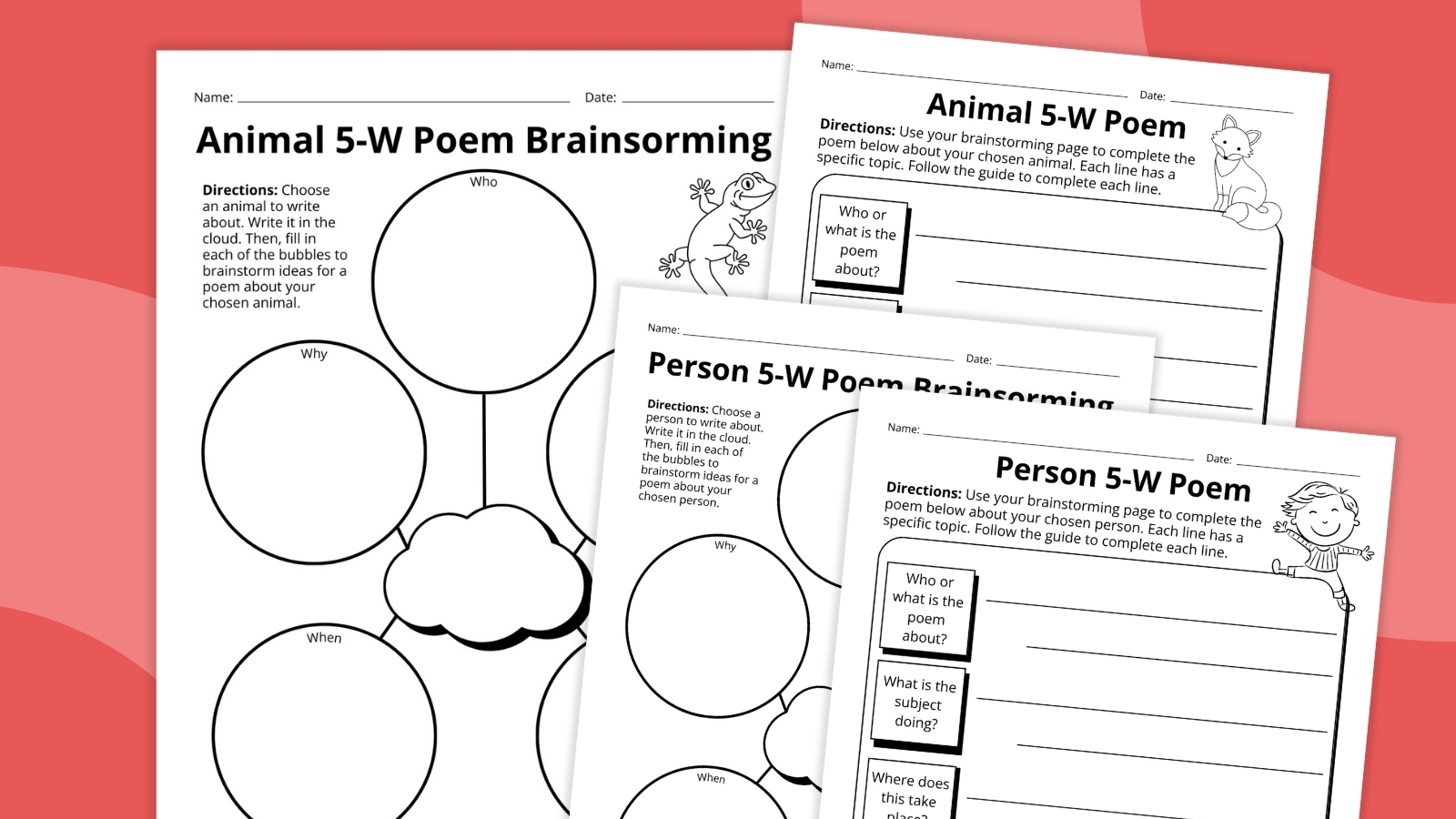
5W Poem
Who, what, when, where, why? Poets use brainstorming and structure to write funny, serious, and sentimental poetry. Show students how it’s done as they write poems about animals or people using the 5W format.
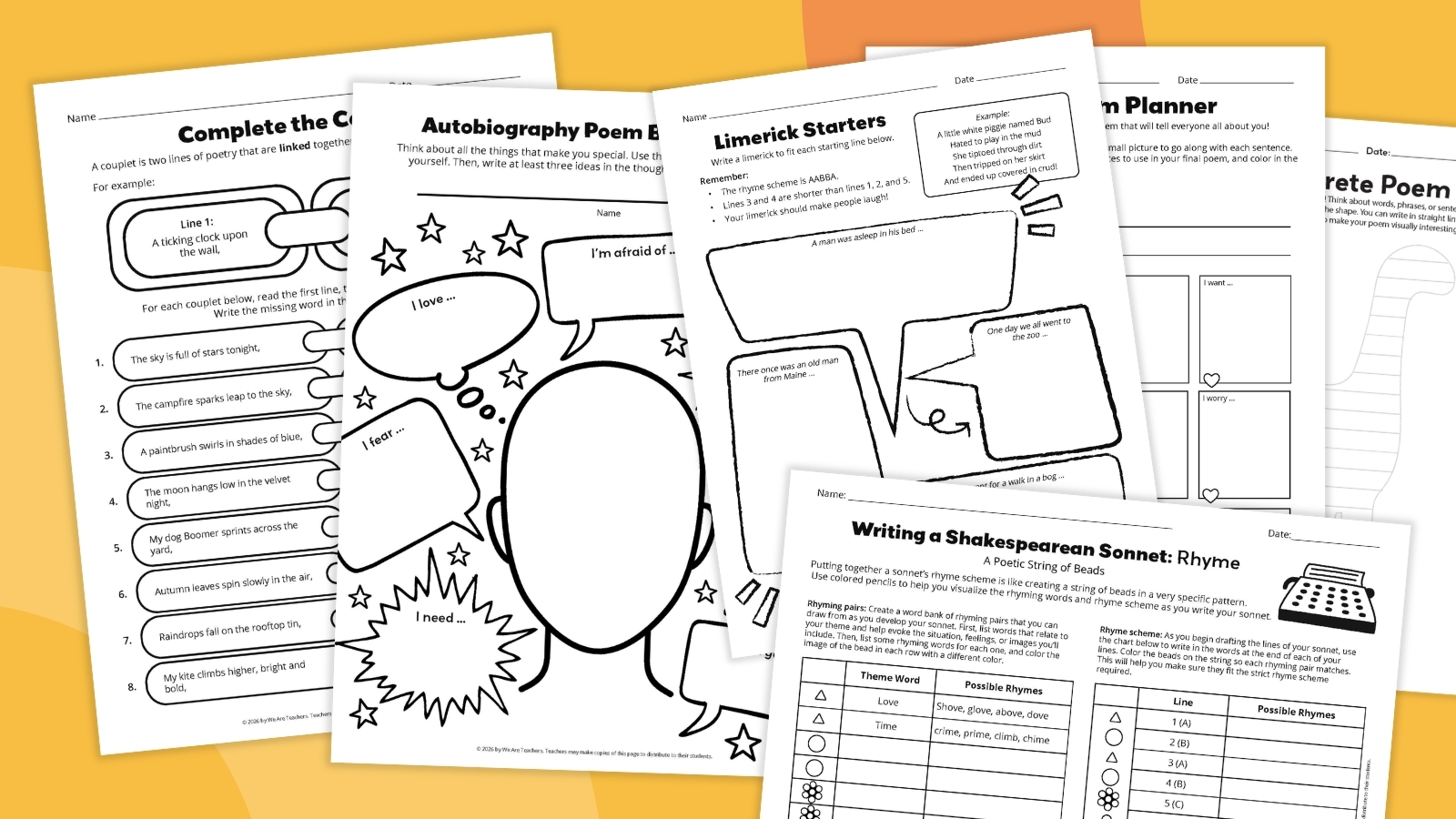
Don’t forget to grab your free poetry worksheet printables!
Plus, check out Famous Poets Your Students Should Know.
[ad_2]
Source link