

It can be hard to know which poems will spur your middle and high schoolers into deep, meaningful discussion and which will leave them yawning. So we asked experienced teachers to share their favorite poems—the ones that always get a reaction, even from teens. Here are their top picks for the best poems for middle school and high school students.
Jump to:
Note: Every classroom is different, so please be sure to review these poems for middle and high school students before sharing to ensure they align with your learning environment.
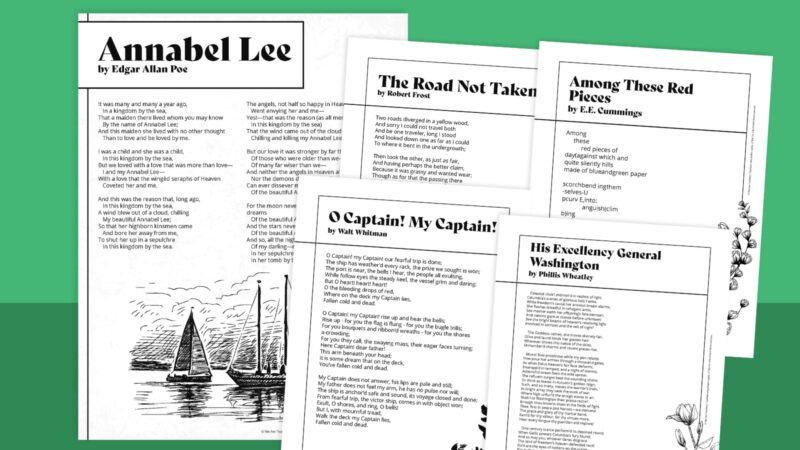
FREE PRINTABLES
Middle and High School Poems
This printable bundle includes some of our favorite middle and high school poems to share with students. Just fill out the form on this page to get them.
Poems for Middle School and High School
1. Nothing Gold Can Stay by Robert Frost
Nature’s first green is gold …
Themes: The life cycle, loss, regret
Literary devices: Alliteration, metaphor, personification
This poem is a great introduction to poetry that can be analyzed and discussed within a class period. Plus you can talk about how the poem relates to what students experience as they move through childhood milestones.
2. The Road Not Taken by Robert Frost
Two roads diverged in a yellow wood,
And sorry I could not travel both …
Themes: Individualism vs. nonconformity; choices and consequences
Literary devices: Extended metaphor, imagery, symbolism, rhyme
“The Road Not Taken” is a classic poem that every middle and high schooler really should read. It’s also a poem about things that teens struggle with, like whether to conform or be themselves, or the consequences of their actions. Engage students in a classic close reading of this poem so they can experience it for themselves, and discuss it as a class.
3. Rat Ode by Elizabeth Acevedo
Because you are not the admired nightingale …
Themes: Resilience, survival, misunderstanding
Literary devices: Personification, metaphor, tone
Listen to the author herself as she performs her poetry. Study how Acevedo creates a shift in tone and how that changes the meaning of the poem and the readers’ expectations.
4. I Lost My Talk by Rita Joe
I lost my talk
The talk you took away.
Themes: Loss, cultural identity, oppression
Literary devices: Repetition, symbolism, tone shift
This poem follows the pain and suffering Joe experienced at Shubenacadie Residential School in Nova Scotia. As middle schoolers find their own voices, this poem is a great one for students to read and discuss for the general meaning. Or you can research residential schools in Canada and the United States and talk about the history and ethics of those schools with regard to Indigenous people. As you analyze it, talk about the various meanings of “talk” as it relates to language, culture, and identity.
5. Friend by Josephine Miles
I met a man in a woolen reefer,
A friend of my friend’s.
Themes: Change, memory, passage of time
Literary devices: Symbolism, metaphor, enjambment
This poem uses run-on lines to create a flowing rhythm (enjambment), so it’s a great one to read aloud or encourage students to read in a poetry slam. You can also use it to talk about how friendships change over time.
6. There Are Birds Here by Jamaal May
when they said those birds were metaphors
for what is trapped
between buildings …
Themes: Challenging stereotypes, resilience, misrepresentation, hope
Literary devices: Repetition, contrast, symbolism
The repeated line “There are birds here” reinforces the idea that life and beauty exist even when things seem hopeless. Students can use this poem in a Socratic seminar to talk about how the author describes and reflects on Detroit and negative perceptions of the city, and the presence of joy, nature, and community that point to a broader endurance.
7. Fire and Ice by Robert Frost
Some say the world will end in fire,
Some say in ice.
Themes: End of the world, emotions
Literary devices: Symbolism, contrast, imagery
This poem will especially engage students who like “Game of Thrones” as there is discussion that the poem inspired the author of that work. For all middle schoolers, Frost doesn’t hold back with this poem, and it’s an ideal one for discussion and debate. Where do students fall, fire or ice?
8. Dear Future Generations: Sorry by Prince Ea
I think I speak for the rest of us when I say
Sorry, sorry we left you with our mess of a planet …
Themes: Destruction, responsibility, climate
Literary devices: Personification, direct address, metaphor
Ea documented this to raise awareness about the alarming rates of deforestation and the reckless destruction of our environment. Read this poem to discuss themes of climate change, or bring it into science class to show students how poets can reflect the times they write in, and what is a writer’s responsibility to reflect and work to change problems they see.
9. Casey at the Bat by Ernest Lawrence Thayer
The outlook wasn’t brilliant for the Mudville nine that day …
Themes: Pride, failure, sports
Literary devices: Hyperbole, alliteration, rhyme and meter
An oldie but goodie! Use this poem to engage your sports-obsessed middle schoolers or to analyze the AABB rhyme scheme.
10. The Rose That Grew From Concrete by Tupac Shakur
Funny it seems, but by keeping its dreams,
it learned to breathe fresh air.
Themes: Perseverance, transformation, hope
Literary devices: Metaphor, symbolism, rhyme and rhythm
The late artist created a clear connection between the rhythm and deeper meaning of poetry and rap. Yes, this poem is good to engage students who are interested in music, but it’s also a good poem to analyze and connect to students’ lives as they go through their own transformative experiences.
11. The Listeners by Walter de la Mare
“Is there anybody there?” said the Traveller,
Knocking on the moonlit door …
Themes: Unanswered questions, isolation, the passage of time
Literary devices: Symbolism, personification, repetition
“The Listeners” is a poem for your fans of science fiction. Read this poem aloud and talk about tone—how does the poet create that eerie atmosphere?
12. We Wear the Mask by Paul Laurence Dunbar
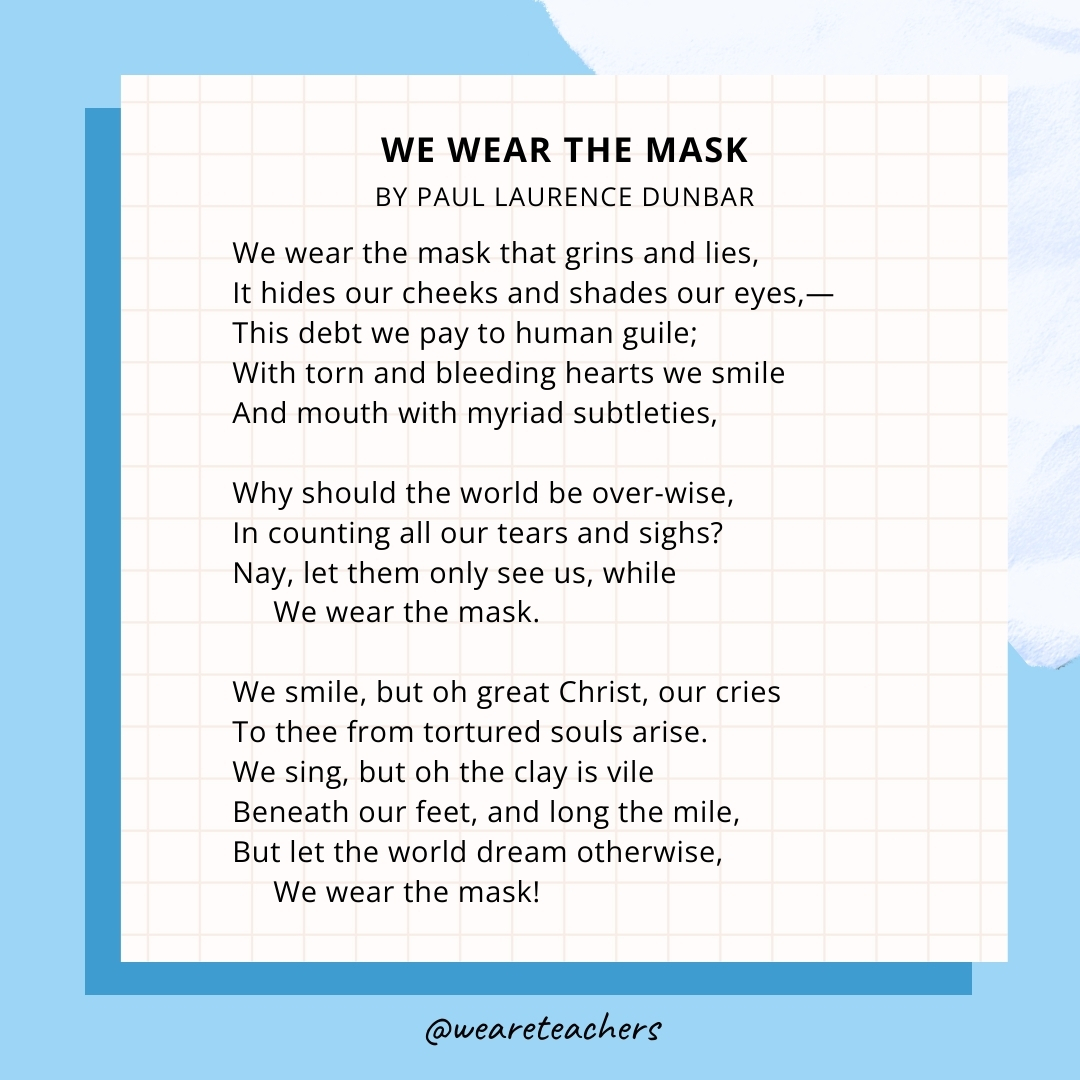
We wear the mask that grins and lies,
It hides our cheeks and shades our eyes …
Themes: Racial injustice, masking emotions, resilience
Literary devices: Metaphor, personification, imagery
A reaction to the experience of being Black in America in the late 19th century. The mask is a metaphor that is used to symbolize the facade that individuals put on to hide their own emotions (a metaphor that adolescents can relate to). It’s also important to talk about how Dunbar’s poem fits into African American history.
13. A Dream Within a Dream by Edgar Allan Poe
You are not wrong, who deem
That my days have been a dream …
Themes: Fleeting nature of time, illusion vs. reality
Literary devices: Rhyme scheme, metaphor, imagery
“A Dream Within a Dream” is an introspective poem that delves into the nature of reality and the fragility of life. Poe was an expert at rhyme scheme—and this poem is clear evidence of that with its AABACDCD pattern. Use it to introduce and analyze rhyme scheme in a poem.
14. Deer Hit by Jon Loomis
You’re seventeen and tunnel-vision drunk,
swerving in your father’s Fairlane wagon home …
Themes: Human impact on nature, reflection, guilt
Literary devices: Juxtaposition, personification, tone
Students won’t soon forget this poem, both for the story and the sensory details. “Deer Hit” is about the moments immediately after a deer is hit by a car. Read it for the impact that sensory details can have on a reader or to talk about themes of how humans interact with nature.
15. Eating Poetry by Mark Strand
Ink runs from the corners of my mouth.
Themes: Power of poetry, art, self-transformation
Literary devices: Surrealism, enjambment, personification, simile
The title may entice some more reluctant poetry readers into this poem about the power of literature. Strand imagines a scenario where eating poetry is literally transformative. You can read it with students to discuss how poetry can transform or how something they love can feel like a powerful force in their lives.
16. And the Ghosts by Graham Foust
they own everything
Themes: Loss, memory, absence
Literary devices: Metaphor, imagery
Put this poem up for students to discuss when you want to show them just how powerful one line can be. Students can also reflect on the various meanings of the word “ghosts” and what that means for them.
17. That Sure Is My Little Dog by Eleanor Lerman
Yes, indeed, that is my house that I am carrying around …
Themes: Companionship, pets, love and loss
Literary devices: Contrast, metaphor, imagery
Many poems engage with the theme of the connection between humans and animals, which makes them great to bring into the classroom. Use “That Sure Is My Little Dog” to talk about how people can make their pets an extension of themselves.
18. Another Reason Why I Don’t Keep a Gun in the House by Billy Collins
The neighbors’ dog will not stop barking.
Themes: Violence, impulsivity and control, absurdity
Literary devices: Tone, hyperbole, allusion
Any student who has ever felt annoyed or had to put up with daily frustrations will relate to this poem, which reflects on the absurdity of a violent impulse. This is also a good poem to use to talk about how our thoughts can have unpredictable consequences. The poem also alludes to broader conversations about gun control, which older students may be ready to discuss.
19. Mother to Son by Langston Hughes
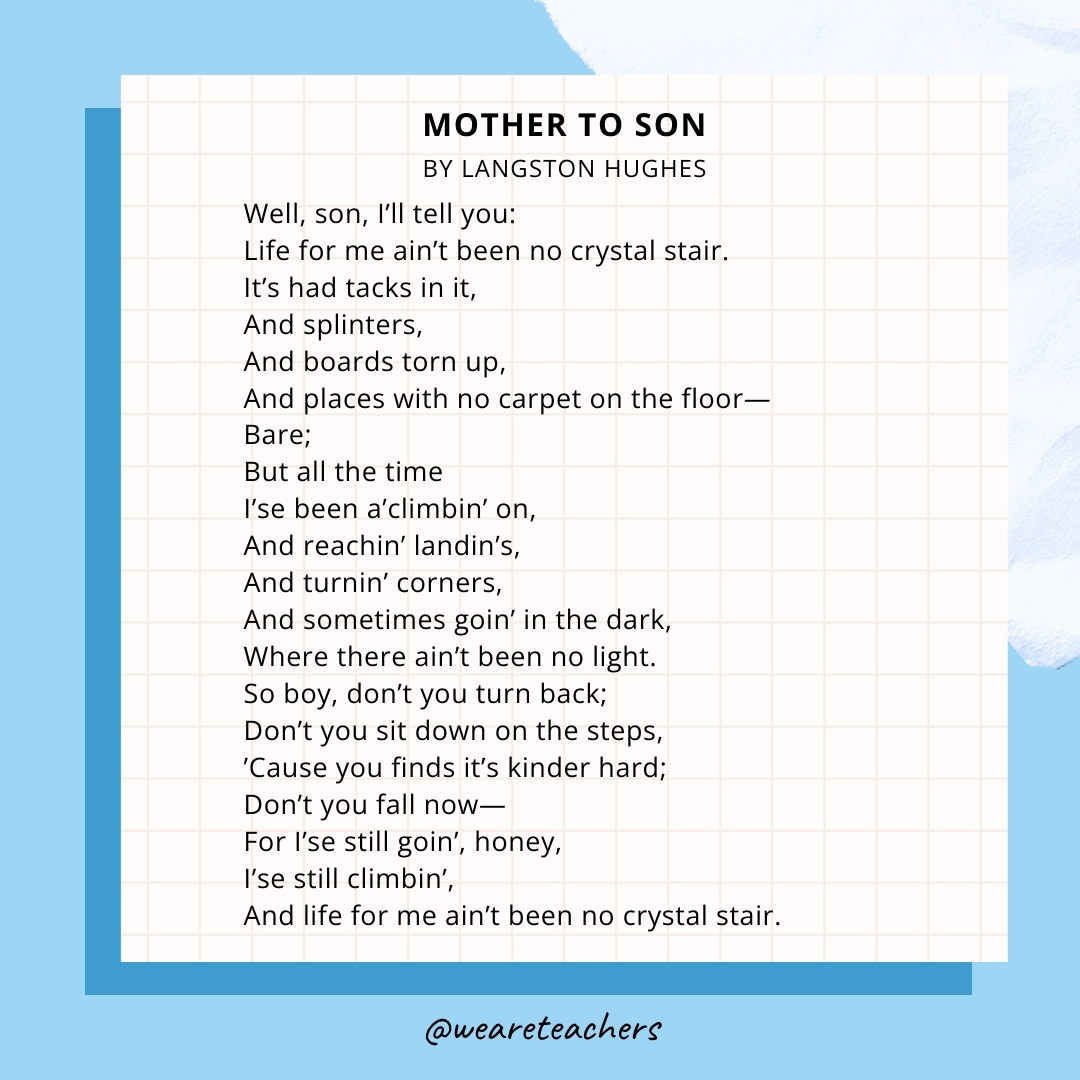
Well, son, I’ll tell you:
Life for me ain’t been no crystal stair.
Themes: Perseverance, resilience, hope
Literary devices: Dialect, tone, symbolism
A politically charged poem that still rings true today, “Mother to Son” is a powerful, heartfelt narrative about perseverance, resilience, and hope through a mother’s advice to her son. Students should also read Hughes’ other impactful works.
20. Beethoven by Shane Koyczan
Listen
his father
made a habit
out of hitting him …
Themes: Resilience, art, adversity
Literary devices: Allusion, enjambment, symbolism
Through a poem with allusion to Beethoven’s life that flows easily from line to line, Koyczan reflects on resilience and the healing power of music. This poem is worth reading and discussing on its own or alongside information about Beethoven.
21. Oranges by Gary Soto
The first time I walked
With a girl, I was twelve …
Themes: Love, small moments, adolescence
Literary devices: Imagery, symbolism, enjambment
Soto’s poem about trying to impress a girl shows what small moments reveal about ourselves and how those moments embed themselves in our memories. Support students in reflecting on how this poem connects to their own lives. Plus, this poem, with its story-like quality and enjambment, is a great one to read aloud.
22. This Is Just To Say by William Carlos Williams
I have eaten
the plums
that were in
the ice box …
Themes: Temptation, regret, imperfection
Literary devices: Enjambment, symbolism
“This Is Just to Say” leaves lots of space for inference, which leads to great discussion. It’s a poem that creates a simple expression of human behavior, but that is more layered the more students read and analyze it. In particular, students can talk about how the poet creates a casual tone and whether or not he actually regrets eating the plums.
23. Having a Coke With You by Frank O’Hara
is even more fun than going to San Sebastian …
Themes: Love, ordinary moments, admiration
Literary devices: Imagery, metaphor
O’Hara explores a simple moment between two people and is full of personal reflection. With the longer lines and stream-of-consciousness format, it’s a good one to talk about the various ways that poets organize their writing.
24. Pass On by Michael Lee
When searching for the lost, remember eight things …
Themes: Time, acceptance, memory
Literary devices: Tone, enjambment, imagery
Lee’s poem creates snapshots of memory, creating lines and ideas for every student to grab and hold on to. This is a good poem to talk about tone, which is reflective, and accepting life’s impermanence.
25. Snow by David Berman
Walking through a field with my little brother Seth …
Themes: Change, nature, isolation
Literary devices: Juxtaposition, tone, imagery
“Snow” is a melancholy narrative in miniature. Berman discusses the complexity of human emotion within imagery of snow and the environment. Talk about the juxtaposition between the events and what’s happening and the beauty of nature.
26. Still I Rise by Maya Angelou
You may write me down in history
With your bitter twisted lies …
Themes: Empowerment, resilience, triumph
Literary devices: Repetition, simile, rhetorical questions
This is a poem that must be read aloud and listened to. Find videos of the poem being read by Angelou and other orators to show the way the energy of the poem can be interpreted. Then, students can discuss what Angelou is saying about the African American experience, what she may have been responding to when she wrote it, and how the poem is relevant today.
Learn more: Maya Angelou Quote posters for your classroom.
27. So You Want To Be a Writer by Charles Bukowski
if it doesn’t come bursting out of you
in spite of everything,
don’t do it.
Themes: Writing, rejection and persistence, self-expression
Literary devices: Direct address, tone, metaphor
Bukowski’s poem is a blunt commentary about what it really means to write and be a writer. Middle and high schoolers will appreciate the blunt and unflinching tone. And as they develop their own writing selves, they can talk about why writing remains an important human experience. This poem is also written directly to the reader, which is unique for poems and an interesting aspect for analysis.
28. We Real Cool by Gwendolyn Brooks
We real cool. We
Left school. We
Lurk late. …
Themes: Rebellion, youth, identity
Literary devices: Enjambment, rhyme, tone
This poem, about independence and defiance, speaks directly to the adolescent experience. Talk about what was happening in history when Brooks wrote this poem, and how it’s become a timeless poem. If you’re doing a poetry slam, this poem is great for students to read aloud and make their own.
29. Do Not Go Gentle Into That Good Night by Dylan Thomas
Do not go gentle into that good night,
Old age should burn and rave at close of day …
Themes: Fighting for life, resistance to death, regret
Literary devices: Villanelle, repetition, metaphor
This reflection on life, death, and the human drive to resist is a great one for close reading and line-by-line analysis. It’s also a villanelle, a 19-line fixed form with five tercets and final quintain—students can analyze the structure and how it moves the poem forward.
30. Daddy by Sylvia Plath
You do not do, you do not do
Any more, black shoe …
Themes: Family relationship, anger, resentment
Literary devices: Allusion, imagery, simile
Sylvia Plath is an author whom students may discover during their high school years, so her poem is a good introduction to the classic writer. This poem explores a complex relationship between father and daughter in Plath’s unsparing tone.
31. I Died for Beauty by Emily Dickinson
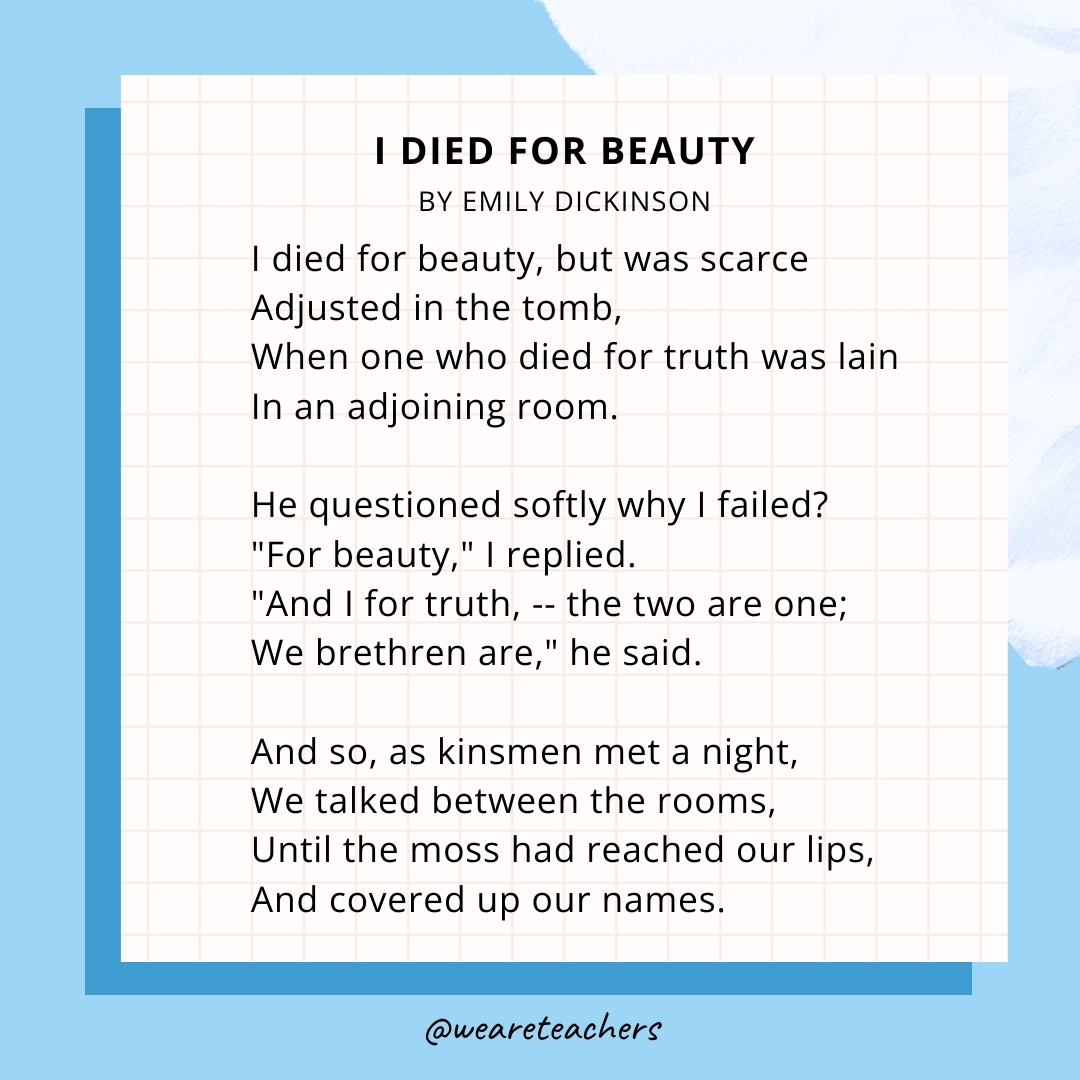
I died for beauty, but was scarce
Adjusted in the tomb …
Themes: Beauty, truth, death
Literary devices: Symbolism, tone, imagery
Dickinson was so good at creating mood, this time about the connection between beauty and truth. Dickinson’s poems often require context, so study this poem alongside some information about Dickinson’s life and what she’s most known for. In this poem, students can analyze the symbolism that Dickinson uses to describe time and death, and what else the words “tomb” and “moss” could represent.
32. Annabel Lee by Edgar Allan Poe
It was many and many a year ago,
In a kingdom by the sea
That a maiden there lived whom you may know
By the name of Annabel Lee …
Themes: Love, death, obsession
Literary devices: Repetition, rhythm and rhyme, imagery
A ghost story wrapped up in a poem, this story is a classic Poe poem. Poe writes in his haunting, macabre style and describes a love so strong it can transcend death. This poem is great for close readings and for reading aloud or a poetry slam. It’s also a perfect poem for students to use to inspire projects—how can they make this poem come alive?
33. Ode to a Large Tuna in the Market by Pablo Neruda
Here,
among the market vegetables,
this torpedo
from the ocean …
Themes: Nature, transformation, death
Literary devices: Imagery, personification, free verse, metaphor
The rest of the poem is as humorous as the title, and it’s fun to dissect and analyze how Neruda writes about everyday objects, like the tuna on ice. It’s also a statement about nature, as Neruda contrasts the tuna’s former life with its presentation in the supermarket. Students can unpack this poem and identify the literary devices that make it most effective.
34. Among These Red Pieces by e.e. cummings
Among
these
red pieces of
day(against which and
quite silently hills
made of blueandgreen paper …
Themes: Love, beauty, individuality
Literary devices: Alliteration, metaphor, symbolism, enjambment
The use of color and how Cummings arranges the lines, punctuation, and spacing are all quintessential Cummings. In addition to how Cummings weaves English and Italian to create the scene, students can discuss how the dashes and parentheses affect how we read the poem.
35. Very Like a Whale by Ogden Nash
One thing that literature would be greatly the better for
Would be the more restricted employment by the authors of simile and metaphor.
Themes: Poetry, language, humor
Literary devices: Satire, rhyme, hyperbole
Nash’s comical poem pokes fun at the overuse of similes and metaphors in literature. It’s a good poem to end a unit on. Once students have developed their own opinions of what is missing in literature and what they think authors and poets should do, they can give a deeper commentary on Nash’s opinion.
36. The Cremation of Sam McGee by Robert W. Service
There are strange things done in the midnight sun …
Themes: Friendship, loyalty, humor
Literary devices: Imagery, narrative, irony
This poem, with its satire and dark humor, is an all-American poem. Students can read it to discuss the references that Service included and how they create the atmosphere and setting. Then, students can read the poem for the story to discuss what actually happens in the poem. Read it aloud so students can hear the rhythm.
37. The Highwayman by Alfred Noyes
The wind was a torrent of darkness among the dusty trees.
Themes: Love, loyalty and betrayal, revenge
Literary devices: Metaphor, simile, rhythm, narrative
When a highwayman meets the inn owner’s daughter, they fall in love immediately … as a rival eavesdrops. This narrative poem is another fun one to use with other narrative poems, like “Annabel Lee” and “The Cremation of Sam McGee,” to show how poets can be storytellers.
38. Language Lessons by Alexandra Teague
The carpet in the kindergarten room
was alphabet blocks; all of us fidgeting …
Themes: Communication, memory, realization
Literary devices: Imagery, enjambment
This poem, with themes of language, culture, and identity as the author reflects on learning language in school, is one that students can relate to as they grow out of elementary school and move on to higher grades. How can students connect with the poet’s experience and feelings?
39. Mirror by Sylvia Plath
I am silver and exact. I have no preconceptions.
Themes: Identity, perception, aging
Literary devices: Personification, metaphor, imagery
This poem speaks from a mirror’s perspective, sharing truths as a woman looks at her own reflection. All middle and high schoolers can delve into a poem about identity and aesthetics and how we perceive ourselves.
40. She Walks in Beauty by Lord Byron
She walks in beauty, like the night
Of cloudless climes and starry skies …
Themes: Beauty, idealized love, purity
Literary devices: Imagery, metaphor, rhyme scheme
Byron describes a beautiful woman in this poem. Students can analyze it on its own or in comparison to other poems about beauty and identity, like those by Dickinson and Plath. This is also a good poem to include if you are talking about themes of love and how poets treat love in their work.
41. A Man Said to the Universe by Stephen Crane
A man said to the universe:
“Sir, I exist!”
Themes: Human struggles, futility
Literary devices: Dialogue, personification
This short poem speaks volumes. In today’s world, students can analyze the staying power of this poem and what it could mean for teens in today’s busy, social-media-filled world.
42. The Laughing Heart by Charles Bukowski
your life is your life
don’t let it be clubbed into dank submission.
Themes: Embracing life, individuality, freedom
Literary devices: Imagery, repetition, metaphor
In this uplifting poem that is written directly to the reader, Bukowski encourages people to make the most of each day. It’s a good poem to incorporate into a poetry unit to lighten the mood or engage students in a carpe diem moment.
43. Tattoo by Ted Kooser
What once was meant to be a statement—
a dripping dagger held in the fist …
Themes: Aging, change
Literary devices: Enjambment, metaphor, personification
What stories can an old man’s tattoo tell us? This soft, lyrical poem about watching an old man who has a tattoo will resonate with middle and high schoolers because of the vivid images and wistful wondering about who this old man once was. Students can reflect on what their younger selves might see if they came across their current selves, or what they may look like in the future.
44. A Litany in Time of Plague by Thomas Nashe
Adieu, farewell, earth’s bliss;
This world uncertain is;
Fond are life’s lustful joys …
Themes: Death, life, powerlessness, illness
Literary devices: Tone, imagery, symbolism, refrain
This poem, written in the late 16th century in response to the bubonic plague, is still relevant today. The idea that no one is immune from a pandemic is depicted in the lines “Rich men, trust not in wealth, Gold cannot buy you health.” Include this poem in a collection of poems that were written in response to historical events so students can analyze how poets incorporate pivotal events into their writing.
45. I’m Nobody, Who are you? by Emily Dickinson
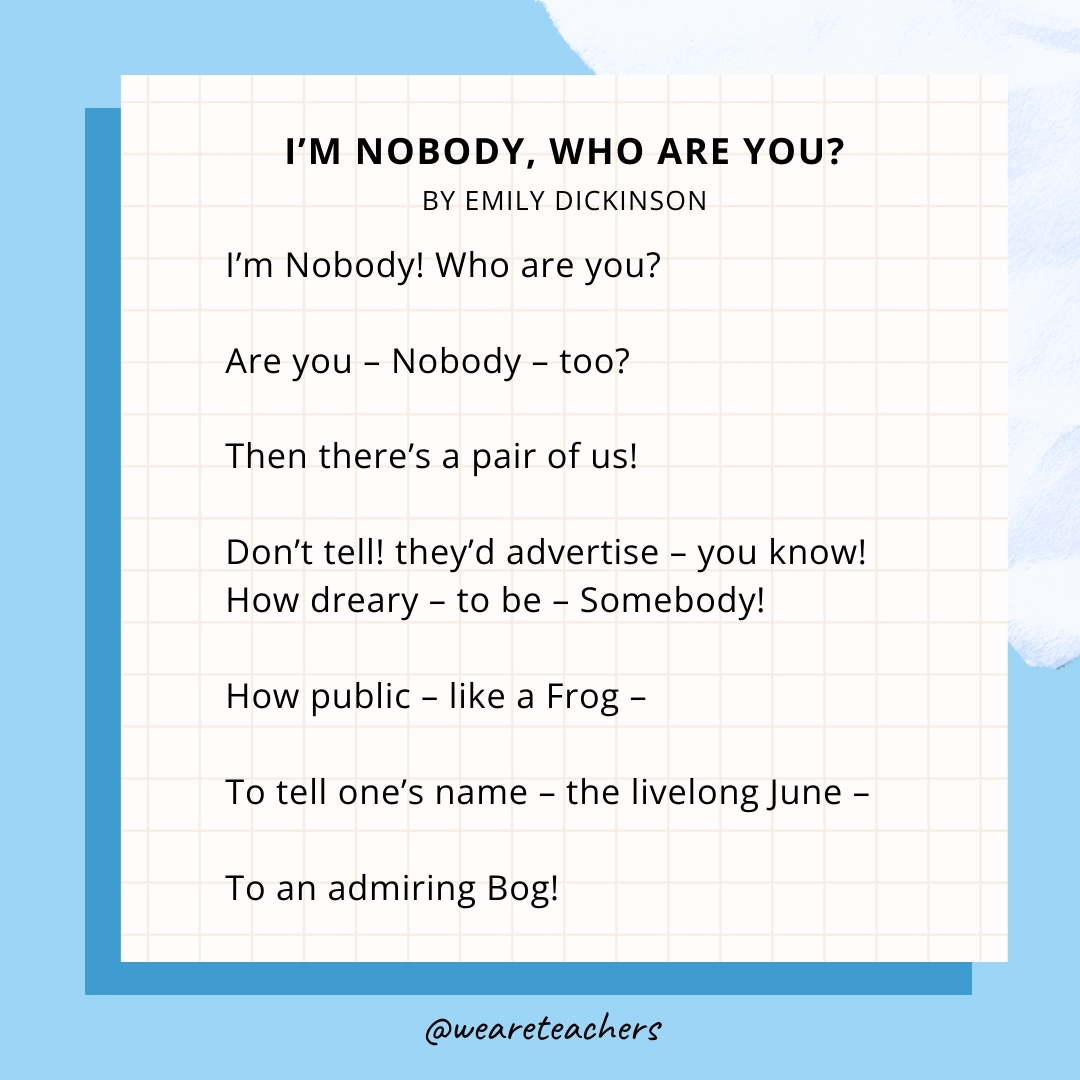
I’m Nobody! Who are you?
Are you – Nobody – too?
Themes: Identity, rejection of fame, privacy
Literary devices: Punctuation, metaphor, rhythm
This playful poem is about identity and wanting not to be famous. It’s an interesting poem to analyze today, when students have multiple social media pages. This poem is also an example of irregular rhythm, which is fun to read alongside more predictable poetry.
46. The Raven by Edgar Allan Poe
Once upon a midnight dreary, while I pondered, weak and weary …
Themes: Psychological torment, grief, hopelessness
Literary devices: Repetition, alliteration, symbolism
Have you even read poetry if you haven’t read “The Raven”? It’s a Poe classic, probably because of the evocative yet accessible language and melancholic storytelling. Depending on your students, start a unit with this poem to engage them in one of the most suspenseful poems, or incorporate it into a storytelling packet.
47. I Wandered Lonely as a Cloud by William Wordsworth
I wandered lonely as a cloud
That floats on high o’er vales and hills …
Themes: Nature, memory, inspiration
Literary devices: Metaphor, imagery, simile
Wordsworth uses lots of great poetry tools in this poem. Use it to model and teach the basics of poetry—simile, metaphor, imagery, and more.
48. The Hill We Climb by Amanda Gorman
When day comes we ask ourselves,
“where can we find light in this never-ending shade?”
Themes: Democracy, progress, hope
Literary devices: Anaphora, imagery, symbolism
Amanda Gorman is an amazing modern poet who resonates with young people. Students will love pulling apart all the meaning in Gorman’s poem, which she recited at Joe Biden’s presidential inauguration. The poem also incorporates interesting literary devices like anaphora, or repeating phrases at the beginning of lines, and personification of history in the line “History has its eyes on us.”
49. If – by Rudyard Kipling
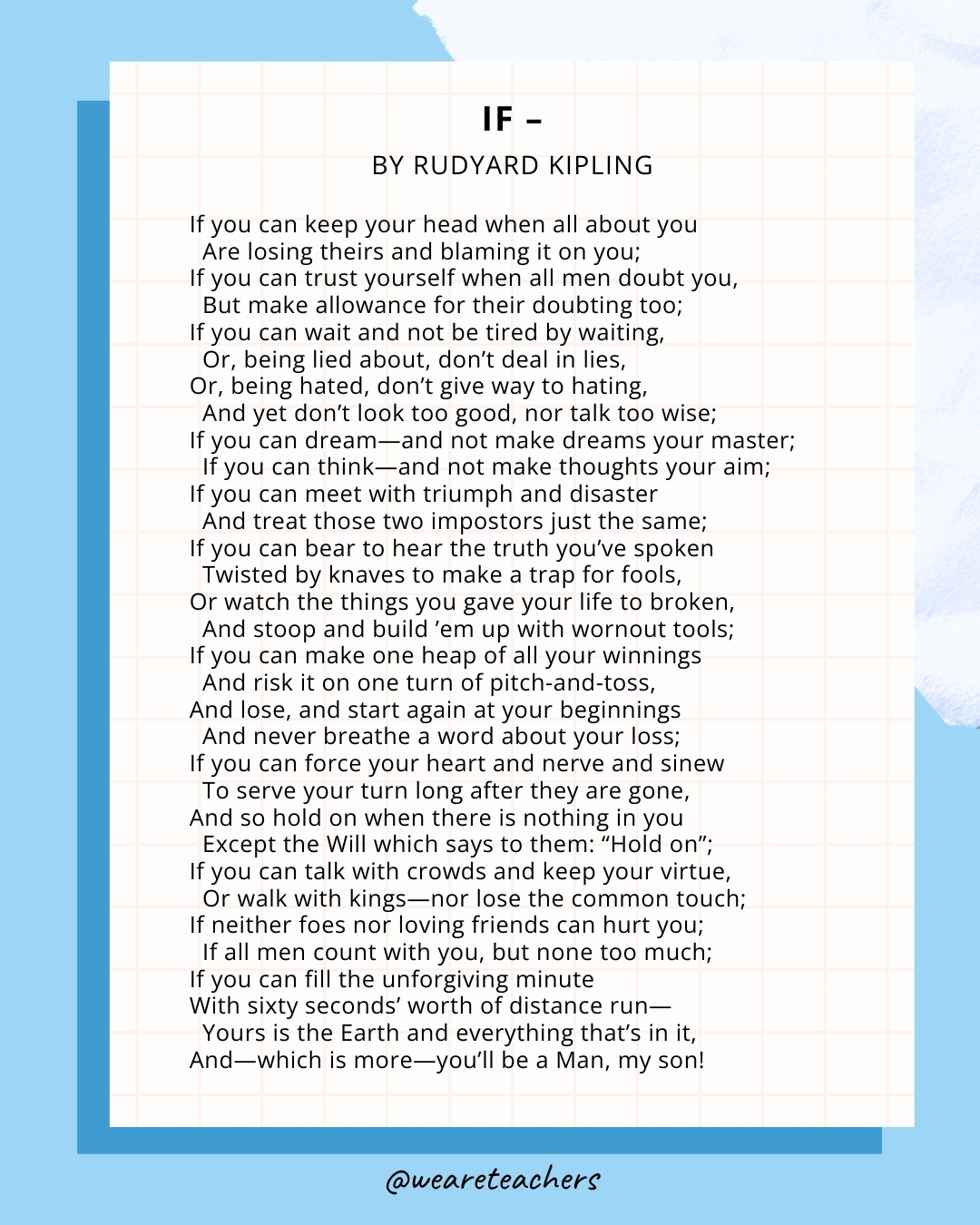
If you can keep your head when all about you
Are losing theirs and blaming it on you …
Themes: Resilience, leadership, integrity
Literary devices: Anaphora, parallelism, metaphor
This poem will kick off some lively analysis as students make connections and pick apart Kipling’s message, which still rings true today. Kipling’s poem is didactic, so this is a good poem to use when talking about the messages that we can can glean from poems.
50. Stopping by Woods on a Snowy Evening by Robert Frost
Whose woods these are I think I know.
His house is in the village though …
Themes: Temptation, life and death, responsibility
Literary devices: Imagery, repetition, alliteration, personification
Read this poem aloud so students can hear how Frost created the soft, contemplative scene. The poem is deceptively simple to read through but can be analyzed as a statement about temptation or life and death. Students can also analyze the rhyme scheme and talk about how it changes in the final stanza.
51. Invictus by William Ernest Henley
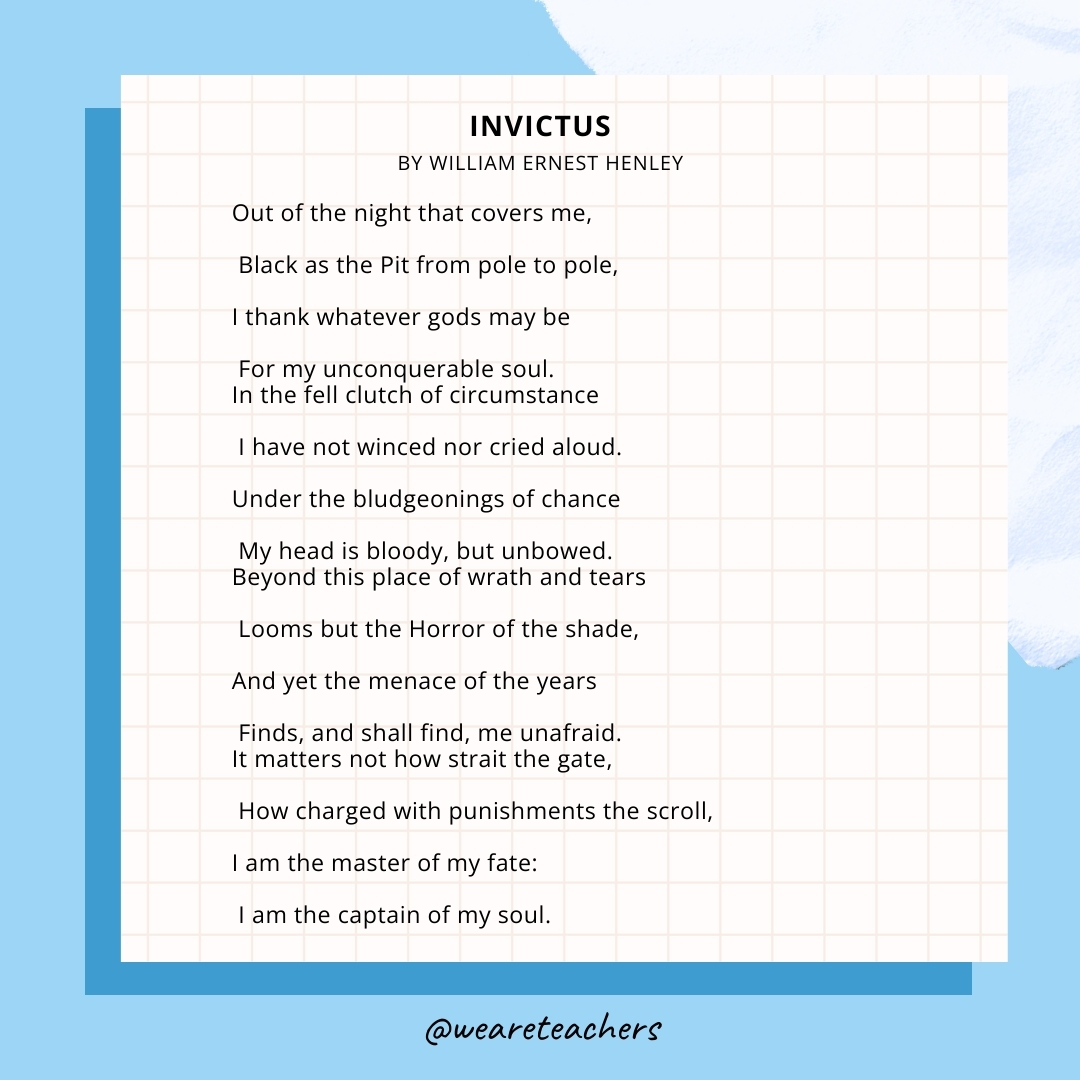
Out of the night that covers me,
Black as the pit from pole to pole …
Themes: Overcoming challenges, strength in adversity, destiny
Literary devices: Symbolism, imagery
The themes of overcoming challenge and resilience still resonate with adolescents. In particular, the final two lines of this poem are worth analysis all on their own. What does it mean to be the captain of your soul? How much control do we really have?
52. Webcam the World by Heather McHugh
Get all of it. set up the shots …
Themes: Technology, modern life
Literary devices: Punctuation, enjambment
A statement on technology and nature, McHugh develops a very modern theme in a traditional-looking poem. There’s a lot for students to unpack, from how the traditional format either goes against or helps reinforce the themes to what McHugh is saying about technology use.
53. The Doll House by A.E. Stallings
There in the attic of forgotten shapes
(Old coats in plastic, hat boxes, fur capes
Amongst the smells of mothballs and cigars) …
Themes: Illusion vs. reality, childhood, passage of time
Literary devices: Contrast, symbolism
Stallings digs into her childhood dollhouse and reflects on what it means about childhood and the simple things in life. Even middle schoolers experience nostalgia, and this poem will tap into that. Use this poem to talk about contrast and how Stallings contrasts the dollhouse with everyday life.
54. See It Through by Edgar Albert Guest
When you’re up against a trouble,
Meet it squarely, face to face …
Themes: Courage, optimism, determination
Literary devices: Refrain, imagery
This uplifting poem about perseverance has a message about learning from failure. After you have read it with students, use the poem to make inspirational posters that reinforce the idea that we learn through failure.
55. Be the Best of Whatever You Are by Douglas Malloch
If you can’t be a pine on the top of a hill,
Be a scrub in the valley—but be
The best little scrub by the side of the rill …
Themes: Persistence, optimism, determination, being the best you can be
Literary devices: Repetition, anaphora, metaphor, rhyme
This poem is a reminder for students that they should be true to themselves and be proud of that. Take this poem stanza by stanza and discuss all the messages that the poet has for the reader.
56. Adventures of Isabel by Ogden Nash
Isabel met an enormous bear,
Isabel, Isabel, didn’t care …
Themes: Fearlessness, confidence, humor
Literary devices: Rhyme, hyperbole, repetition, personification
A great example of how poetry can be humorous and fun to read—think Shel Silverstein for middle and high schoolers. This whimsical poem tells the story of a fearless girl named Isabel. This is also a great poem to introduce younger students to poetry (think 6th and 7th graders).
57. On Turning Ten by Billy Collins
The whole idea of it makes me feel
like I’m coming down with something …
a kind of measles of the spirit,
a mumps of the psyche …
Themes: Growing up, loss of innocence, nostalgia
Literary devices: Enjambment, imagery, metaphor
It’s silly to read an in-depth reflection about moving into double digits, but middle and high schoolers can see the humor in this poem, as well as the serious side. Using it in combination with other poems that have the theme of nostalgia and looking back, students can analyze the poems side-by-side and talk about whether or not 10 is too young to be nostalgic.
58. Phenomenal Woman by Maya Angelou
Pretty women wonder where my secret lies.
I’m not cute or built to suit a fashion model’s size …
Themes: Confidence, self-acceptance, individuality
Literary devices: Repetition, rhyme, refrain
A great read for Women’s History Month or any month. Angelou explores the stereotypes that are typically associated with women and what they mean and has created a powerful poem about self-acceptance and self-love. Use this poem to critique modern beauty standards.
59. Jabberwocky by Lewis Carroll
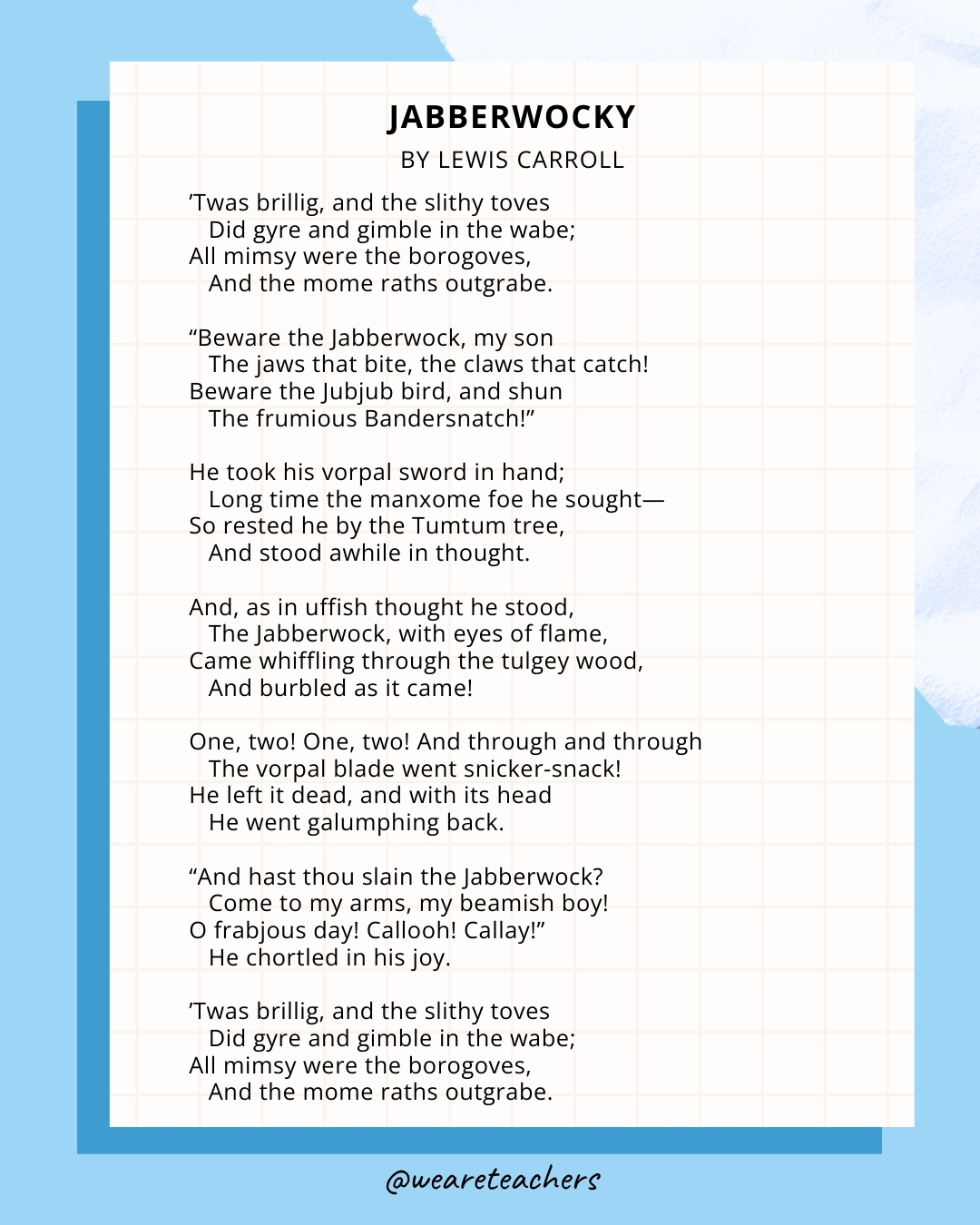
’Twas brillig, and the slithy toves
Did gyre and gimble in the wabe …
Themes: Heroism, good vs. evil, language
Literary devices: Portmanteau, rhyme scheme, repetition, alliteration, nonsense verse
Older students are able to analyze “Jabberwocky” and talk about how Carroll used his imagination to make up everything from worlds to words. Younger students can listen to this classic poem read aloud and talk about how the words sound and feel to them.
60. Harlem by Langston Hughes
What happens to a dream deferred?
Themes: Frustration, inequality, hope
Literary devices: Simile, rhetorical questions
This poem has one of the strongest and best-known first lines. Take students through this poem line by line so they can discuss what Hughes imagines happens to a dream, and how that relates to the dreams they have or have had. A line from the poem also inspired the play “A Raisin in the Sun.”
61. Venus and Adonis by Shakespeare
Even as the sun with purple-color’d face
Had ta’en his last leave of the weeping morn …
Themes: Love, Greek myths
Literary devices: Rhyme, narrative, personification
In this story of the unrequited love between the goddess Venus and the human Adonis, students can be introduced to Shakespeare and his style in a more readable poem.
62. His Excellency General Washington by Phillis Wheatley
Celestial choir! enthron’d in realms of light,
Columbia’s scenes of glorious toils I write.
Themes: History, democracy
Literary devices: Rhyme, symbolism
Phillis Wheatley was a well-known poet in the 18th century and in the anti-slavery movement. Her poems align well with social studies classes about colonial America. In this poem, Wheatley implores President George Washington to continue fighting for democracy.
63. O Captain! My Captain! by Walt Whitman
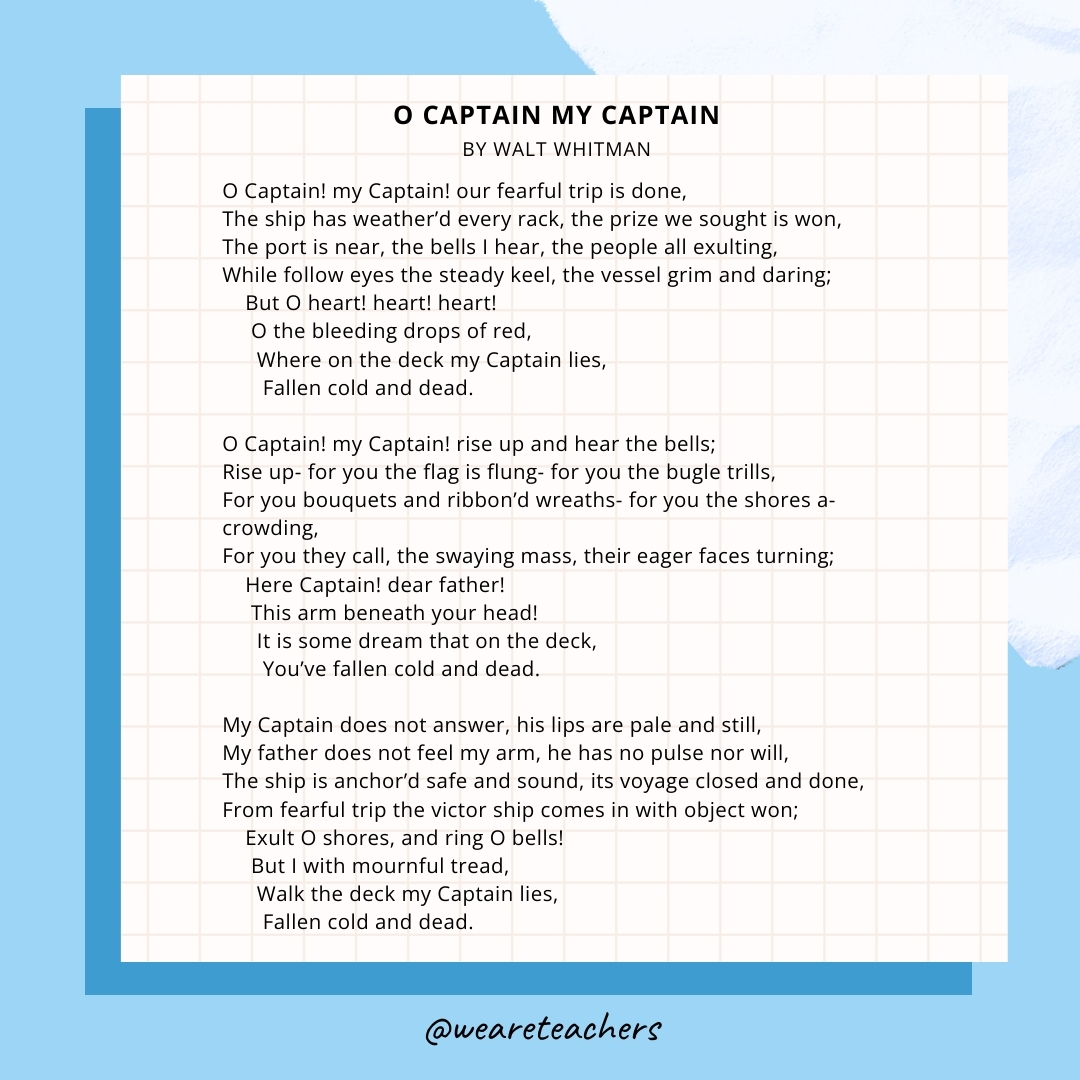
O Captain! my Captain! our fearful trip is done …
Themes: Loss, victory, admiration
Literary devices: Extended metaphor, symbolism, repetition
This elegy mourning the death of Abraham Lincoln is a great one to read with students once they’ve learned about Lincoln and his life. Students can talk about the historical context of the poem, what an elegy is, and what Whitman admired about Lincoln. Through this poem, students can also analyze an extended metaphor where the “captain” represents Lincoln.
64. “Faith” is a fine invention by Emily Dickinson
“Faith” is a fine invention
For Gentlemen who see!
Themes: Faith versus action, skepticism
Literary devices: Metaphor, capitalization, juxtaposition
Dickinson always accomplishes so much in so few lines. This poem is a perfect example of how Dickinson packs a punch in her writing. Challenge students to unravel this poem considering all the techniques she uses, from capital letters to word choice and metaphor.
65. Since Hanna Moved Away by Judith Viorst
The tires on my bike are flat.
The sky is grouchy gray.
At least it sure feels like that.
Since Hanna moved away.
Themes: Friendship, loss
Literary devices: Rhyme, refrain, hyperbole, symbolism
Children’s author Judith Viorst knows how to talk to kids. Pair this poem with a story about grief and loss, or use it in a poetry packet about feelings. This poem also is easy to differentiate, with access points for students of varying reading levels.
66. With This Bright Voice by Amanda Gorman
Be bold, sang Time
For when you honor yesterday
Tomorrow ye will find …
Themes: Hope, resilience, taking action
Literary devices: Metaphor, enjambment
Gorman wrote this poem for the UNICEF Gala in 2025. Lead students into a unit on poetry with Gorman’s recent words so they can see how poetry is relevant and powerful in today’s world.
67. Not Here, Exactly by Joanna Fuhrman
One mountain tried
to taste another,
then spit it out.
Themes: Isolation, detachment
Literary devices: Free verse, personification, simile, enjambment
This poem uses emotion and feelings, rather than story, to explore the feeling of being detached from those around you. Modern teens can discuss how this poem reflects, or does not reflect, their experiences.
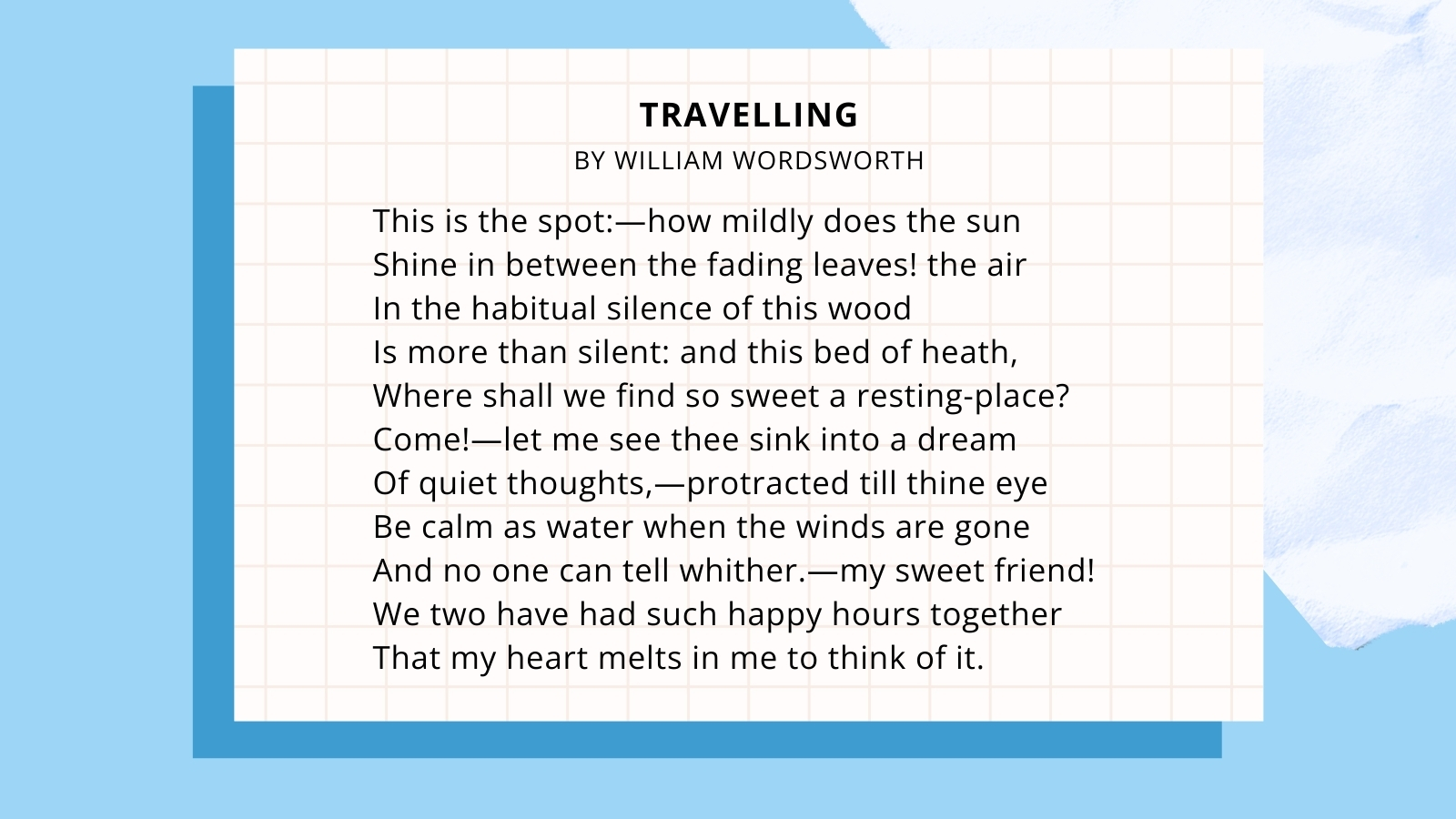
68. Travelling by William Wordsworth
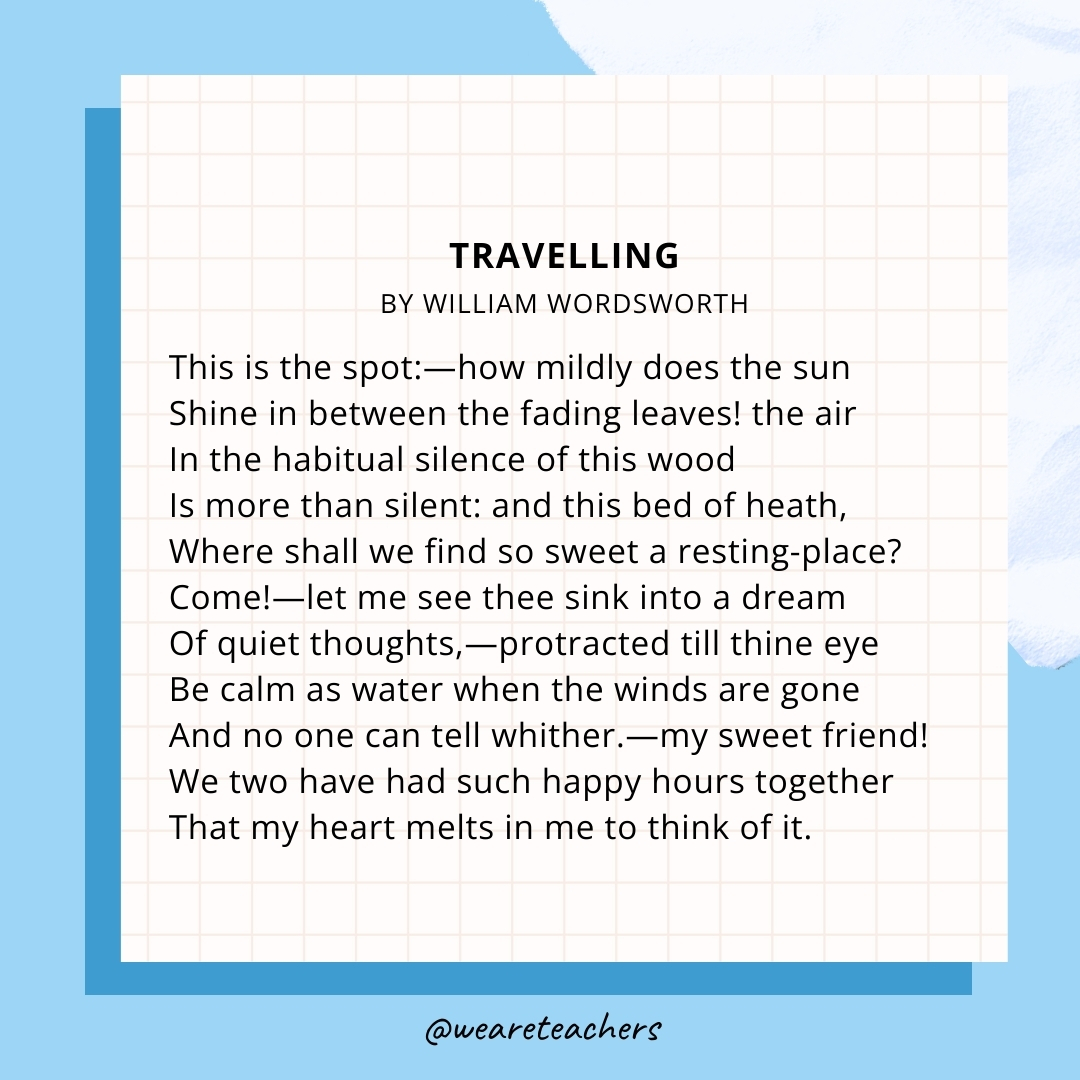
This is the spot:—how mildly does the sun
Shine in between the fading leaves!
Themes: Companionship, solitude, memory, imagination
Literary devices: Enjambment, personification, imagery
Wordsworth is a must-read, and his poems can feel challenging for students. In “Travelling,” he examines how memory can change loneliness into comfort. Students can do a surface-level analysis of the poem, or go deeper by reflecting on how their experiences are similar to or different from Wordsworth’s.
69. The List of Famous Hats by James Tate
Napoleon’s hat is an obvious choice I guess to list as a famous hat, but that’s not the hat I have in mind. That was his hat for show.
Themes: History, humor
Literary devices: List, irony, juxtaposition, conversational tone
Build background knowledge before reading this poem, or challenge students to build knowledge as they read about hats and history. Students can discuss the structure of the poem—is this really a random list of historical figures or is there more going on?
70. A Way of Seeing by Kwame Dawes
It all comes from this dark dirt,
memory as casual as a laborer.
Themes: Perspective, empathy, mindfulness
Literary devices: Imagery, metaphor, repetition
Dawes explores how focus and observation can build understanding and how history can be learned without a formal documentation of it. Analyze the way Dawes explores ordinary moments creating connection.
71. Let America Be America Again by Langston Hughes
Let America be America again.
Let it be the dream it used to be.
Themes: The American dream, inequality, identity and voice
Literary devices: Repetition, imagery, lists
Hughes was so good at putting the American experience and struggle into prose. In this poem, Hughes explores the gap between America’s ideals and realities while urging readers to work together to reclaim those promises.
72. There is no Frigate like a Book by Emily Dickinson
There is no Frigate like a Book
To take us Lands away.
Themes: Reading, imagination
Literary devices: Metaphor, simile
This short, accessible poem is a good introduction to Emily Dickinson. It celebrates reading and imagination as Dickinson argues that books are a powerful way to travel. Is her message still relevant today?
73. Nature by George Herbert
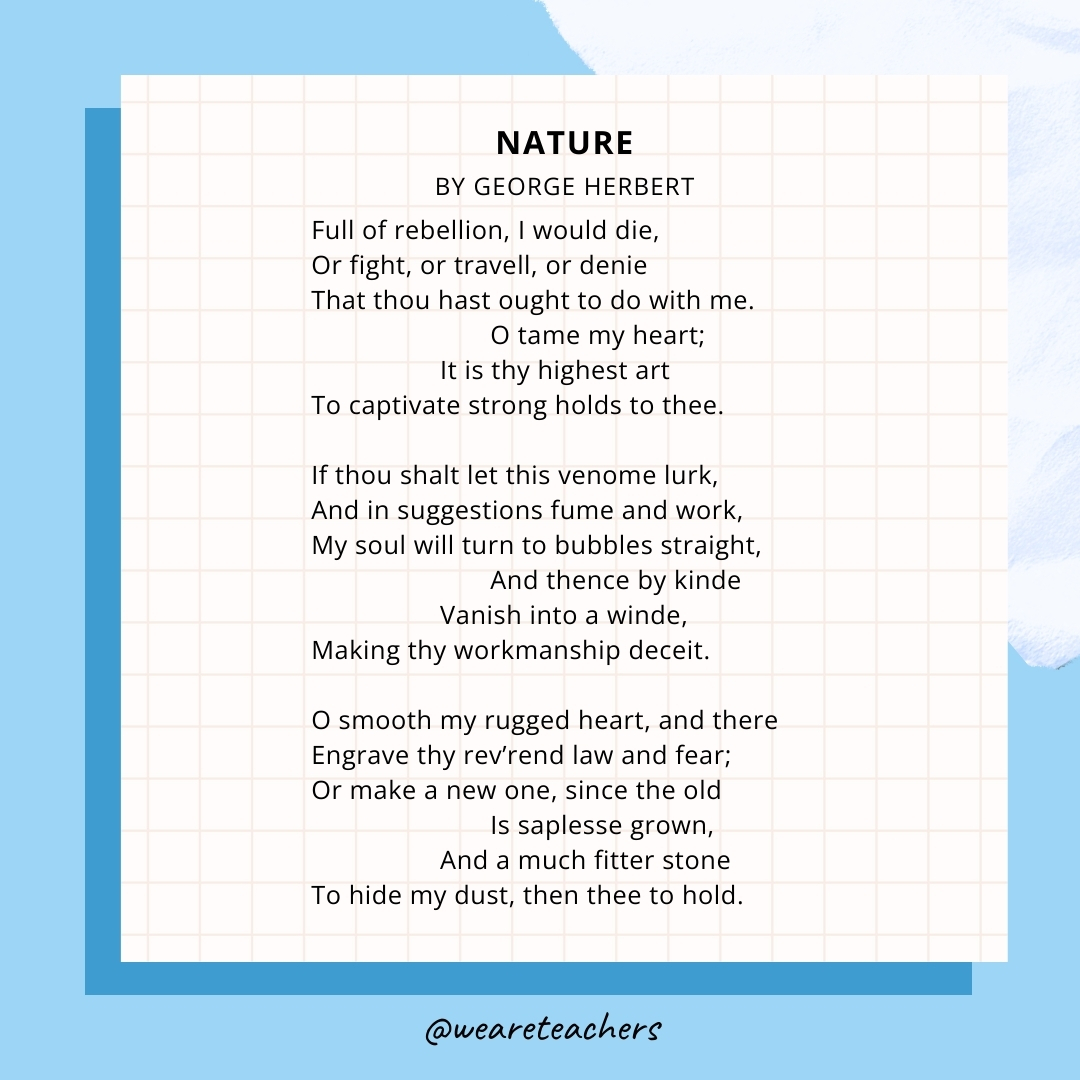
Full of rebellion, I would die
Or fight, or travell, or denie
That thou hast ought to do with me.
Themes: Human nature, appearance
Literary devices: Personification, metaphor, tone
Herbert argues that there are limitations to human nature and the natural world. Students can unpack the poem line by line, and talk about how Herbert’s message would have connected with readers in his time.
74. I, Too by Langston Hughes
Tomorrow,
I’ll be at the table
When company comes.
Themes: Equity, pride, identity
Literary devices: Metaphor, symbolism, imagery, enjambment
Langston Hughes’ “I, Too” is a must-read for students who are learning about American history. Reading Hughes’ poem as they develop background knowledge about African American history will make the poem’s literal and figurative meanings come to light.
75. Carrying Our Words by Ofelia Zepeda
We travel carrying our words.
We arrive at the ocean.
Themes: Language, nature, reciprocity
Literary devices: Repetition, imagery
It’s impossible to read “Carrying Our Words” without learning about Zepeda, a member of the Tohono O’odham Nation of southwestern Arizona. Learn about Zepeda and other Native American poets and how their poetry draws from their culture, history, and experience.
76. Square Cells by Jenny Xie
The screens plant bulbs
of tension inward, but hit no nerves.
Themes: Digital vs. physical reality, surveillance
Literary devices: Imagery, metaphor, symbolism, enjambment
Students, who have been on screens since toddlerhood, can apply the reality of living in a digital world with Xie’s perspective on it. How do screens shape perception? How do they shape our emotions?
77. Ode on a Grecian Urn by John Keats
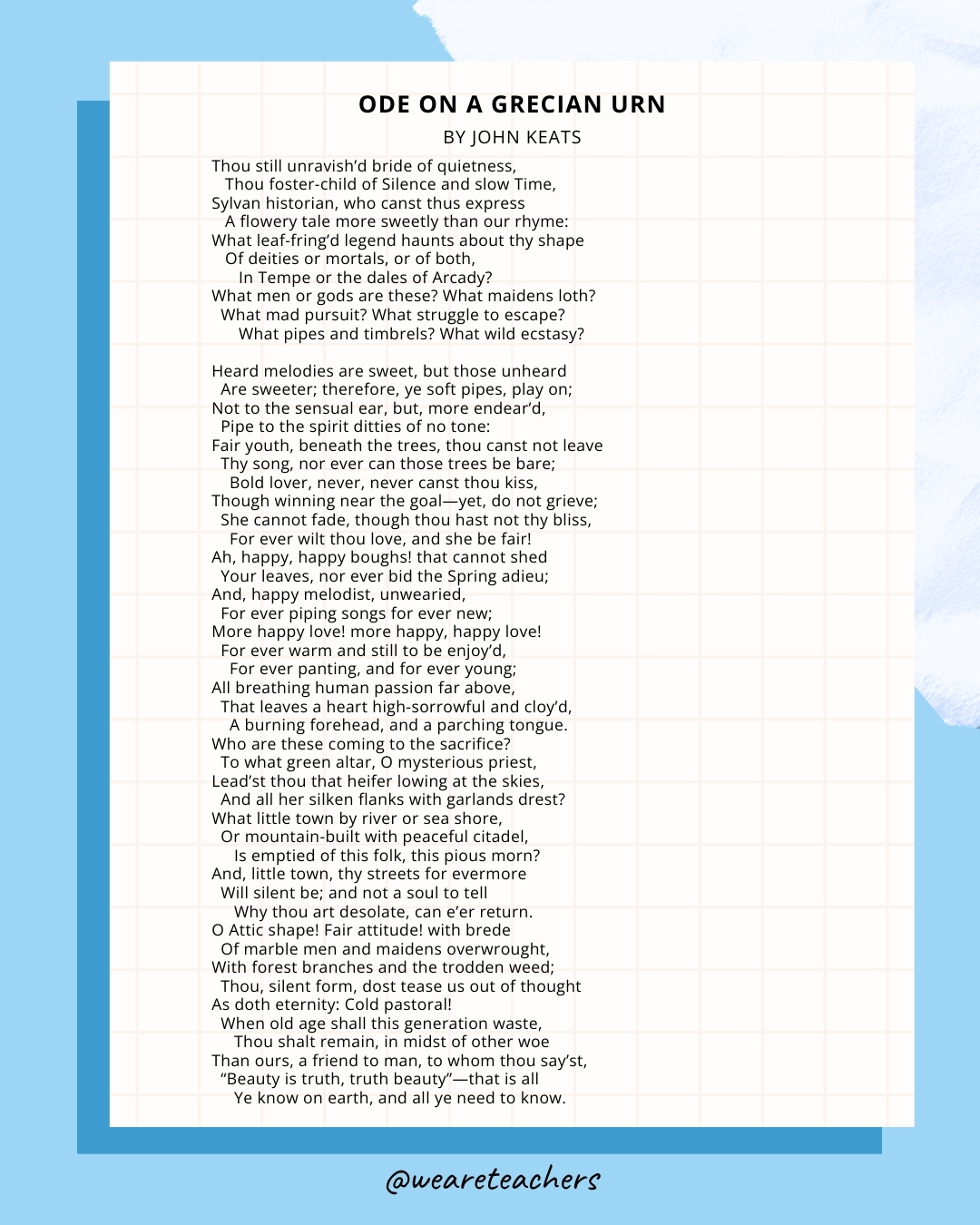
Thou still unravish’d bride of quietness,
Thou foster-child of Silence and slow Time
Themes: Beauty, truth, history, culture
Literary devices: Imagery, symbolism, metaphor
Reading this classic poem, especially with some knowledge of ancient Greece, is a good exercise in how poetry has evolved over time. This poem is fun to read for fluency—with all the old-fashioned phrasing—and is a good exercise in classic poetry analysis.
78. Art Project: Earth by Karen Skolfield
Balloon, then papier mâché.
Gray paint, blue and turquoise green
a clouded world with fishing line attached.
Themes: Beauty, wonder, love, meaning
Literary devices: Imagery, symbolism, tone
Skolfield explores how humans understand and shape their world through the experience of a papier-mâché Earth. Teach this poem alongside a classic poem about nature and humans to see how these themes have evolved.
Teaching Ideas Using These Poems for Middle School and High School
We never said teaching poetry to teenagers would be easy. Here are some teaching tips and tricks for using the poems above in your ELA class:
- Scaffold analysis: Poems seem easy to read, but they’re not, and poetry interpretation can be tough! Use a graphic organizer or other support to help students work through poems.
- Teach through theme: Choose four or five poems that have similar themes, then read and discuss the poems as a group. What is each poet saying about this theme? How have these ideas stayed the same or changed over time?
- Blackout poetry: Show students how word choice matters with blackout poetry. As students pore over a text, choosing just the right words, they’ll get a feel for the poetry writing process.
- Study a poet: Emily Dickinson, Robert Frost, Amanda Gorman, whichever poet you choose, examine how they approach their craft. What do they like to write about? What inspired them? Which literary tools do they use most?
- Use imagery: Have students take one poem that has a lot of imagery and create a drawing (or painting, chalk drawing, etc.) that depicts their poem. Encourage them to go beyond a literal interpretation.
Get your free printable poetry bundle!
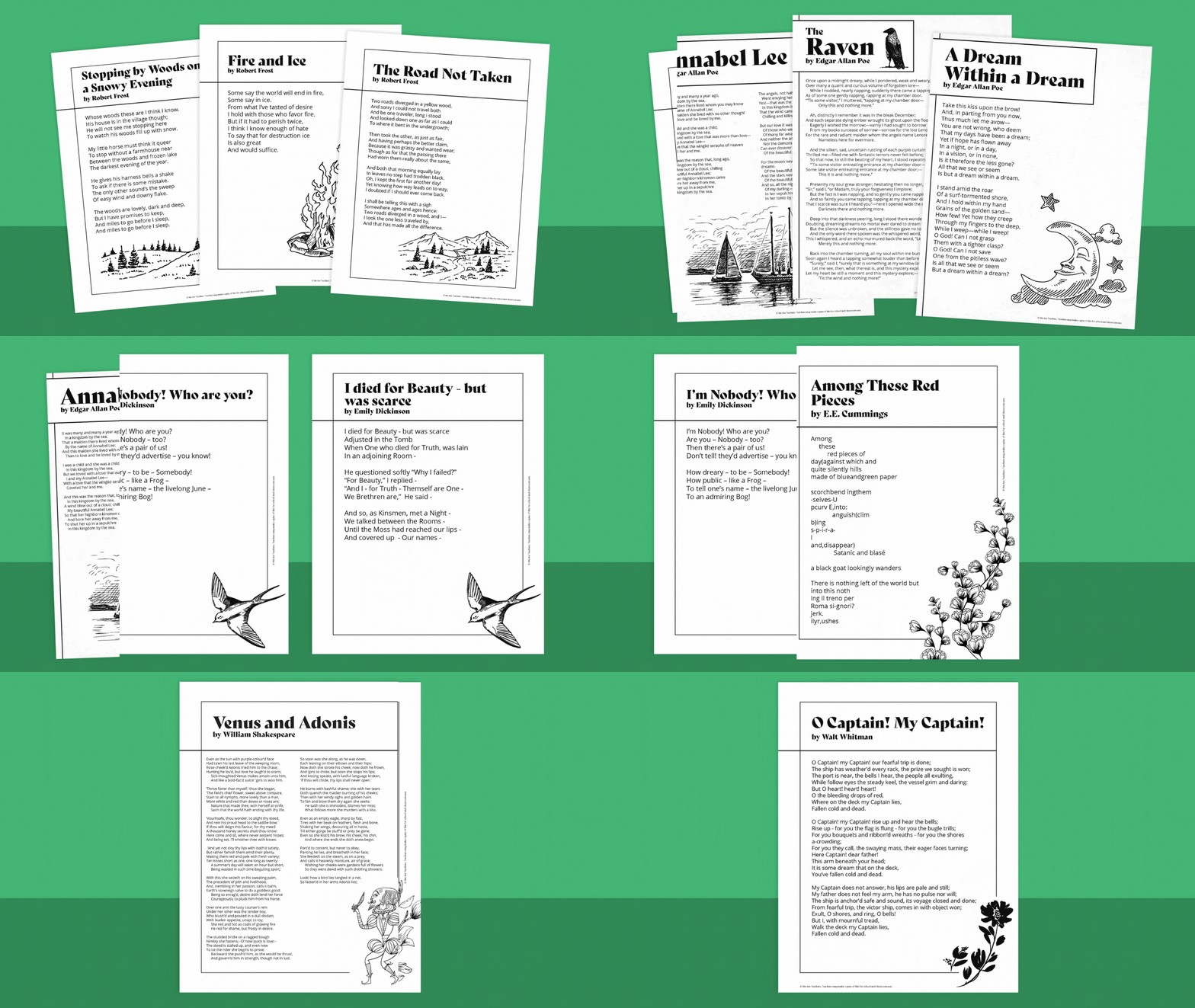
If you love these poems and want some of your favorites to pass out to students, grab our free printable poetry bundle. It includes our favorite poems for middle and high school students. Just fill out the form on this page to get it.
