

Ramadan is a festive and holy time in Islam, meant for togetherness and community. There are nearly 2 billion Muslims worldwide, and 98% of them celebrate Ramadan. For some Muslim students, however, this time can sometimes be lonely or isolating, especially if they are a small minority. Fortunately, there are a few simple things teachers can do to support students during Ramadan. Here’s what you need to know, plus resources to help you along the way.
What Teachers Should Know About Ramadan
These frequently asked questions and answers about Ramadan offer information to help non-Muslim educators understand the basics of the holiday.
When does Ramadan 2026 begin?
This year, Ramadan is expected to begin the evening of Tuesday, February 17, 2026.
The official start and end is based on the sighting of the first crescent moon (hilāl) of the ninth Islamic month, which usually falls on the first night after a new moon. However, many observant Muslims prefer to wait until the actual official sighting of the crescent moon itself, and that can sometimes vary.
Depending on the decision of their local mosques, not all Muslims begin observing Ramadan at exactly the same time. Be prepared for the holiday to begin around the middle of February, and know that it’s possible that some Muslims will begin observing a little earlier than others. Follow their lead as you support students during Ramadan.
How long is Ramadan, and when does it end in 2026?
Ramadan lasts a full month, from the sighting of one crescent moon to the next. Expect Ramadan to end around March 19, 2026.
Do all Muslims fast during Ramadan?
All adult Muslims* are required to fast, which includes anyone who has reached the age of puberty. Some younger children also participate.
The most important part of Ramadan is fasting, one of the Five Pillars of Islam. Muslims are expected to fast from dawn to sunset during this time. This includes anyone who has reached puberty, but some younger children also choose to participate, sometimes for only half a day. That means teachers may need to support Muslim students’ dietary choices during Ramadan in their classrooms.
During Ramadan, Muslims begin their day with a predawn meal called suhur. Once the sun rises, they are not allowed to eat or drink anything, including water. After the sun sets, they break their fast with a celebratory meal called iftar, often begun by eating dates. Teachers overseeing activities before or after school should ensure Muslim students have the opportunity to partake of these meals. Older students may continue their fast, even if they have a sporting event and will need an opportunity to break their fast with water and a light snack.
*There are exceptions to this expectation for those who are ill, elderly, traveling, diabetic, or pregnant or breastfeeding, and other valid considerations. Learn more here.
What other traditions do Muslims observe during Ramadan?
Prayer, reading the Quran, duas (supplications made by Muslims to ask Allah for help, forgiveness, and mercy), volunteering, charitable acts, and moral behavior are especially important during this time.
This is a time set aside for reflection and contemplation of their spiritual beliefs. Muslims may pray more often, especially during times when others may be eating. Many also choose to read or recite the entire Quran during the month.
During Ramadan, Muslims believe all of their actions are amplified in the eyes of Allah. In addition to refraining from eating or drinking during daylight hours, fasting also means avoiding unkind acts. Charitable acts are common, through financial giving or other actions. Support Muslim students during Ramadan by recognizing their kind and charitable acts in and out of the classroom.
What is Eid al-Fitr?
When Ramadan draws to a close, Muslims celebrate the three-day holiday of Eid al-Fitr. It includes feasts, special prayers, communal gatherings, decorations, and often money or small gifts for children. Eid al-Fitr is a joyous time, when Muslims enjoy breaking their long fast together. Muslims look forward to this holiday as it is one of the major holidays celebrated each year. It is emphasized during Eid for adults and parents to not only be kind to children but encourage their children to have fun. They allow children to have treats and they set up fun activities for all children to celebrate.
Some schools and communities declare this time a public holiday. If yours does not, Muslim students may miss school during this time. Support them by offering alternative due dates for assignments as needed. You can also help them by allowing them to complete some work in advance of the holiday or making it easier for them to complete makeup work.
Ramadan Explained: Addressing Common Misconceptions
Though this month is celebrated by millions of people around the globe each year, there are still a lot of misconceptions about it among non-Muslims. Here are a few important things to know, so you can avoid making mistakes when you support students during Ramadan.
Fasting generally isn’t harmful for healthy people.
Those who don’t participate in fasting may believe it is unhealthy, saying “It’s wrong to make hungry teenagers go without food!” But doctors note that fasting is generally safe for those who are healthy. If a person’s health is truly threatened by fasting, Muslim law permits them to break their fast, making up the time or atoning for their actions later.
Some people believe Muslims don’t eat or drink at all for an entire month, but this is clearly not the case. Most Muslims eat two meals each day, one before sunrise and one after the sun goes down. If you’re concerned that fasting is having serious negative effects on one of your students, contact their parents or your school admin staff for support.
Ramadan is not a time of mourning.
While this is a holy and important time, it’s not one of general sadness. “Ramadan is a month of intense spiritual rejuvenation with a heightened focus on devotion,” says ING (Islamic Networks Group). They note that fasting is meant to increase a constant awareness of God-consciousness. “From this awareness, a person should gain discipline, self-restraint, and a greater incentive to do good and avoid wrong.” By avoiding food and drink, Muslims also gain more respect for what it’s like to experience food insecurity, which some people face every day.
Ramadan is actually a highly social time for Muslims, who frequently gather to pray, read the Quran, or break fasts at the end of the day. “For Muslims, Ramadan is a time to train themselves both physically and spiritually by avoiding any negative acts such as gossiping, backbiting, lying, or arguing,” ING notes. “Muslims welcome Ramadan as an opportunity for self-reflection and spiritual improvement, and as a means to grow in moral excellence.”
It’s not necessary to stop everyone in your classroom from eating.
“Ramadan is a month of intense spiritual rejuvenation with a heightened focus on devotion,” says ING (Islamic Networks Group). They note that fasting is meant to increase a constant awareness of God-consciousness. “From this awareness, a person should gain discipline, self-restraint, and a greater incentive to do good and avoid wrong.” By avoiding food and drink, Muslims also gain more respect for what it’s like to experience food insecurity, which some people face every day.
It’s not necessary to ban everyone in your classroom from bringing water bottles or snacks in order to support students during Ramadan. Muslims are used to seeing others eat and drink at this time; noticing their hunger and thirst is part of their self-reflection.
Not all Muslims observe Ramadan in the same way.
While certain required observations are laid forth in Islamic law, some traditions and customs vary by country, region, or even family. As with holiday or observance, practices can be different for each of your Muslim students. Don’t expect each of them to behave in the same way regarding Ramadan. Instead, make room in your classroom and school culture for all students to observe their spiritual practices as needed.
7 Key Ways To Support Students During Ramadan
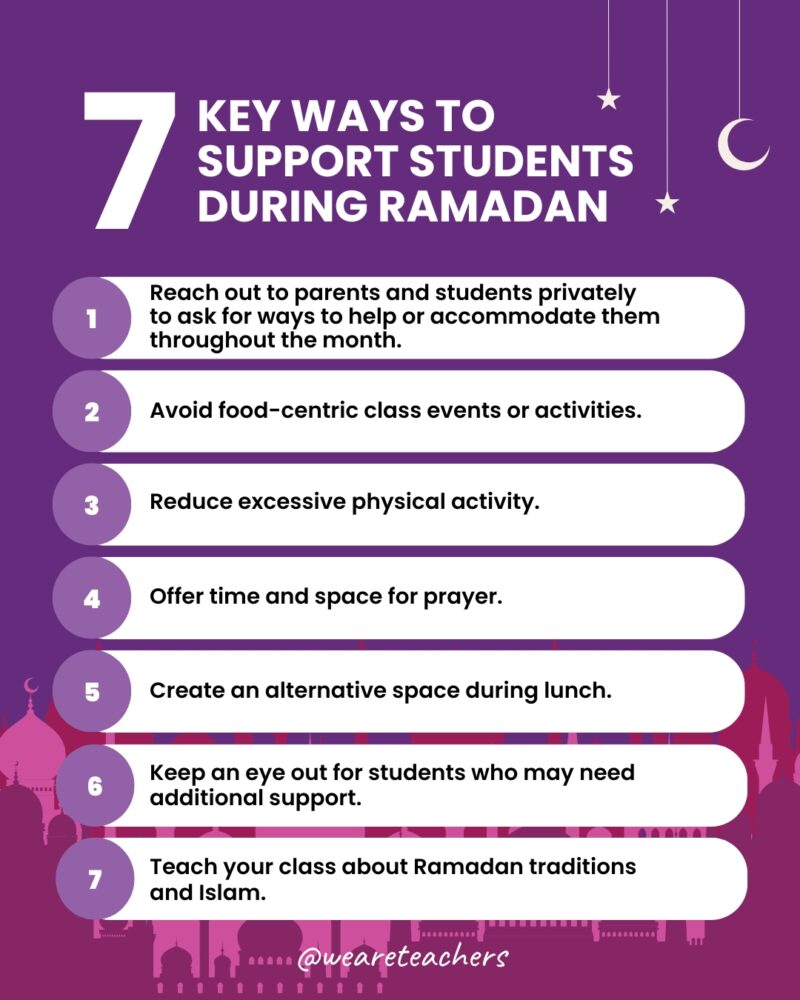
1. Don’t force students to out themselves. Reach out to parents and students privately to ask for ways to help or accommodate them throughout the month.
If you have certain after-school activities during the month, accommodate Muslim students. For example, if you are having a movie night, schedule it around sunset so students observing Ramadan can participate. If you reach out to their parents and give them a heads up, they can work something out, or you could possibly move the activity to a time when they would be able to participate.
2. Avoid food-centric class events or activities.
During Ramadan, all adults who are able to are expected to fast from sunrise to sunset. Depending on which age you teach, you may have students participating in fasting in part or in full.
While food may be an element of some classroom activities, consider ways to avoid making it the main event. This goes for celebrations like birthdays, behavior rewards, and learning activities and games. (This policy also benefits students with food allergies.)
Learn more: A Ramadan Etiquette Guide for Non-Muslims
3. Reduce potentially dangerous physical activity.
Since fasting is an important part of Ramadan, students may be experiencing low blood sugar, weakness, and other symptoms that make physical activity dangerous. Many Muslim students will ask to modify their exercise or to be excused from PE. Others will choose to participate fully in these activities.
Either way, it’s important to talk to your principal about the school’s policy and have alternative ideas for students who may need them.
Learn more: Ramadan and Physical Education
4. Offer time and space for prayer.
During Ramadan, Muslims believe that their spiritual efforts are especially important and enhanced. Muslims who do not regularly pray will often do so, and those who do pray more regularly may pray even more during this time. It’s important for Muslims to have an appropriate space to pray. Almost anywhere will do, but your students must be able to focus and turn toward Mecca. It can also be helpful to offer some privacy, especially since you may have students who choose not to disclose their faith.
One way to create this type of space would be to periodically offer students “mindfulness time,” during which students can pray, meditate, or take a short mental break from what they’re doing. You may even find it helpful to offer a chance to take a short walk outside. Taking a break like this is also a helpful classroom management tool, so it may be worth adopting as a year-round practice.
Learn more: Simple Mindfulness Activities for Kids
5. Create an alternative space during lunch.
While Muslims are supposed to notice their hunger and thirst during Ramadan, sitting in a room where everyone else is eating can be overwhelming, and it’s not a required part of the experience. It’s about awareness, not suffering. Muslim students will feel included if they have an alternative place to take a break during lunch. The library, with a few games to play or fun books to read, can be a great alternative, as can spending time outside.
“In addition to making sure that students have a quiet place to pray,” shares school librarian Amanda D., “I open the library during lunch so students who are fasting don’t have to be in the cafeteria and can enjoy time with friends/peers who are also celebrating.”
6. Keep an eye out for students who may need additional support.
Muslim students may be experiencing acute senses of loss from missing family members who are no longer with them, mourning for lost homes (especially if they’re immigrants), or being made aware of the persecution they face during this time. A key part of Ramadan is breaking the fast each day with friends and family, and the first holiday without a loved one can be especially raw.
Keep an eye out for students who don’t seem like themselves. Be prepared to offer support to these students during Ramadan in whatever way you can. It may be worth talking to parents or students about counseling if the month is especially hard on them emotionally.
Learn more: What Educators Need To Know About Childhood Trauma
7. Teach your class about Ramadan traditions and Islam.
People feel included when the people around them understand their lives. Ramadan is a great opportunity to teach your class about Islam and to build empathy for Muslims. You may offer Muslim students the opportunity to talk about their experiences, take a field trip to a mosque, or do a whole unit about the history of Islam.
For students in elementary school, find ways to incorporate read-alouds about Ramadan. Some examples of stories that can be used are Lailah’s Lunchbox by Reem Faruqi or Golden Domes and Silver Lanterns by Hena Khan. Incorporating a unit on holidays around the world can be a great way to introduce Ramadan. If you’re teaching in a place where Muslims are especially persecuted, you might want to do a lesson debunking common myths and misconceptions too. Invite people from the community to come in and discuss their traditions during the holy month of Ramadan to help students build connections to their friends in the classroom or people they may see or know.
Resources for Teaching and Learning About Ramadan
The best way to support students during Ramadan is to have a good understanding of the holiday yourself, and encourage others to do so as well. Epic is also a great resource teachers can use. It offers many books about Ramadan for all age groups. It also has videos and a read-aloud feature that students can use to read in small-group or whole-group settings. Below are some additional resources to help teachers learn about Ramadan and share information with their students.
