


Our world is full of mysteries—why not try to solve a few? One of the most incredible ways to encourage critical thinking and self-exploration is to ask kids thought-provoking questions. Hearing the responses and exchanging ideas can really expand our perspectives and leave us with important food for thought. Want to try? Here are some philosophical questions to share with students in the classroom.
Jump to:
What is a philosophical question?
Philosophical questions aren’t about easy answers. They tackle big ideas like why we’re here, what it means to live a good life, and the mysteries of the universe. These types of questions don’t have clear answers, and that’s what makes them so interesting.
The best philosophical questions make us think in new ways. Have you ever asked yourself if free will is real or wondered why anything exists at all? Philosophical questions help us pause and reflect on what we believe and why we believe it, giving us a fresh perspective on ourselves and the world.
What makes these questions special is how open they are. They’re also great for conversation because there’s no single right answer! Whether you’re exploring the ethics of artificial intelligence, the meaning of happiness, or what might exist beyond the universe, philosophical questions challenge us to think bigger and see things differently.
Characteristics of Philosophical Questions
Philosophical questions stand out because they explore ideas that go beyond everyday concerns. They challenge us to think deeply about the abstract and complex aspects of life. Here are three characteristics of philosophical questions.
They Don’t Have Simple Answers
These questions are open-ended, inviting endless discussion and interpretation. You can’t answer something like “What’s the meaning of life?” or “Can we truly be happy without pain?” with a single fact. Meant to be explored, not solved, abstract philosophical questions get people thinking, talking, and offering different perspectives that keep the conversation alive.
They Focus on Big Ideas
Philosophical questions also dig into the fundamental concepts that shape how we see the world. They explore morality, existence, and reality—ideas that influence the way we think and act every day. Topics like justice and free will ask us to reflect on the beliefs and principles that guide our lives. These aren’t surface-level musings—they go straight to the core.
They Help Us Think Critically
These questions demand more than casual thought. They push us to analyze, reflect, and question assumptions we might not even realize we hold. For instance, “Is it ever OK to break the law?” makes us weigh ethical values against societal expectations. Wrestling with questions like these doesn’t just challenge our thinking, it sharpens it.
In the end, abstract philosophical questions are less about finding answers and more about exploring ideas. They encourage us to embrace complexity, think in new ways, and connect with others through meaningful conversations. By doing this, we understand ourselves and the world a little better, one thought at a time.
Fun Philosophical Questions
1. Which really came first, the chicken or the egg?
2. If you’d been given a different name, would you be a different person?
3. Would the world be more peaceful if kids were in charge?
4. What is kindness?
5. Do you think music is a universal language?
6. What does happiness feel like in your mind and body?
7. Can one person really change the world?
8. If it were possible to live forever, would you want to?
9. If people live in a time zone ahead of us, does this mean they live in the future?
10. Can a person be happy and sad at the same time?
11. Is it possible to think of nothing?
12. If a tree falls in the forest and no one is there to hear it, does it make a sound?
13. Do animals have thoughts and feelings like humans?
14. If you could see into the future, would you want to know what happens?
15. Are there things in life that are truly random or is everything predetermined?
16. Is it always better to know the truth, even if it hurts?
17. What is the purpose of dreams?
18. Can a machine ever truly understand a human?
19. Is there a difference between living and simply existing?
20. If everyone were exactly the same, would life be better or worse?
21. If you could ask one question and get a guaranteed answer, what would you ask?
22. If everyone had to wear mood colors like a mood ring, would the world be kinder or more chaotic?
23. Would life feel different if we couldn’t see colors?
24. If time suddenly stopped for everyone but you, what would you do first?
Philosophical Questions About Life & Society
25. What is the meaning of life?
26. What is the biggest issue in our society right now?
27. What is your vision of the ideal society?
28. Do you think it’s important to conform in society?
29. How can humans improve the world in the next five years?
30. What is the most important thing in life?
31. Are people too greedy?
32. How could the world change for the better?
33. Is failure ever useful?
34. What would life be like if we never experienced pain?
35. Why is it important to help others?
36. What is freedom?
37. Can too much freedom be a bad thing?
38. Should we have to pay for basic needs such as food, water, and shelter?
39. Should education be free?
40. If happiness were the national currency, what kind of work would make you rich?
41. If you could teach everyone in the world one concept, what concept would have the biggest positive impact on humanity?
42. Is there a perfect balance between work and life, and if so, what does it look like?
43. Do you think modern technology brings people closer together or farther apart?
44. What does it mean to live a good life?
45. Is justice always equitable, or is it influenced by culture?
46. How does individual freedom contribute to or detract from societal harmony?
47. What role should government have in regulating human behavior?
48. Is progress always beneficial, or can it sometimes be detrimental?
49. What are the ethical implications of advancements in artificial intelligence on society?
50. How do art and culture influence societal norms and politics?
51. Is it possible for societies to exist without laws?
52. What are the implications of the growing gap between the rich and the poor?
53. How do personal biases shape our views on society?
54. Should there be limits to freedom of speech, and if so, what should those limits be?
55. Can a small act of kindness change the direction of someone’s whole life?
56. Is it better to focus on your own happiness or the happiness of others?
57. Are people naturally good, or do we learn to be good?
58. Does money make life easier or more complicated?
Philosophical Questions About Growing Up
59. When do children become adults?
60. Are adults as curious as kids?
61. At what age does an adult become “old”?
62. What can kids learn from grown-ups?
63. What can grown-ups learn from kids?
64. Do we become wise through age, study, or experience?
65. Does birth order affect people’s personalities?
66. Do people need to have children?
67. If you could give your younger self one piece of life advice, what would it be?
68. Do people ever truly stop growing, or do we grow in different ways forever?
69. Is childhood something you feel or simply a number?
70. Why do some memories stay with us forever while others fade quickly?
Philosophical Questions About Love & Relationships
71. What is love?
72. Is love about feelings, words, or actions?
73. Does unconditional love really exist?
74. How do you know you are loved?
75. What causes someone to fall in love?
76. What makes a good friend?
77. Are romantic relationships important?
78. Do soulmates exist?
79. Can someone be in love with more than one person?
80. Do you think love at first sight really exists?
81. Is love blind?
82. Can you love others if you don’t love yourself?
83. What makes a relationship last for many years?
84. Does a large age gap matter in a relationship?
85. How do cultural differences impact romantic relationships?
86. Is there a formula for maintaining interest in a long-term relationship?
87. How important is compatibility compared to chemistry in a relationship?
88. Can relationships survive without forgiveness?
89. What role does vulnerability play in strengthening a relationship?
90. Should relationships aim for equality or equity?
91. How does social media affect our perceptions of relationships?
92. Is it possible to maintain a friendship after a romantic relationship ends?
93. How do expectations influence the success or failure of relationships?
94. What is the impact of financial stress on a relationship?
95. How do changes in physical or mental health affect a relationship?
96. Can absence really make the heart grow fonder?
97. Is jealousy ever justifiable in a relationship?
98. What makes someone trustworthy?
99. Is conflict always bad, or can it make relationships stronger?
100. Can you care about someone even if you disagree on important things?
Philosophical Questions About Animals
101. Do humans treat animals properly or do we need to improve?
102. Are dairy and eggs more ethical to eat than meat?
103. What would life be like if animals were dominant over humans?
104. Have some animals or creatures walked the Earth that we don’t know about?
105. Do spiders or bugs experience emotional pain?
106. Do animals feel love?
107. Are animals less intelligent than humans?
108. Do animals like being kept as pets?
109. Is it OK to kill bugs?
110. Do you think our pets have names for us too?
111. Should animals have rights similar to human rights?
112. Can animals understand human languages?
113. Is it ethical to use animals for entertainment purposes, such as in circuses or films?
114. Do animals have a sense of morality or ethics?
115. How do animals perceive their environments differently than humans?
116. Should wildlife habitats be protected even if it means limiting human development?
117. Is it morally acceptable to breed animals selectively for specific traits?
118. Can animals form friendships with different species?
119. What responsibilities do humans have toward endangered species?
120. Is it ethical to keep large animals like whales and dolphins in captivity?
121. Do animals understand fairness?
122. Would animals behave differently if they knew humans could understand them?
123. Do animals worry about the future the way humans do?
Philosophical Questions About Death
124. Where does the soul come from?
125. Does the soul die when the body does?
126. Do you believe in life after death or reincarnation? Why or why not?
127. What do you believe about this statement: “Everyone dies twice. Once with their body and again the last time someone mentions their name”?
128. If you only had five years left to live, how would you live differently?
129. Is euthanasia an immoral way to end a life?
130. Would you ever want to know how or when you were going to die?
131. Should everyone have to be an organ donor?
132. Is fear of death natural, or is it culturally constructed?
133. How does the concept of mortality influence human behavior and decision-making?
134. Can death ever be considered a relief or a release rather than a tragedy?
135. How do different cultures celebrate or mourn death differently?
136. Is it ethical to use life-extending technologies to prolong life at any cost?
137. Should children be shielded from discussions about death, or should it be openly discussed?
138. What legacy do you hope to leave behind when you pass away?
139. How do advancements in medicine that extend life expectancy impact society’s view of death?
140. Why do people fear death if it is a universal experience?
141. How does thinking about death help people appreciate life?
142. Is it possible to celebrate a life without feeling sad about the loss?
Philosophical Questions About the Universe
143. Do you believe in life on other planets?
144. Why are we here on Earth?
145. Do you believe in astrology?
146. Are there alternate universes?
147. Have aliens visited Earth?
148. Should we be spending money to develop space travel?
149. Do you think there could be time travelers living among us right now?
150. If someone could time-travel, would it be ethically wrong to change history?
151. If an advanced life-form from another planet wanted to eat us, would that be wrong considering we eat animals on Earth?
152. What do you think is out in space that we have not discovered yet?
153. If aliens were to arrive on Earth tomorrow, what would you do?
154. What implications would the discovery of extraterrestrial life have on human religions and philosophies?
155. Is the universe finite or infinite, and what does that mean for our understanding of existence?
156. How do scientific discoveries about the universe change our understanding of what it means to be human?
157. Should humanity attempt to colonize other planets?
158. Is it possible that our understanding of physics is fundamentally flawed or incomplete?
159. What ethical considerations should govern the exploration and exploitation of outer space resources?
160. If we find planets with conditions similar to Earth, is it our duty to preserve them or use them for human benefit?
161. How does the vastness of the universe affect our perception of importance or insignificance?
162. Should we be trying to send messages into space to communicate with potential extraterrestrial beings?
163. What responsibilities do we have to protect the integrity of other celestial bodies, like moons or asteroids?
164. If you had the opportunity to travel to space, knowing you could never return to Earth, would you go?
165. If we discovered intelligent life on another planet, what would we want them to know about us?
166. Does the universe care whether humans exist?
167. If humans moved to another planet, would we still think of Earth as “home”?
Philosophical Questions About Law & Governance
168. Are equal and fair the same thing?
169. What makes something right and something wrong?
170. Will war ever go away?
171. Is our legal system fair?
172. Is it OK to commit a crime to save another person’s life?
173. Is it OK to steal something to survive?
174. Should the legal drinking age be lower or higher?
175. Should the legal age for driving be lower or higher?
176. Should good healthcare be a universal right?
177. Should people living an unhealthy lifestyle pay more for healthcare?
178. Should there be stricter laws about what goes into our food?
179. If killing someone saved hundreds of other people, would that make it OK?
180. Does power change people?
181. What makes a crime a crime?
182. Should buses have seat belts?
183. Should voting be mandatory for all eligible citizens?
184. Can a society exist without laws?
185. Is absolute freedom possible or desirable in a governed society?
186. Should privacy be considered a fundamental human right?
187. How should governments balance national security and personal freedoms?
188. Is it ethical for a government to monitor its citizens?
189. Should the death penalty be allowed, and if so, under what circumstances?
190. What role should international law play in governing actions that affect multiple countries?
191. Is it ever justifiable for citizens to overthrow a government?
192. How can laws evolve to accommodate changes in societal norms and technology?
193. Should governments regulate the internet, and if so, to what extent?
194. Can corruption within a legal system ever be fully eradicated?
195. Is it ethical to pardon individuals convicted of serious crimes?
196. Should there be a global standard for human rights?
197. How should a society determine its leaders?
198. Should laws ever change based on the emotions of society?
199. Is it possible for a leader to make everyone happy?
200. Should people be allowed to choose which laws they personally find fair?
Philosophical Questions About the Paranormal
201. Have you ever had any paranormal or strange experiences that defy explanation?
202. Do you believe in ghosts or spirits?
203. Do humans have extrasensory powers like psychic abilities or telepathy?
204. Do you believe in miracles?
205. Do you think that life is predetermined or that you choose your own path?
206. Does karma really exist?
207. Is it possible that paranormal creatures like vampires and werewolves really do exist?
208. Do you believe in the law of attraction?
209. Can places be genuinely haunted, or are these experiences psychological?
210. Is there a scientific explanation for paranormal phenomena, or do they truly transcend science?
211. How do cultural beliefs influence our perceptions of the paranormal?
212. Do you think that certain people are more susceptible to paranormal experiences than others?
213. What implications would the existence of paranormal beings have on our understanding of the world?
214. Can dreams be a gateway to supernatural realms or foretell the future?
215. Is it possible to communicate with the dead?
216. How do modern depictions of paranormal phenomena in media influence our beliefs about the supernatural?
217. If ghosts exist, do they have feelings?
218. Are supernatural stories a reflection of our fears or our imagination?
219. Why are people drawn to mysteries that cannot be explained?
Philosophical Questions About Science & Technology
220. What has been the greatest advancement or invention of our time?
221. Can robots develop emotions, consciousness, or morality?
222. Are you controlling your technology or is your technology controlling you?
223. Is social media a good thing in our society?
224. Why is it so easy to spread misinformation on social media?
225. How will the development of artificial intelligence influence our understanding of human intelligence?
226. Do you think that technology is advancing us or destroying us?
227. Is time travel possible?
228. What ethical considerations should guide the development of technologies that can alter human genetics?
229. Is technology making us more polarized or more open in our thinking?
230. Is technology gathering too much of our information?
231. Should humans strive to become a multi-planetary species?
232. How should society address the ethical concerns raised by artificial intelligence?
233. Does the rapid pace of technological innovation outpace our ability to understand its implications?
234. Can genetic engineering go too far, and if so, where should we draw the line?
235. Is the pursuit of scientific knowledge always justified, regardless of potential consequences?

236. How does technology influence our understanding of reality?
237. Should we fear the rise of autonomous weapons systems?
238. What role does ethics play in scientific research?
239. How can we ensure that technology benefits all of society rather than just a select few?
240. Will artificial intelligence ever surpass human intelligence, and what would that mean for humanity?
241. How should we manage the ethical dilemmas posed by cloning and other reproductive technologies?
242. Should humans create technology that they cannot fully control?
243. Does social media change who we are or just reveal who we already were?
244. If scientists could erase bad memories, should they?
Tough Philosophical Questions
245. Can people change?
246. What makes someone human?
247. Is hope essential to life?
248. What is intuition (your gut feeling)?
249. Why are we so afraid of the unknown?
250. Is there only one truth or can it be different for everyone?
251. Do we need good and evil to coexist in life?
252. What are dreams?
253. Is it possible to be in the wrong place at the right time?
254. Should wealthy people leave their money to their families or give it to charity?
255. Is lying ever OK?
256. Will life as we know it end someday?
257. Why do we remember things we should forget and forget things we want to remember?
258. Where do our thoughts come from?
259. Is suffering necessary for personal growth?
260. Can justice truly be objective?
261. What defines the boundary between something that is art and something that is not art?
262. Is absolute peace achievable in society?
263. How does language shape our perception of reality?
264. Is it ethical to bring children into a world with so many challenges?
265. Can we ever achieve true equality?
266. What is the role of government in people’s personal lives?
267. Is freedom an illusion?
268. Can science explain everything?
269. What is the nature of consciousness?
270. Is there a purpose to life or is it purely random?
271. Should humans seek to control nature or adapt to it?
272. Is there such a thing as a selfless act?
273. How does our understanding of the universe influence our daily decisions?
274. If you could know the absolute truth to one question, what question would you ask?
275. Does the existence of suffering negate the presence of a benevolent higher power?
276. How do personal experiences shape our perception of truth?
277. What role does fate play in our lives, and can we alter its course?
278. Is true altruism possible, or is every action motivated by self-interest?
279. How do societal expectations influence individual choices?
280. Can moral decisions be governed by logic alone?
281. Is identity something we are born with or is it constructed over time?
282. What does it mean to lead a meaningful life?
Philosophical Questions About Imagination & Creativity
283. Is imagination more important than knowledge?
284. Can creativity solve all problems?
285. Where do new ideas come from?
286. Is there a limit to human creativity?
287. How does creativity make life better?
288. Do we need rules to inspire creativity, or does freedom spark more ideas?
289. Is everyone born creative, or is it something we develop?
290. How do emotions influence creativity?
291. Can artificial intelligence ever truly be creative?
292. Why do some people lose their imagination as they grow up?
293. Is creativity a skill, a talent, or both?
294. Can you create something truly original, or is all creativity inspired by something else?
295. How does art help us understand the world?
296. Is imagining something the same as experiencing it?
297. How does imagination shape the future?
298. Are people defined more by their choices or by their circumstances?
299. Is being happy more important than being successful?
300. If no one remembered anything you did, would your actions still matter?
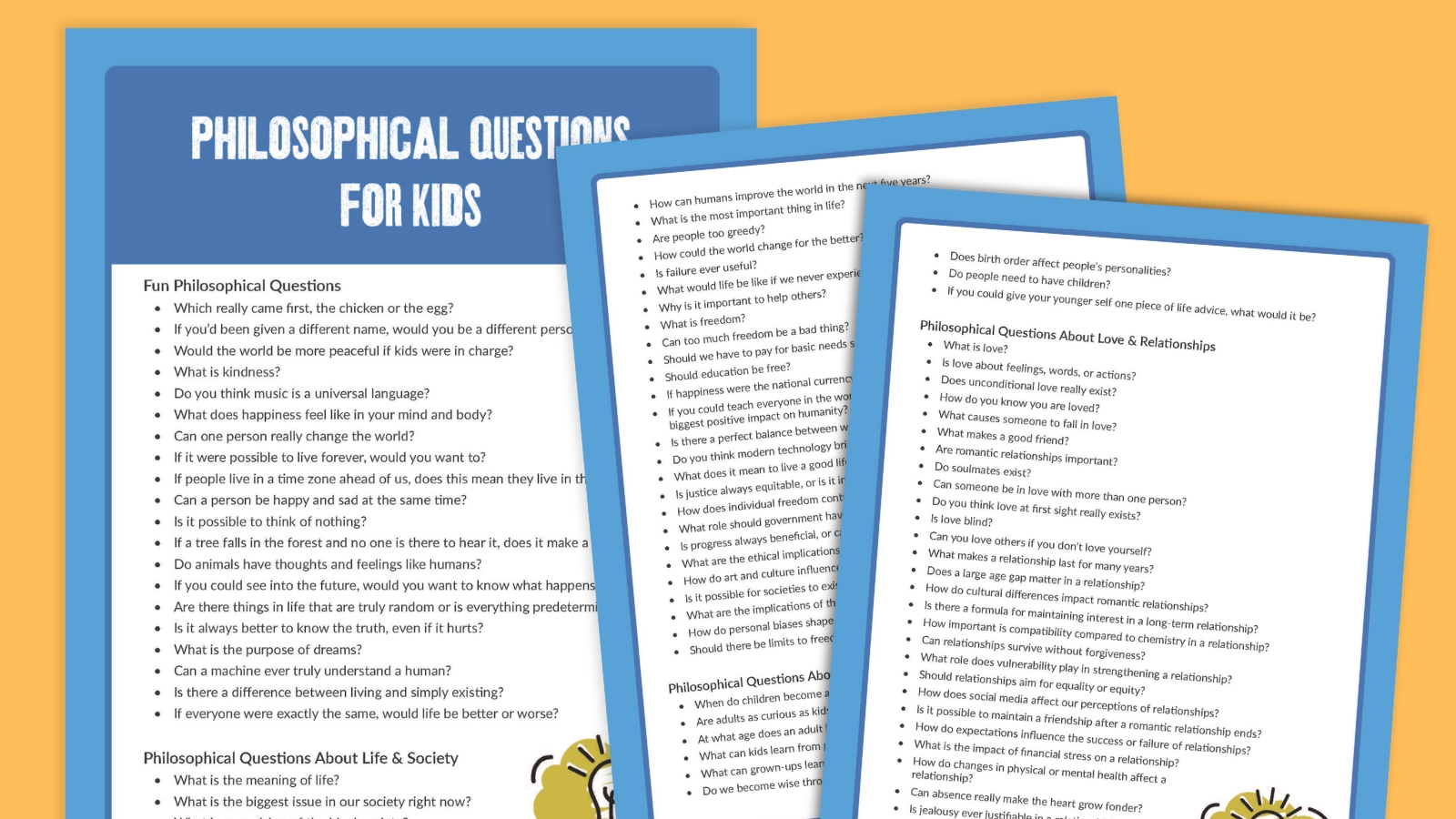
Get your free printable list of philosophical questions!
Grab a copy of our free printable list of philosophical questions for kids to use with your students. Just click the button below and fill out the form to get it.
