

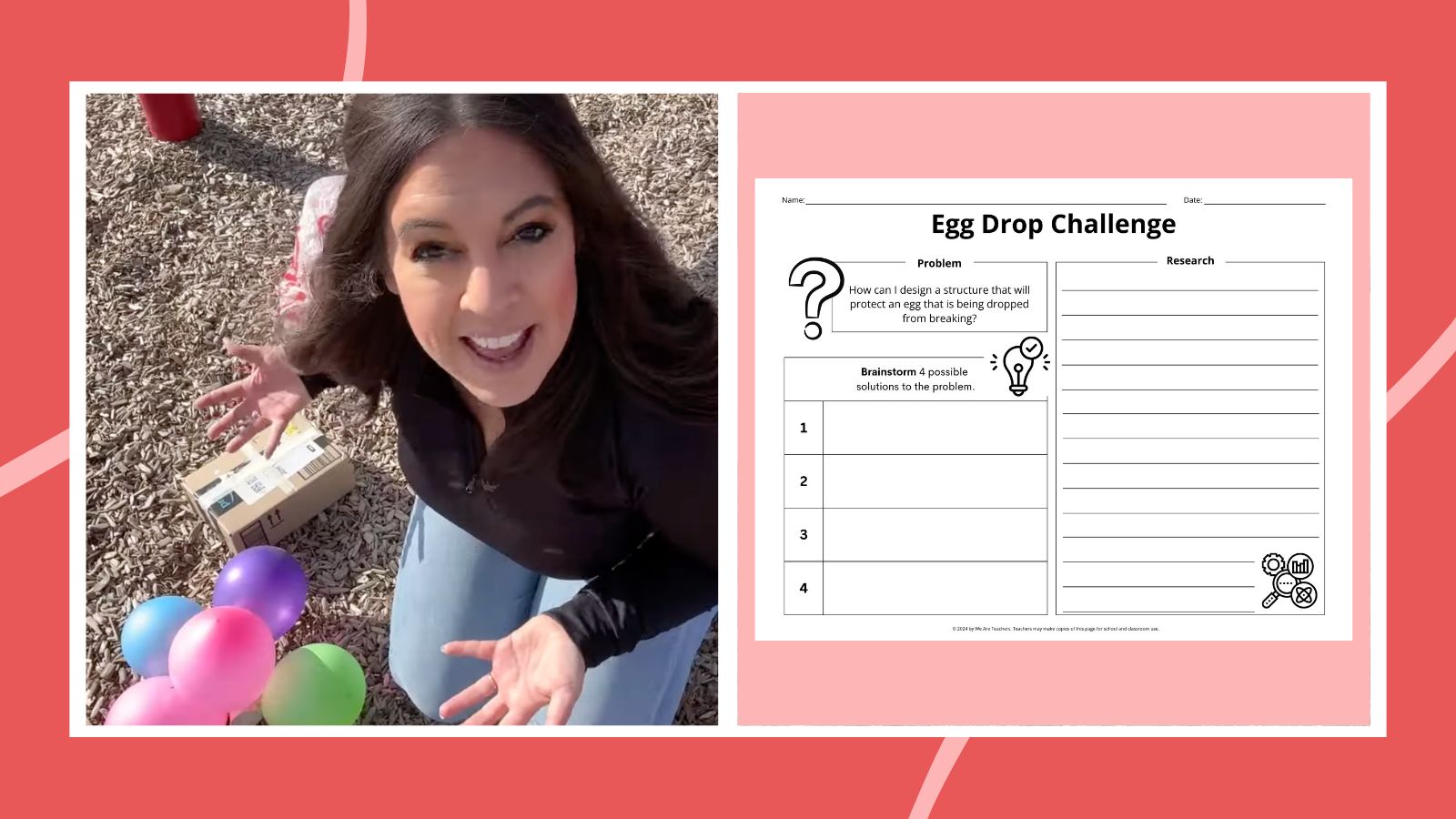
The egg drop may be the most versatile activity there is. It can be done in kindergarten to teach about gravity, in middle school to teach engineering, and in high school physics. (We’ve even done the egg drop in professional development as a team-building activity!) If you’re looking for creative egg drop challenge ideas, our list will give you plenty of inspiration for every grade level.
What does the egg drop challenge teach?
It looks like fun, and kids love it, but the egg drop challenge is more than a filler activity. You can use the egg drop challenge to teach science, problem-solving, or teamwork.
- In science, the egg drop challenge teaches students about gravity, force, and energy. Talk about how much force the egg withstands when it is dropped, and how the various ways of padding or protecting the egg impact the force the actual egg feels.
- The egg challenge also teaches the engineering process as students understand the problem, design a prototype, test the prototype, and reflect on their test.
- Use the challenge to have students practice teamwork. It takes collaboration and communication for students to design and test their prototype, and it takes self-control to maintain their composure if it breaks.
1. Essential egg drop challenge
Watch our how-to video for easy step-by-step instructions on the intricacies of the egg drop challenge! The video includes fun ideas to spice up the egg drop challenge and a few examples of how to craft the best device to hold your egg.
2. Disaster egg drop
Add some real-life application to the egg drop challenge by having students imagine that they are trying to deliver eggs to people who have been in a disaster. They must use contents from care packages to pack and try to deliver their eggs. The focus of this egg drop is on the change from potential to kinetic energy and how energy moves when it impacts the ground.
3. Parachute egg drop
Looking for tried-and-true ideas for the parachute egg drop method? Give students a variety of materials—straws, Popsicle sticks, paper, bags—and see who can make a parachute that helps the egg float instead of splat.
4. Humpty Dumpty egg drop
First, decorate an egg like Humpty Dumpty (smiley face, overalls). Then, fill baggies with different materials like water beads, sand, pasta, and cotton balls. Drop Humpty in and see which material protects him the best.
5. Hot-air balloon egg drop
Create a basket from a paper cup, fruit basket, or another container. Then, connect a “basket” to a balloon with yarn and see whether or not the balloon will float gently enough so the egg doesn’t break. You may try this in different types of weather to see what happens to the balloon and egg when it’s windy or not.
6. Crash cart egg race
In this version of an egg drop, build a cart for an egg, then send each egg down a ramp or course to see if the cart will protect the egg.
7. Cereal egg drop
Another lesson in how energy gets absorbed. Place an egg in a can, and surround the can with a soft cereal, like puffed rice. Try different cereals and different levels of packing to see which one protects the egg the best.
8. Dodecahedron egg drop
Create a dodecahedron out of straws, place an egg in the middle, and drop it. Will the straw structure protect the egg enough for it not to break? Bonus: Students learn about geometry and dodecahedrons.
9. Styrofoam cup egg drop
Use Styrofoam cups to create a stack around the egg. Place a heavy rock in the bottom of the first cup (the rock should be heavier than the egg). Then, put six more cups on top, put the egg into the seventh cup, and cover the stack with the eighth. Tape the stack together and drop.
10. Rubber band suspension egg drop
Suspend an egg using rubber bands and pantyhose for protection. Will the egg bounce and wiggle or crack on impact?
11. Paper straws egg drop
Sometimes having limited materials brings out students’ creativity. Give students nothing but an egg, a piece of paper, and scissors. Then, see what they can come up with.
12. Pringles can drop
A Pringles can is the perfect size and shape to protect an egg. Use cushioning and pencils to hold the egg in place.
13. Sponge egg drop
Cut a hole in the middle of a sponge and fit the egg into the hole. Then, use straws and tape to secure the egg and see if the sponge will soften the blow.
14. Paper bag parachute
Looking for more ideas that incorporate parachutes in your egg drop challenge? Place the egg in a red Solo cup with some cushioning (shredded paper, cotton). Then, attach a plastic bag to the cup and launch it in a place where the wind can catch the bag.

15. Toilet paper and duct tape egg drop
Tuck an egg into a roll of toilet paper, pack with cotton balls, and cover with duct tape. You could use this strategy to drop the egg, or roll it down an obstacle course.
16. Oobleck-wrapped egg challenge
For a multi-step and slimy approach, make Oobleck and cover the egg in Oobleck. Then, put the egg in a cup that includes a soft packing material (mini-marshmallows, cotton balls). Cover the top with plastic wrap or tape and get ready to drop.
17. Ship egg drop
In this version, students build a “ship” to protect their eggs. Give students a collection of materials like Popsicle sticks, straws, rubber bands, pipe cleaners, yarn, cotton balls, and sandwich bags. Then challenge them to make ships to protect their eggs.
18. Pool noodle egg drop
What can’t you do with pool noodles? Cut them into parts and use duct tape for reinforcement. Tie them with rubber bands to create a soft, spongy egg pod. Test which pool noodle protection method keeps the eggs safe.
19. Toilet paper roll reinforcement
Use toilet paper rolls as pillars to support and protect an egg, then use a sponge and rubber bands to hold it together. The big question with this egg drop is whether it will float down or crash.
20. Water bag egg drop
What happens if you put eggs in a bag full of water? First, have students hypothesize whether the eggs will break based on how much water is in the bag. Then, test your hypothesis.
21. Reinforced box egg drop
Talk about what it means to reinforce an object, then provide students with different ways to reinforce an egg in boxes or jars (or jars in boxes).
22. Floam-covered eggs
Cover an egg in floam and see if it provides enough cushioning to break the fall. If you don’t have floam, you can also try kinetic sand, play dough, or anything that will cover the egg and absorb the impact.
23. Peanut butter jar egg drop
Tuck an egg in a peanut butter jar, pack it with tissues, and secure it in a box. Then see if that protects the egg from cracking when dropped.
24. Balloon cushion egg drop
Surround the egg in balloons filled with beads to provide a softer landing.
25. Bungee egg drop
This activity isn’t an egg drop per se. Students use rubber bands to create a bungee jump for an egg and predict how many rubbers bands they will need for the egg to drop a certain length (maybe 6 feet). For students who are well versed in the egg drop, this is a fun spin on the idea.
26. Backyard egg drop
Looking for ideas to make the egg drop project more challenging? Ask students to find materials in nature—sticks, leaves, an abandoned bird’s nest—to create their egg drop structures.
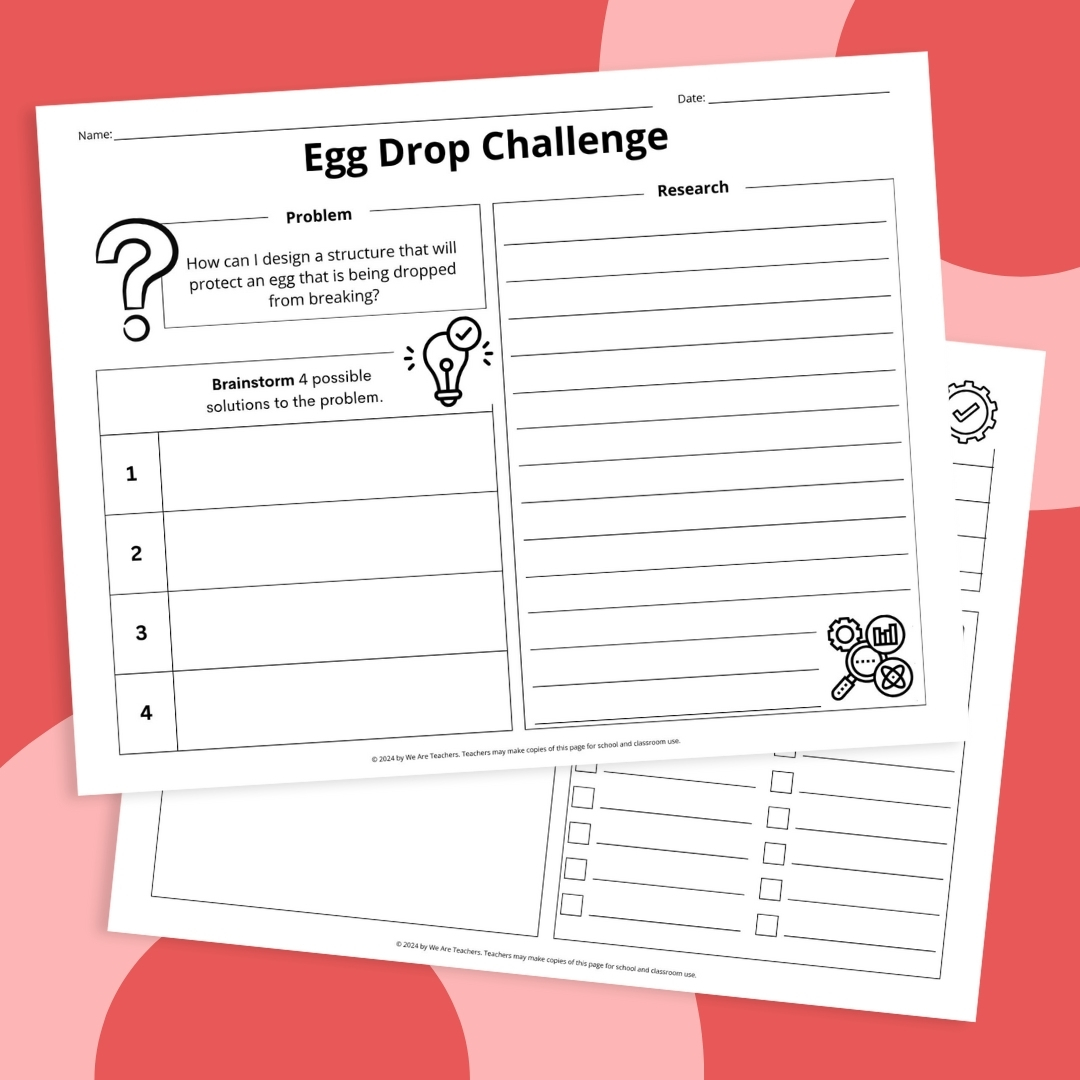
Get your free egg drop challenge worksheet!

Click the button below to receive your free printable worksheet, which you can use to accompany an egg drop challenge in your classroom. The worksheet includes space to brainstorm egg drop designs, as well as a section to document results.
