

The Definition Of Maslow’s Hierarchy Of Needs
by TeachThought Staff
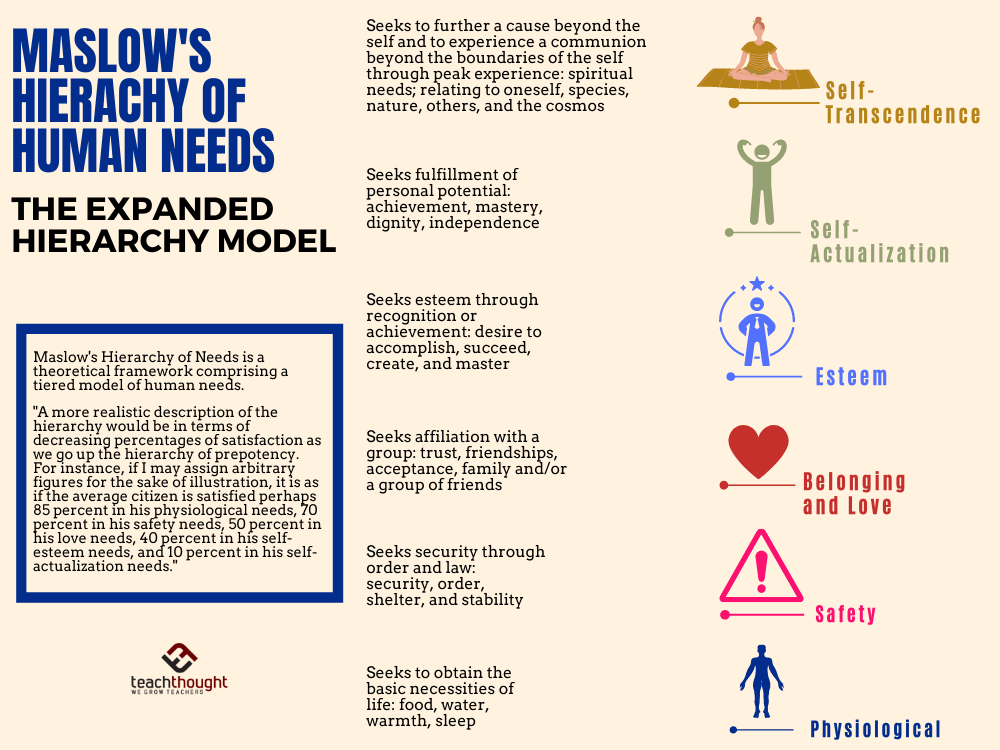
Maslow’s Hierarchy of Needs is a theoretical framework comprising a tiered model of human needs, often depicted as hierarchical levels within a pyramid.
The framework was developed by Abraham Maslow in his 1943 paper, ‘A Theory of Human Motivation’ in the journal Psychological Review and revised multiple times (thus resulting in multiple versions), and in 1954 was republished in his book, ‘Motivation and Personality.’
For the purpose of this post, we will refer to one expert’s interpretation of the entire body of work as he seeks to reconcile so many unique expressions of Maslow’s views (including personal journal articles) before his death in 1970. (That paper is cited below.)
| Level (Bottom → Top) | Need | Description | Examples |
|---|---|---|---|
| 1 (Base) | Physiological Needs | Basic biological requirements for human survival. | Air, water, food, sleep, shelter, rest breaks. |
| 2 | Safety Needs | The need for security, stability, and protection from harm. | Physical safety, predictable routines, financial security, health, safe environment. |
| 3 | Love & Belonging | The need for relationships, connection, and being part of a group. | Friendships, family bonds, classroom community, acceptance, affection. |
| 4 | Esteem Needs | The need for respect, status, competence, and self-confidence. | Recognition, achievement, responsibility, feeling capable and valued. |
| 5 (Top) | Self-Actualization | The need to realize one’s full potential and pursue personal growth and meaning. | Creative work, pursuing passions, problem-solving, personal goals, “becoming who you can be.” |
As we noted in Bloom’s Revised Taxonomy, while the revisions to works like these are always important, the idea that the ‘new Bloom’s’ means that the ‘old Bloom’s’ is ‘outdated’ might not be the best way to view the changes. Rather, looking at the purpose of the original work and the nature of and reasons for–and effects of–changes can provide a more comprehensive perspective on the thinking behind the works themselves.
What is Maslow’s Hierarchy of needs used for?
The framework is useful in a variety of professional fields, from psychology and sociology to personal training, government, and self-improvement. The hierarchy has always been relevant in education but became more strongly emphasized during the COVID crisis that upended many of our ‘normal’ collective behaviors as a society–including how we teach children.
Equally, the framework is informative to better understand the needs of teachers who have been expected to navigate the crisis individually as human beings while protecting and nurturing dozens (sometimes many dozens) of other lives, many of whom are struggling to mitigate the effects of a quickly-changing–and politically charged–world.
That teachers have to do so while the act of teaching itself has been significantly changed (remote teaching, for example) only increases the relevance and significance of Maslow’s framework as a tool to support both teachers and students to realize some kind of system of teaching and learning that is sustainable, innovative, and human in its goals, actuators, and priorities.
Maslow’s hierarchy of needs is useful to understand what motivates humans through a series of ‘checkpoints’ that need to be, to one degree or another ‘satisfied’ before higher levels can be entirely accessed, much less mastered. The framework also implies that we live in constant pursuit of that highest level: self-transcendence.
In this respect, the framework can be useful to adjust for and respond to the diverse needs of human beings participating in any ‘thing’–a system, sequence, event, or challenge, for example–that seeks human progress of some kind (physical, intellectual, spiritual, etc.) It is an acknowledgment of the dizzying–and interdependent-0-complexities of the human experience.
What did Maslow actually believe?
According to Mark E. Koltko-Rivera in, ‘Rediscovering the Later Version of Maslow’s Hierarchy of Needs: Self-Transcendence and Opportunities for Theory, Research, and Unification,’ Maslow’s work has been widely misunderstood. (1)
The conventional description of Abraham Maslow’s (1943, 1954) hierarchy of needs is inaccurate as a description of Maslow’s later thought. Maslow (1969a) amended his
model, placing self-transcendence as a motivational step beyond self-actualization.
“Abstract: Objections to this reinterpretation are considered. Possible reasons for the persistence of the conventional account are described. Recognizing self-transcendence is part of Maslow’s hierarchy has important consequences for theory and research: (a) a more comprehensive understanding of worldviews regarding the meaning of life; (b) broader understanding of the motivational roots of altruism, social progress, and wisdom; (c) a deeper understanding of religious violence; (d) integration of the psychology of religion and spirituality into the mainstream of psychology; and (e) a more multicultural integrated approach to psychological theory.”
Maslow believed that people have a need for physiological and safety needs. These needs must first be met before any other level of needs can be addressed.
Maslow’s Quotes About Human Motivation
“So far, our theoretical discussion may have given the impression that these five sets of needs are somehow in a step-wise, all-or-none relationship with each other. We have spoken in such terms as the following: ‘If one need is satisfied, then another emerges.’ This statement might give the false impression that a need must be satisfied 100 percent before the next need emerges. In actual fact, most members of our society, who are normal, are partially satisfied in all their basic needs and partially unsatisfied in all their basic needs at the same time.
“A more realistic description of the hierarchy would be in terms of decreasing percentages of satisfaction as we go up the hierarchy of prepotency. For instance, if I may assign arbitrary figures for the sake of illustration, it is as if the average citizen is satisfied perhaps 85 percent in his physiological needs, 70 percent in his safety needs, 50 percent in his love needs, 40 percent in his self-esteem needs, and 10 percent in his self-actualization needs.”
Terminology And Definitions Around Maslow’s Hierarchy Of Needs
Physiological: Physiological needs include food, water, sleep, air, warmth, shelter, etc. Safety includes security from harm, freedom from fear, and protection against illness.
Once these basic needs are satisfied, one can move on to social/love needs, esteem needs, self-actualization needs, and finally transcendence needs. The last two tiers of needs are considered more spiritual than physical or emotional.
Social: Social needs include belongingness, love, respect, recognition, friendship, cooperation, community service, etc.
Love includes affection, intimacy, sexual attraction, romance, marriage, family life, children, etc. Respect involves being treated with dignity and worthiness.
Recognition means having your work acknowledged as valuable.
Friendship requires trust, loyalty, honesty, sharing, caring, empathy, etc.
Cooperation implies working together toward common goals. Community service refers to helping others who cannot help themselves.
Self-Actualization: This tier consists of personal growth, creativity, achievement, power, prestige, status, etc.
Personal Growth entails learning new skills, knowledge, understanding, wisdom, experience, etc.
Creativity encompasses artistic expression, scientific discovery, invention, innovation, etc.
Achievement refers to success at something you’ve set out to do. Power involves control over one’s environment.
Prestige indicates how well respected someone is within their field. Status signifies rank among peers.
Transcendent: Transcendental needs refer to spirituality, meaning, purpose, fulfillment, happiness, peace, joy, enlightenment, etc. Meaning concerns what it all means; purpose relates to why things exist.
Fulfillment refers to feeling complete, contented, happy, peaceful, joyful, enlightened, etc. Happiness has been defined as “the state of mind which results when man realizes he possesses those qualities necessary to satisfy his desire for survival, health, pleasure, and love.”
Peaceful means freedom from internal or external conflict.
Joy comes from experiencing positive emotions such as excitement, enthusiasm, pride, gratitude, hope, confidence, compassion, appreciation, awe, wonder, curiosity, inspiration, etc.
Enlightenment occurs when there is no longer ignorance about reality. It is achieved through meditation, prayer, contemplation, study, reflection, etc.
Happiness is subjective. Some believe that true happiness lies in achieving inner satisfaction rather than external rewards. Others think that happiness depends upon whether one feels good about oneself. Still, others feel that happiness is simply a matter of perspective.
Purpose is related to finding meaning in life. People often find this sense of purpose through religion, philosophy, art, science, politics, business, education, sports, music, etc.
Fulfilling relationships involve loving another person unconditionally. They also require mutuality, reciprocation, equality, fairness, integrity, commitment, responsibility, accountability, etc.
Healthy relationships imply harmony between partners. Healthy marriages should provide both spouses with equal opportunities to express feelings, share interests, enjoy activities, make decisions, etc.
Esteem is based on our perception of ourselves relative to others.
FAQ: The Expanded Version Of Maslow’s Hierarchy Of Needs
Maslow’s 1943 and 1954-published five-stage model was expanded in 1970 to include both cognitive and aesthetic needs, then revised again to add transcendence needs (Maslow, 1970b).
What Are Physiological Needs?
Physiological needs are universal human needs that combine biological and cognitive/psychological needs.
What is the hierarchy of needs?
Maslow’s hierarchy of needs is a framework for understanding human needs arranged as a hierarchy. It is usually represented as a pyramid with the more basic needs at the bottom. The concept was introduced by Abraham Maslow in his 1943 paper “A Theory of Human Motivation” in the journal Psychological Revie. Maslow subsequently extended the idea to include his observations of humans’ innate curiosity.
What is Feeling of Belonging?
After physiological and safety needs are fulfilled, the third level of human needs is interpersonal and involves feelings of belongingness.
What are the social groups?
For example, some large social groups may include clubs, co-workers, religious groups, professional organizations, sports teams, gangs, and online communities.
What is love?
Love has many definitions but can be thought of as selfless and enduring affection.
What are the social belonging needs?
A lack of belonging can adversely affect the individual’s ability to form and maintain emotionally significant relationships Social belonging needs include Professional Connections, Friendship Intimacy, healthy local communities (physical), and digital participation, as well. This need for belonging may overcome the physiological and security needs, depending on the strength of the nature and dynamics of the social setting.
What is a concept pyramid?
Maslow’s hierarchy of needs is often portrayed in the shape of a pyramid with the largest, most fundamental needs at the bottom and the need for self-actualization and transcendence at the top.
What is meta motivation?
Maslow also coined the term ‘meta motivation’ to describe the motivation of people who go beyond the scope of the basic needs for ‘survival’ and strive for constant betterment.
What is a higher version of esteem?
The ‘higher’ version of esteem is the need for self-respect and can include a need for strength, competence, self-confidence, independence, and freedom.
What is an explicit motive?
Self-actualization is understood as the goal or explicit motive, and the previous stages in Maslow’s hierarchy fall in line to become the step-by-step process by which self-actualization is achievable; an explicit motive is the objective of a reward-based system that is used to intrinsically drive completion of certain values or goals.
What are the basic needs of human beings?
Biological and physiological needs: air, food, drink, shelter, warmth, sleep, etc.
What are the changes to Maslow’s model?
Changes to the original five-stage model are highlighted and include a seven-stage model and an eight-stage model; both developed during the 1960s and 1970s.
What are the Esteem Needs?
Esteem needs were classified into two categories: (i) esteem for oneself (dignity, achievement, mastery, independence) and (ii) the need to be accepted and valued by others (e.g., status, prestige).
What is Transcendence?
Transcendence requires a person to be motivated by values that transcend beyond the personal self (e.g., mystical experiences and certain experiences with
What is the hierarchy of needs?
Maslow’s hierarchy of needs is a motivational theory in psychology comprising a five-tier model of human needs, often depicted as hierarchical levels within a pyramid.
