

“Ready or not, AI is here,” says educator Holly Clark in her book The AI-Infused Classroom. “AI isn’t about replacing student effort; it’s about amplifying it with intelligent tools.”
To truly harness the potential of AI in education, it’s essential to move beyond simply using AI tools and instead focus on empowering students to become critical thinkers, creative problem-solvers, and active participants in their learning process. Becoming experts in strategic AI prompts can play a pivotal role in this transformation, turning K-12 students from passive learners into active innovators across content areas.
Why should teachers and schools teach students how to use AI tools?
The ISTE Standards for students note that they should “critically curate a variety of resources using digital tools to construct knowledge.” As Clark notes, “The future of AI isn’t science fiction, it’s the reality our students will inherit. And it’s up to us to prepare them to not just exist in that world, but to shape it.” By mastering the art of crafting effective AI prompts, educators and students can leverage AI as a powerful learning partner, enriching educational experiences and fostering essential skills for the future.
I think it’s critical to teach our students responsible, ethical, and constructive ways to utilize AI tools. New technology doesn’t just disappear, it’s going to be around for the foreseeable future. It’s our responsibility to teach our students the skills they will need to be successful outside of our classroom.
—Eliana Belle, K-5 English Language Development Teacher in Oregon
This guide provides practical insights and examples on how to create impactful AI prompts, highlighting their versatility across different subjects and study skills.
Jump to:
Teaching Students To Write AI Prompts
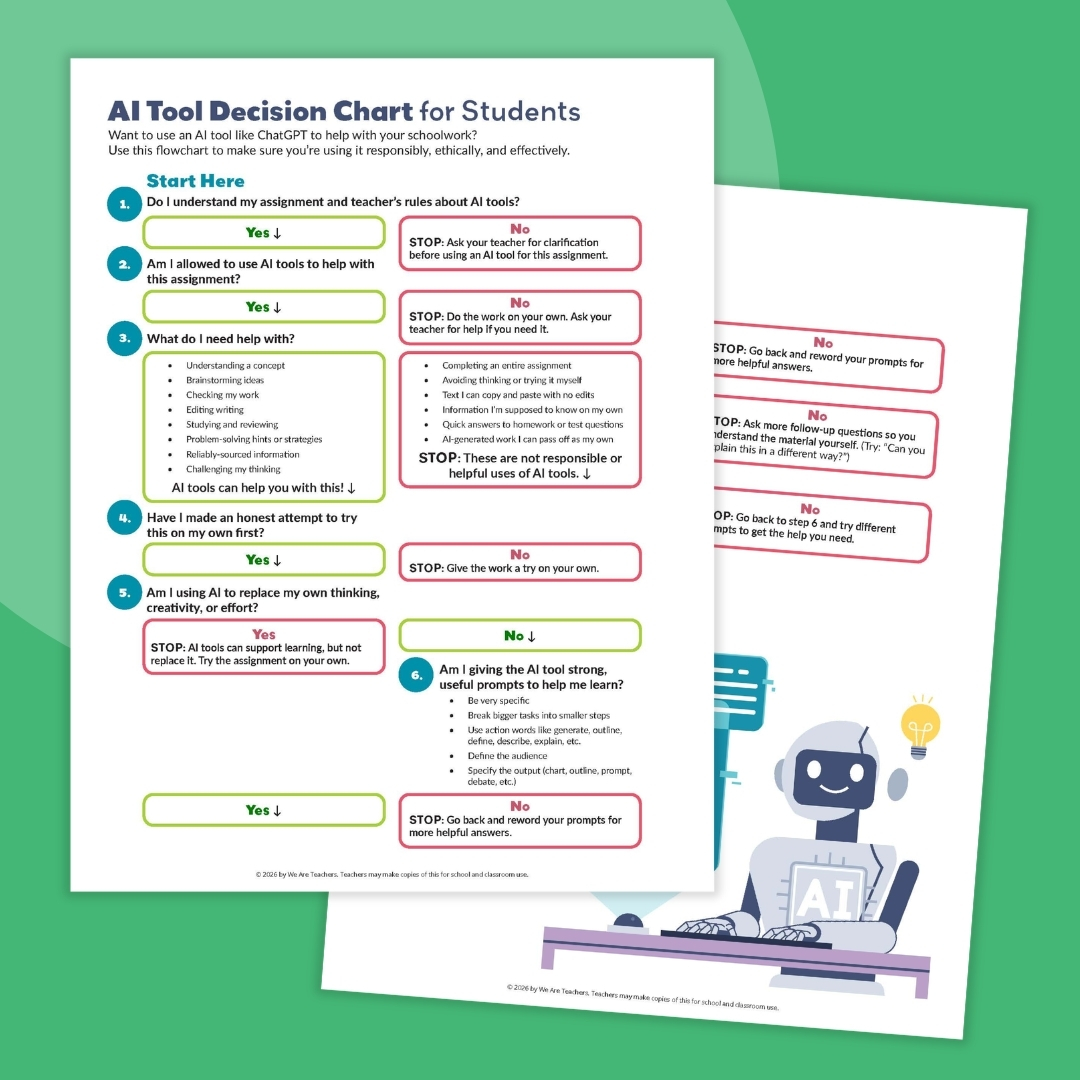
Crafting effective AI prompts is key to getting the most out of these powerful tools. Think of it like giving clear instructions to a helpful, albeit sometimes quirky, assistant. Here’s a breakdown of how to write prompts that will truly enhance student learning.
Start with action-oriented verbs
Teach students to begin their prompts with action verbs that clearly indicate what they want the AI to do. Instead of vague requests, use verbs like:
- Generate: “Generate a list of …”
- Create: “Create a short story about …”
- Analyze: “Analyze the main character in …”
- Explain: “Explain the concept of …”
- Summarize: “Summarize the key points of …”
- Compare: “Compare and contrast …”
- Illustrate: “Illustrate with examples …”
Define your request clearly
Ambiguity leads to unpredictable results. Teach students to be specific about what they’re asking.
- Instead of “Tell me about animals,” try “Explain the differences between mammals and reptiles, including examples of each.”

Break down complex requests into smaller, simpler parts
If you have a multistep task, don’t overwhelm the AI (or the student!). Break it down into smaller, manageable prompts.
- Instead of “Write a research paper on the American Revolution,”—that’s complex!—start with:
- “Brainstorm three potential topics for a research paper on the American Revolution.”
- Then “Create an outline for a paper on [chosen topic],” and so on.
Give examples of the desired format or style
Help the AI understand what you’re looking for by providing examples.
- “Write a haiku about a rainy day. A haiku is a three-line poem with a 5, 7, 5 syllable structure.”
- Or “Summarize this article in bullet points.”
Indicate the desired tone
Specify the tone you want the AI to adopt. Do you want it to be formal, casual, silly, technical, or academic? For younger students, they might want a more playful tone.
- “Explain photosynthesis in a fun way to a 5th grader.”
- “Make up a silly song about biodiversity.”
Give feedback to improve results
AI is a learning tool itself. If the initial results aren’t quite right, provide constructive feedback and refine your prompt.
- For example, if the AI’s explanation is too complex, you might say, “Please simplify it further and use examples that children will understand.”
Try rephrasing if you’re not getting great results
Sometimes, simply rewording your prompt can make a big difference.
- Experiment with different phrasing to see what works best.
- Try using synonyms or restructuring your sentence.
Consider using role-playing prompts
- “Act as a historian explaining the causes of World War I.”
- “Act as a scientist explaining the water cycle.”
- “Act as a character from ‘Romeo and Juliet’ and explain your motivations.”
AI Prompts by Subject

Since AI can help teachers, too, let’s explore some AI prompts for various K-12 content areas. You can find even more ready-to-use prompts and best practices for working smarter and more efficiently in Moreland University’s free guide, Empowering Educators With AI: 100+ Prompts To Save Teachers Time.
English and Language Arts
Writing Prompts for Creative Stories
- “Give me a short story idea about a talking animal who goes on an adventure.” (Elementary)
- “Help me structure a character map for this story idea.” (Middle School)
- “Write a dystopian short story outline exploring themes of censorship and freedom of expression, utilizing foreshadowing.” (High School)
Character Analysis Exercises
- “Analyze the character. What are her strengths and weaknesses?” (Elementary/Middle School)
- “Compare and contrast the motivations of Macbeth and Lady Macbeth in Shakespeare’s ‘Macbeth.’” (High School)
Grammar and Vocabulary Practice
- “Generate 10 sentences using different types of punctuation marks: periods, commas, question marks, and exclamation points.” (Elementary/Middle School)
- “Define the following vocabulary words and use each in a sentence: [list of words].” (Middle/High School)
Information Text, Essays + Research
- “Suggest five research questions related to [topic].” (All Grades)
- “Rewrite this sentence in a more _________ way: [sentence].” (All Grades)
- “Provide feedback on my essay: [essay text].” (Middle/High School)
- “What are five key points I should take away from this article?” (Middle/High School)
Mathematics
Problem-Solving Scenarios
- “Create a word problem about sharing cookies equally among friends.” (Elementary)
- “Design a real-world problem involving calculating the area and perimeter of a garden.” (Middle School)
- “Generate three practice problems about [mathematical concept].” (High School)
Real-World Applications of Mathematical Concepts
- “Explain how fractions are used in cooking and baking.” (Elementary/Middle School)
- “Illustrate how geometry is used in architecture and construction.” (Middle and High School)
Explanations of Complex Formulas + AI Prompts for Students
- “Explain the _________ theorem in simple terms and provide examples.” (Middle School)
- “Describe the _________ formula and its applications in solving algebraic equations.” (High School)
Science
Experiment Design Prompts
- “Design a simple experiment to test the effect of sunlight on plant growth.” (Elementary and Middle School)
- “Develop a hypothesis and experimental procedure to investigate the relationship between temperature and the rate of dissolving sugar in water.” (Middle and High School)
Explanations of Scientific Phenomena
- “Explain the water cycle to a 3rd grader.” (Elementary)
- “Describe photosynthesis and its importance for life on Earth to a 7th grader.” (Middle School)
- “Analyze the theory of evolution by natural selection and provide supporting evidence.” (High School)
Hypothetical Scenarios for Critical Thinking
- “Imagine if _________ happened for one day. What could result?” (Elementary and Middle School)
- “Suppose we discovered _________. How might life be different?” (Middle and High School)
Social Studies
Historical Event Analysis
- “Summarize the main causes of the American Revolution.” (Middle School)
- “Analyze the impact of the Civil Rights Movement on American society.” (High School)
Cultural Comparison Exercises
- “Compare and contrast the traditions of two different religious holidays celebrated around the world.” (Elementary and Middle School)
- “Discuss the similarities and differences between ancient Roman and ancient Greek civilizations.” (Middle and High School)
Current Events Discussions
- “Summarize a recent news article about climate change and explain its potential impact.” (Middle and High School)
- “Discuss the different perspectives on a current social issue and analyze the arguments for each side.” (High School)
AI Prompts for Student Study Skills

Note-Taking Strategies
- “Explain different note-taking methods, such as the Cornell method and mind mapping.” (Middle and High School)
- “Summarize this article in bullet points as if you were taking notes.” (Middle and High School)
Time-Management Techniques
- “Create a sample weekly study schedule for a high school student balancing academics, extracurricular activities, and free time.” (Middle and High School)
- “Generate tips for effective time management and avoiding procrastination.” (Middle and High School)
Test-Preparation Tips
- “Provide strategies for preparing for a multiple-choice test in history.” (Middle and High School)
- “Generate practice questions for a math test on fractions.” (Middle School)
AI Prompts for Student Research and Projects
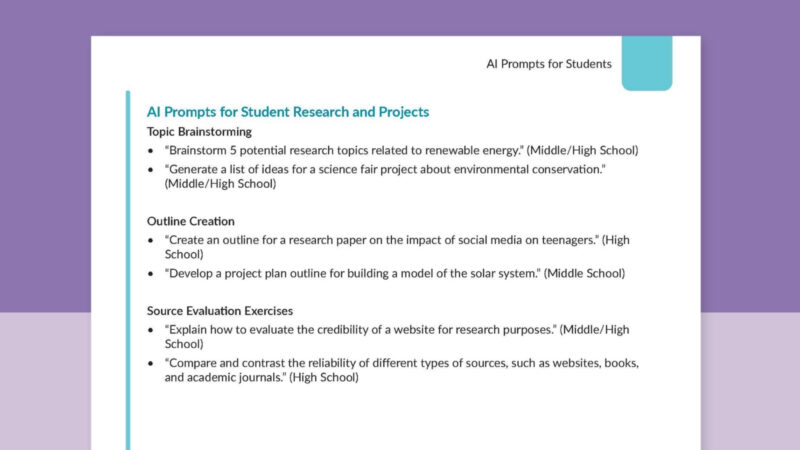
Topic Brainstorming
- “Brainstorm and potential research topics related to renewable energy.” (Middle and High School)
- “Generate a list of ideas for a science fair project about environmental conservation.” (Middle and High School)
Outline Creation
- “Create an outline for a research paper on the impact of social media on teenagers.” (High School)
- “Develop a project plan outline for building a model of the solar system.” (Middle School)
Source Evaluation Exercises
- “Explain how to evaluate the credibility of a website for research purposes.” (Middle and High School)
- “Compare and contrast the reliability of different types of sources, such as websites, books, and academic journals.” (High School)
Using AI for Personalized Learning
- Adaptive Practice Questions: AI can generate practice questions tailored to a student’s skill level.
- “Generate 10 algebra problems that are slightly more challenging than the previous set based on my performance.”
- Customized Explanations Based on Learning Style:
- If a student is a visual learner, they can prompt AI to “Explain the concept of photosynthesis using diagrams and visuals.”
- For auditory learners, “Explain the concept of photosynthesis as if you were giving a lecture.”
- Progress Tracking and Goal Setting: AI can help students track their progress and set realistic learning goals.
- “Based on my understanding of fractions, suggest a realistic goal for improving my skills in the next week.”
Ethical Considerations for Using AI
While AI offers incredible potential, it’s crucial to address ethical considerations:
- Importance of Original Thinking: Emphasize that AI is a tool to assist learning, not to replace original thought. Students should use AI to enhance their understanding and creativity, not to simply generate answers without engaging with the material.
- Balancing AI Assistance With Independent Work: Encourage a healthy balance between using AI for support and engaging in independent work. Students should still strive to develop their own problem-solving skills and critical thinking abilities.
- Proper Citation and Attribution: Teach students the importance of properly citing AI when it contributes to their work, just as they would cite any other source. This fosters academic honesty and responsible AI usage. For younger students, this can be simplified to acknowledging when AI was used to help.
By learning to craft effective AI prompts, students can unlock personalized learning experiences, enhance their understanding across subjects, and develop crucial study and research skills.
AI Prompts for Students FAQs
What are AI prompts for students?
AI prompts for students are instructions that learners give an AI tool to help them learn, study, plan, or complete school assignments. Good prompts tell the tool what the student needs and the type of response they want. Some examples include “Give me five quiz questions to practice multiplying fractions,” or “Help me write an outline for paper on symbolism in ‘The Scarlet Letter.’”
Why should we teach students to use AI tools like ChatGPT?
“The future of AI isn’t science fiction, it’s the reality our students will inherit. And it’s up to us to prepare them to not just exist in that world, but to shape it,” says Holly Clark in her book The AI-Infused Classroom. Today’s businesses are embracing AI tools, which means students will need to know how to use them well to succeed in their future careers.
Is it cheating for students to use AI prompts?
“AI isn’t about replacing student effort; it’s about amplifying it with intelligent tools,” Holly Clark explains in The AI-Infused Classroom. Though students certainly can use AI tools to cheat, most of them won’t—as long as we teach them the ways to use these tools effectively and ethically.
Remember, once upon a time, people said that letting kids use calculators would destroy their math skills. Instead, research shows that when taught and used properly, calculators support students’ math skills growth and even build their confidence to tackle more complex calculations. Today’s AI tools can also be beneficial to learners, if we teach students to use them responsibly.
How can students write the most effective AI prompts?
Good AI prompts are clear and specific. Rather than asking the tool to tackle too much at once, break requests into smaller steps. When you’re asking for information, always ask your AI tool to provide reliable sources so you can verify the accuracy of the response. If you’re having trouble getting the help you need, try rephrasing your request using different language. And remember to offer feedback to your AI tools—they’re designed to learn, so help them improve by letting them know how they’re doing!
What should students know about the ethics of using AI tools?
Teach students that AI tools are learning aids, not just shortcuts to the right answer. While AI tools can take care of some of the “busy work,” they can’t replace true, deep learning. Remind them that AI tools aren’t always correct or trustworthy—they’ll need to use their own common sense and critical thinking skills along with them. Establish school AI guidelines and teach students how to abide by them while enhancing their learning and study skills.
Encourage discussion in class about other ethical considerations when using AI tools, such as the possible theft of intellectual property, privacy concerns, and environmental impacts. Tip: Try asking your tool to debate an ethical issue related to AI with you and your class!
Get your AI prompts printables!
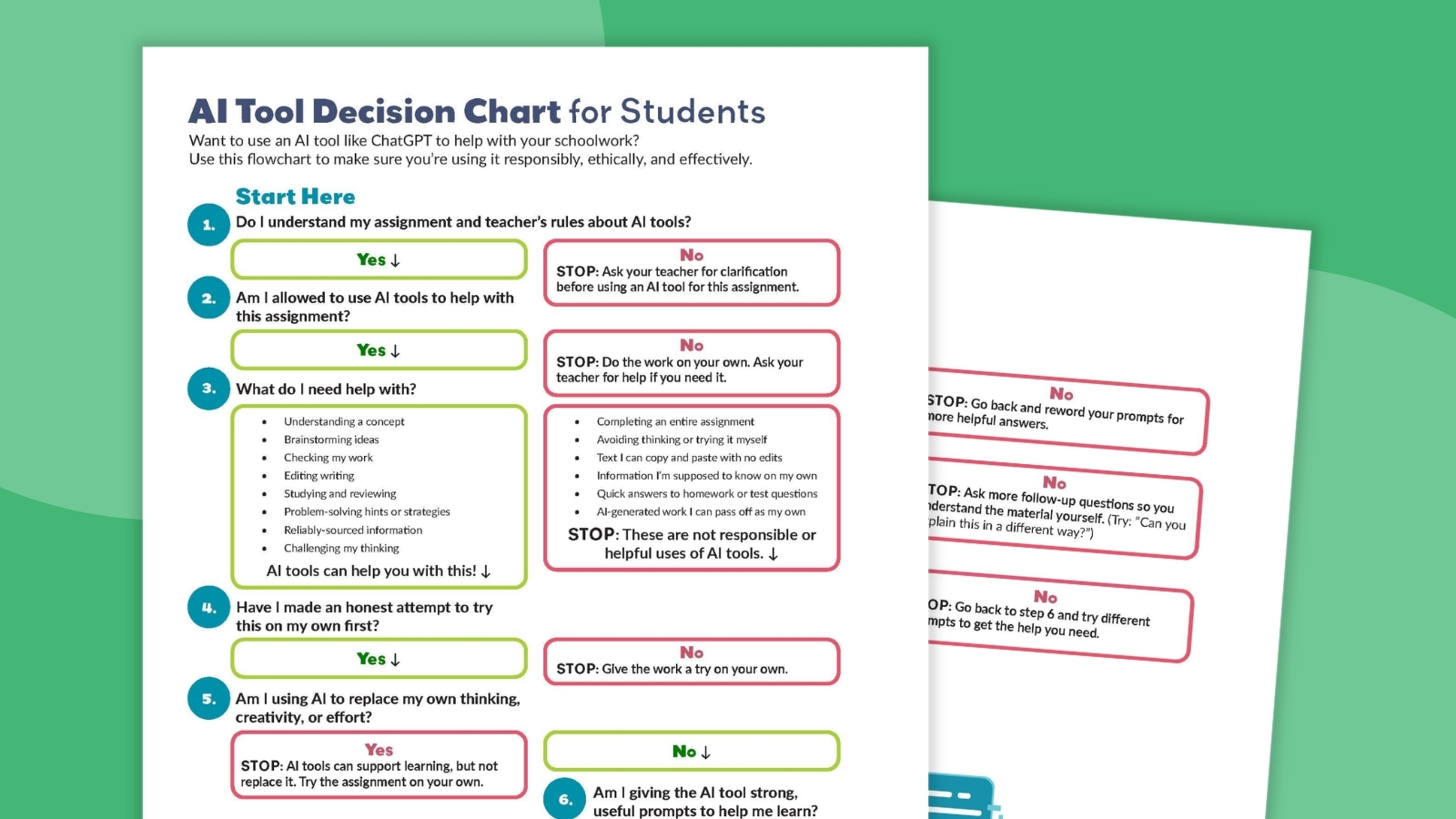
Download and print out our free handout with all of the AI tools and prompts your students will need to succeed using AI. Just enter your email info in the form on this page for immediate access!
Plus, check out the Best AI Lesson Plan Generators for Educators.
For more articles like this, be sure to subscribe to our newsletters to find out when they’re posted!

