

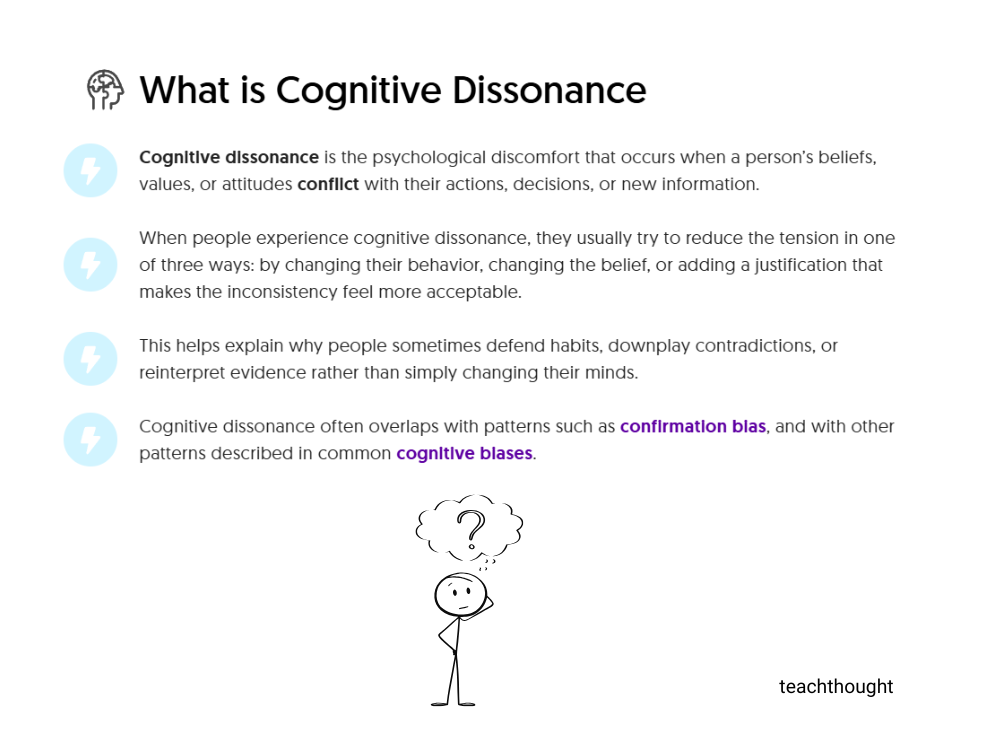
Cognitive dissonance is the psychological discomfort people feel when their beliefs, values, or self-image conflict with their actions, decisions, or new information.
Definition
Cognitive dissonance is a theory in psychology describing the tension that arises when a person holds inconsistent beliefs, or when behavior conflicts with stated values. That discomfort often motivates the person to reduce the inconsistency by changing behavior, revising beliefs, or adding a justification.
Key Characteristics of Cognitive Dissonance
- It involves felt psychological discomfort, not just a contradiction on paper.
- It usually appears when an action, belief, value, or identity claim does not align with another important cognition.
- The discomfort tends to be stronger when the issue matters to the person or affects how they see themselves.
- People are often motivated to reduce the tension quickly, but not always rationally.
- Resolution may involve honest change, but it may also involve defensiveness, distortion, or rationalization.
How Cognitive Dissonance Typically Unfolds
1. A conflict appears
A belief, value, or self-image clashes with a behavior, decision, or new information.
Example: A student believes honesty matters but cheats on an assignment.
2. Discomfort is felt
The inconsistency creates internal tension such as unease, guilt, defensiveness, or pressure to explain the mismatch.
Example: The student sees the behavior as inconsistent with being an honest person.
3. A response follows
The person tries to reduce the discomfort by changing the behavior, changing the belief, or adding a justification.
Example: The student stops cheating, redefines the act as “not really cheating,” or claims the assignment was unfair.
Three Common Ways People Reduce Cognitive Dissonance
1. Change behavior
The person brings actions into better alignment with stated beliefs or values.
Example: A student who believes cheating is wrong stops using unauthorized help on assignments.
2. Change belief
The person revises the original belief so the conflict feels less serious.
Example: A person who values health but keeps smoking decides that health outcomes are mostly determined by genetics.
3. Add justification
The person introduces a new explanation that makes the inconsistency feel reasonable.
Example: A student who cheats tells himself the assignment was unfair or that everyone else was doing the same thing.
Examples of Cognitive Dissonance
Academic Integrity vs. Academic Behavior
“Cheating is wrong. Academic honesty matters.”
A student copies homework, uses unauthorized AI or online help, or shares answers during a test.
The student sees himself as honest but has behaved dishonestly. That mismatch creates discomfort because the behavior conflicts with a moral standard and a preferred self-image.
- Change behavior: stop cheating and complete future work independently.
- Change belief: redefine the act as “just getting help” rather than cheating.
- Add justification: claim the assignment was unfair, the pressure was too high, or everyone else was doing it.
Health Values vs. Daily Habits
“My health matters. Good nutrition, sleep, and exercise are important.”
A person repeatedly eats poorly, sleeps very little, skips exercise, or uses substances in ways that conflict with those goals.
The person values health but behaves in ways that undermine it. The discomfort comes from recognizing the gap between stated priorities and repeated habits.
- Change behavior: improve routines and reduce harmful habits.
- Change belief: decide that health is mostly outside personal control anyway.
- Add justification: say stress, lack of time, or current demands make the behavior understandable.
Financial Responsibility vs. Spending
“Being responsible with money matters. I should save and avoid unnecessary debt.”
A person makes repeated impulse purchases, carries avoidable credit card debt, or postpones saving while claiming financial discipline is important.
The person sees himself as financially responsible, but the behavior suggests something else. The resulting tension comes from the clash between identity and evidence.
- Change behavior: budget more carefully and reduce discretionary spending.
- Change belief: decide that long-term saving is less important than enjoying the present.
- Add justification: frame the purchases as rewards, exceptions, or necessary stress relief.
Personal Ethics vs. Dishonest Conduct
“Honesty matters. I want to do the right thing even when it is inconvenient.”
A person lies to avoid consequences, takes credit for someone else’s work, or stays silent after acting unfairly.
The discomfort comes from seeing a direct conflict between personal morals and actual behavior. The person wants to view himself as ethical, but the conduct points in another direction.
- Change behavior: tell the truth, accept consequences, and correct the action.
- Change belief: decide that small dishonesty is normal or harmless.
- Add justification: say there was no real choice, the situation was unfair, or the lie prevented a worse outcome.
Related Concepts
Why Cognitive Dissonance Matters in Learning
- It helps explain why people sometimes resist evidence that challenges their beliefs.
- It clarifies why self-justification can interfere with reflection and decision-making.
- It supports instruction in critical thinking, metacognition, and intellectual humility.
- It helps students examine the gap between what they say they value and how they actually respond.
References
Festinger, L. (1957). A Theory of Cognitive Dissonance. Stanford University Press.
Harmon-Jones, E., & Mills, J. (Eds.). (1999). Cognitive Dissonance: Progress on a Pivotal Theory in Social Psychology. American Psychological Association.
Aronson, E. (1992). The Social Animal (6th ed.). W.H. Freeman.
