

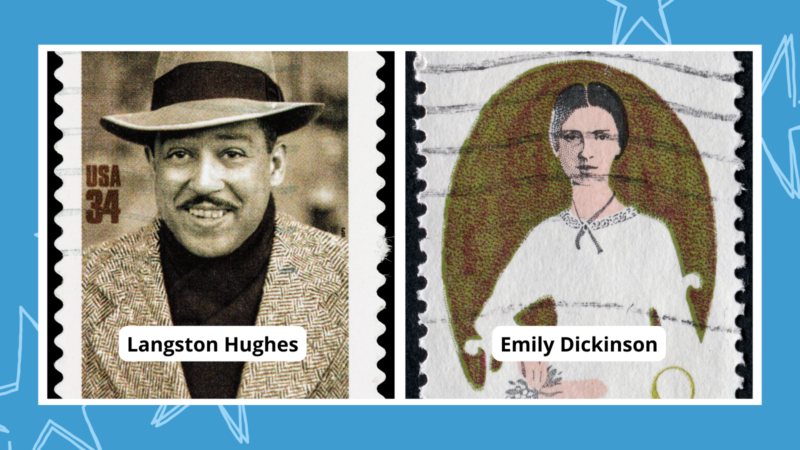
While students may recognize the names of famous American poets such as Emily Dickinson and Walt Whitman, there are lesser-known yet prominent poets from every state in our country! We’ve put together this sampler of notable poets (one per state) for your students to get to know. Who knows who might be inspired to become their state’s creative ingenue?
Note: Be sure to preview poems before sharing them with students to make sure these American poets are suitable for your classroom.
Ashley M. Jones
Alabama
The youngest person and first person of color to be appointed poet laureate of Alabama, Jones is a college professor and the founding director of the Magic City Poetry Festival.
Quote: “We hold these truths like dark snuff in our jaw, Black oppression’s not happenstance; it’s law.” —All Y’all Really From Alabama
John Haines
Alaska
Haines, poet laureate of Alaska and former Fellow of the Academy of American Poets, wrote more than 10 collections of poetry.
Quote: “And when the morning climbs the limbs we’ll part without a sound, fulfilled, floating homeward as the cold world awakens.” —If the Owl Calls Again
Alberto Ríos
Arizona
Born of Chicano heritage, Rios’ lyrical use of magical realism is compelling. Honors include being appointed Arizona’s first poet laureate and chancellor of the Academy of American Poets from 2014 to 2020.
Quote: “What you did not have, and I gave you. What I had to give—together, we made. Something greater from the difference.” —When Giving Is All We Have
Maya Angelou
Arkansas
One of America’s most beloved authors, poets, and civil rights activists, Maya Angelou was awarded the Presidential Medal of Freedom by President Barack Obama. Her deeply personal poems speak of the strength of women—black women in particular—and question prejudices and standards.
Quote: “Just like moons and like suns, with the certainty of tides; just like hopes springing high, still I’ll rise.” —Still I Rise
Lawrence Ferlinghetti
California
Author of more than 30 books of poetry, Lawrence Ferlinghetti was co-founder of the City Lights Booksellers & Publishers in San Francisco, an influential creative consortium of poets and authors.
Quote: “And now in the back seat of their eternity, reaching out to embrace them.” —A Far Rockaway of the Heart, 2
Andrea Gibson
Colorado
The first winner of the Women of the World Poetry Slam in 2008, Andrea Gibson was Colorado’s ninth poet laureate. Their poetry passionately explores gender identity, LGBTQ+ rights, politics, and personal healing. Deeply personal, her live poetry performances have elevated her to cult status.
Quote: “Anytime I said I want to die, I meant I am willing to do anything to live.” —Every Time I Said I Want To Die
Wallace Stevens
Connecticut
A modern poet fueled by the transformative power of the imagination, Stevens was not widely known until the year before his death, but he is now considered a major poet of the 20th century.
Quote: ”The great poet came to me in a dream.” —Honor Moore
Alice Dunbar-Nelson
Delaware
Alice Dunbar-Nelson was a high school teacher, poet, and prominent activist for women’s suffrage and civil rights. Born of mixed heritage, Dunbar-Nelson became part of the early Harlem Renaissance literary community and helped pave the way for future Black writers.
Quote: “There is tropical warmth and languorous life where the roses lie.” —Amid the Roses
Peter Meinke
Florida
A poetic everyman, Meinke captured the beauty of everyday life. Poet laureate of the state of Florida, he was the winner of the O. Henry Award and two fellowships from the National Endowment for the Arts.
Quote: “The trick is, to live your days as if each one may be your last.” —Advice to My Son
Sidney Lanier
Georgia
As an accomplished musician, Lanier aimed to apply the principles of music such as rhythm, tone, and melody to his poetry. He was a veteran of the Confederate army, and while imprisoned, he contracted tuberculosis and died in 1881.
Quote: ”The feverish heaven with a stitch in the side, Of lightning.” —The Feverish Heaven
W.S. Merwin
Hawaii
Poet laureate of the United States in 2010 and 2011, Merwin was a staunch anti-war activist and environmentalist. His poetry explores a sense of wonder and celebrates the power of language.
Quote: “Every year without knowing it I have passed the day when the last fires will wave to me.” —For the Anniversary of My Death
Ezra Pound
Idaho
Denounced in the United States as a fascist, Pound was one of the most influential and controversial poets of the 20th century and a driving force behind literary modernism.
Quote: “The apparition of these faces in the crowd; Petals on a wet, black bough.” —In a Station of the Metro
Gwendolyn Brooks
Illinois
Brooks published more than 20 books of poetry and was the first Black woman appointed poet laureate of the United States and the first Black poet to win the Pulitzer Prize.
Quote: “Oh mother, mother, where is happiness?” —The Sonnet-Ballad
James Whitcomb Riley
Indiana
Nicknamed the “Hoosier Poet,” Riley’s work reflected the local Indiana dialect and humorously captured small-town America. Much of his poetry focused on childhood, rural communities, and the simple pleasures of life.
Quote: “You better not fool with a Bumblebee! Ef you don’t think they can sting—you’ll see!” —The Bumblebee
Paul Engle
Iowa
Engle, a highly educated American poet and teacher, transformed the Iowa Writers’ Workshop into one of the most influential creative writing programs in the world. His work reflects a strong sense of place and a belief in the power of literature to connect people.
Quote: “Beneath a burning star, on a green earth I stand; good and evil are my right and my left hand.” —Elements
Langston Hughes
Kansas
The leading voice of the Harlem Renaissance, Hughes wrote honest portrayals of the joys and hardships of working-class Black lives. Hughes’ work employs the vernacular of Black communities, conveying authenticity and making his work relatable to its readers.
Quote: “What happens to a dream deferred?” —Harlem
Wendell Berry
Kentucky
Poet, novelist, and environmentalist, Berry’s central message is learning to live in harmony with the natural rhythms of the Earth. Berry was awarded the National Humanities Medal by President Barack Obama in 2010.
Quote: “When despair for the world grows in me and I wake in the night at the least sound in fear of what my life and my children’s lives may be, I go and lie down where the wood drake rests in his beauty on the water, and the great heron feeds.” —The Peace of Wild Things
Mona Lisa Saloy
Louisiana
Mona Lisa Saloy is a Black American poet and the author of Black Creole Chronicles and other titles. She was the 2021–23 poet laureate of Louisiana.
Quote: “Grudges never lasted more than an hour or no longer than a busted lip that’s gone when the swelling fades and heals like our sunburns.” —God Was Willing Sis: I’m Home
Edna St. Vincent Millay
Maine
Poet, playwright, and feminist Edna St. Vincent Millay was the first woman awarded the Pulitzer Prize for poetry, in 1923. Her signature themes include love, independence, and the fleeting nature of youth.
Quote: “My candle burns at both ends; it will not last the night.” —First Fig
Learn more: Edna St. Vincent Millay
Lucille Clifton
Maryland
Prominent poet, educator, and author who served as the Maryland poet laureate, Clifton is known for writing short, powerful poems about family, identity, history, and growing up as a Black woman in America.
Quote: “Come celebrate with me that every day something has tried to kill me and has failed.” —Won’t You Celebrate With Me
Emily Dickinson
Massachusetts
One of the most important poets in American literature, Dickinson wrote nearly 1,800 poems, though only a few were published during her lifetime. Her short poems were filled with deep insights about nature, death, love, hope, and faith.
Quote: “Hope is the thing with feathers that perches in the soul.” —Hope Is the Thing With Feathers
Philip Levine
Michigan
Levine grew up in Detroit, Michigan, and worked in car factories as a teenager. This experience strongly shaped his poetry, writing about working-class life. Levine was the winner of the Pulitzer Prize for Poetry and a U.S. poet laureate.
Quote: “We stand in the rain in a long line waiting at Ford Highland Park. For work.” —What Work Is
Robert Bly
Minnesota
A legend of contemporary poetry, Robert Bly accessed his rural Minnesota upbringing to create poetry about the quiet landscape of the Midwest. An anti–Vietnam War advocate, his work also tackled topics like life, imagination, and what it means to be human.
Quote: “There is so much sweetness in children’s voices, and so much discontent at the end of day.” —Living at the End of Time
Natasha Trethewey
Mississippi
Two-term U.S. poet laureate and Pulitzer Prize winner Natasha Trethewey is celebrated for exploring race, memory, and resilience through precise, lyrical craftsmanship.
Quote: “Here, the Mississippi carved its mud-dark path, a graveyard for skeletons of sunken riverboats.” —Pilgrimage
T.S. Eliot
Missouri
Born in St. Louis, Eliot was educated at Harvard and the Sorbonne. The poet, playwright, and literary critic, whose work helped define modernist literature, won the Nobel Prize in Literature in 1948.
Quote: “April is the cruellest month, breeding lilacs out of the dead land, mixing memory and desire, stirring dull roots with spring rain.” —The Waste Land
James Welch
Montana
Welch, a Native American poet and novelist of Blackfoot and Gros Ventre heritage, is widely regarded as a foundational voice in contemporary Native American literature.
Quote: “We need no runners here. Booze is law and all the Indians drink in the best tavern.” —Harlem, Montana: Just Off the Reservation
Ted Kooser
Nebraska
The wide-open spaces of the Midwest inspired Kooser, who often wrote simple poems turning ordinary moments into thoughtful reflections. He was U.S. poet laureate from 2004 to 2006.
Quote: “The gravel road rides with a slow gallop over the fields, the telephone lines streaming behind, its billow of dust full of the sparks of redwing blackbirds.” —So This Is Nebraska
Shaun T. Griffin
Nevada
Deeply interested in environmental issues and the spiritual connection between people and the land, Griffin’s work often blends poetry with a love of the natural world. Griffin was poet laureate of Nevada and co-founder of a nonprofit agency serving children and families.
Quote: “What began as sorrow can only be shame—the winnowing of children from their frames.” —Beneath the Laurel of Immigrant Ashes
Donald Hall
New Hampshire
U.S. poet laureate in 2006 and 2007, Hall’s poetry expresses a deep yearning for a simpler past and reveals his lasting respect for the natural world.
Quote: “When my father had been dead a week, I woke with his voice in my ear.” —White Apples
William Carlos Williams
New Jersey
Pediatrician and poet Williams helped shape the Imagist movement, encouraging writers to try new forms using clear, direct language. He was the winner of the National Book Award and the Pulitzer Prize for Poetry and was U.S. poet laureate in 1952.
Quote: “So much depends upon a red wheel barrow glazed with rain water.” —The Red Wheelbarrow
Joy Harjo
New Mexico
Joy Harjo, a member of the Muscogee (Creek) Nation and a student of Indigenous history, was honored as the first Native American U.S. poet laureate, serving three terms. Her poetry draws deeply from the natural world, especially the landscapes of the American Southwest and the spiritual realm.
Quote: “Remember the sky that you were born under, know each of the star’s stories.” —Remember
Walt Whitman
New York
Walt Whitman, known as the “father of free verse,” wrote in a unique style of poetry, eschewing traditional rules of rhyme and pattern. His poetry celebrates democracy, individuality, and the beauty of everyday people.
Quote: “I hear America singing, the varied carols I hear.” —I Hear America Singing
A.R. Ammons
North Carolina
Winner of two National Book Awards for Poetry, Ammons’ work examined nature, science, and big philosophical questions, often exploring how people fit into the natural world.
Quote: “I said I will find what is lowly and put the roots of my identity down there.” —Still
Thomas McGrath
North Dakota
The poetry of Thomas McGrath focuses on working people, fairness, and life on the Great Plains. He believed poetry should speak up for ordinary people and address real social and political issues, causing some controversy during the McCarthy era of American history.
Quote: “Sirs, when you are in your last extremity … I just want you to know how you can not count on me.” —Gone Away Blues
Paul Laurence Dunbar
Ohio
Dunbar, one of the first nationally recognized African American poets, wrote in both standard English and dialect, capturing the voices and experiences of Black Americans. His work paved the way for later Black poets and the Harlem Renaissance.
Quote: “We wear the mask that grins and lies, it hides our cheeks and shades our eyes.” —We Wear the Mask
Jeanetta Calhoun Mish
Oklahoma
Jeanetta Calhoun Mish is an American poet, essayist, editor, and teacher whose work is deeply rooted in Oklahoma’s land and working-class culture. She was Oklahoma’s poet laureate in 2017 and 2018.
Quote: “A ruby crocus near the porch sends up hope.” —Near Spring Equinox
William Stafford
Oregon
A conscientious objector of World War II, Stafford’s pacifist beliefs are reflected in his work. His quiet, powerful poetry focuses on nature and everyday life. He was U.S. poet laureate from 1970 to 1971.
Quote: “We were going to the highest dune … the ocean was performing.” —With Kit, Age 7, at the Beach
Kai Davis
Pennsylvania
Contemporary spoken-word artist Kai Davis is known for powerful live performances that explore Blackness, queerness, womanhood, and grief. A two-time slam poetry champion, they were also the 2024-2025 Philadelphia poet laureate.
Quote: “Every Tuesday and Thursday at 11 a.m., I bite my tongue.” —Temple Town
C.D. Wright
Rhode Island
A graduate of Brown University, Wright served as Rhode Island’s poet laureate from 1994 to 1999. Born in Arkansas, her poetry is deeply connected to the Ozarks and Southern life.
Quote: “Is the woman in the pool of light really reading or just staring at what is written?” —Lake Echo, Dear
Terrance Hayes
South Carolina
Born in Columbia, South Carolina, Terrance Hayes’ work considers themes of pop culture, race, music, and masculinity. He was awarded the National Book Award and received a MacArthur “Genius” Grant.
Quote: “When I am so small Da’s sock covers my arm, we cruise at twilight until we find the place the real men lean, bloodshot and translucent with cool.” —The Golden Shovel
Layli Long Soldier
South Dakota
Born in the Oglala Lakota Nation, Soldier’s writing is deeply connected to Lakota history, language, and identity. She was awarded a National Book Critics Circle Award for Poetry and is considered an important contemporary voice in American poetry.
Quote: “Here, the sentence will be respected.” —38
Nikki Giovanni
Tennessee
An influential voice of the Black Arts Movement in the 1960s and 1970s, Giovanni’s early poems focused on civil rights, Black pride, and social justice. Giovanni taught for many years at Virginia Tech and inspired generations of students.
Quote: “I was born in the congo; I walked to the fertile crescent and built the sphinx.” —Ego Tripping (there may be a reason why)
Naomi Shihab Nye
Texas
Palestinian American Nye’s poetry explores themes of identity, peace, kindness, and cultural understanding. She was the Young People’s Poet Laureate for the Poetry Foundation from 2019 to 2021.
Quote: “Thank you for insulting me. You helped me see how much I was worth.” —Gratitude List
Clinton F. Larson
Utah
Writing on themes of regional pride and spirituality, Clinton F. Larson was instrumental in publishing literature connected to the Church of Jesus Christ of Latter-day Saints.
Quote: “You invest the air above me, yet would range abroad and spoil heaven for my joy.” —The Conversions of God
Robert Frost
Vermont
Frost lived and farmed in Vermont for over 40 years. A four-time Pulitzer Prize winner, he is one of the most celebrated American poets for his iconic works.
Quote: “Two roads diverged in a yellow wood, and sorry I could not travel both.” —The Road Not Taken
Rita Dove
Virginia
Pulitzer Prize winner and onetime U.S. poet laureate Rita Dove’s poetry often explores history, identity, music, and family. Her work stands out through the use of clear, vivid language and powerful storytelling.
Quote: “It’s supposed to be prose if it runs on and on, isn’t it?” —Prose in a Small Space
Theodore Roethke
Washington
Known for his intense, emotional poems about nature, childhood, and personal growth, Roethke won the Pulitzer Prize in 1954 and taught for many years at the University of Washington.
Quote: “The whiskey on your breath could make a small boy dizzy.” —My Papa’s Waltz
Louise McNeill
West Virginia
Growing up in the Appalachian Mountains, the landscape, culture, and people of that region profoundly shaped McNeill’s writing. She was West Virginia poet laureate for six years.
Quote: “She was a Kane and the Kanes were white trash.” —Nora Kane
Lorine Niedecker
Wisconsin
Not widely recognized in her lifetime, Lorine Niedecker was connected to the Objectivist poetry movement. Known for writing very short, precise poems, her work focused on nature, poverty, work, and personal experience.
Quote: “I married in the world’s black night for warmth if not repose.” —I Married
Craig Arnold
Wyoming
Craig Arnold was a contemporary American poet known for adventurous, thoughtful poems about science, travel, and personal reflection. His career was cut short when he disappeared on a hiking trip in Japan.
Quote: “The bird who creaks like a rusty playground swing …” —The Invisible Birds of Central America
